

CANCÚN WTO MINISTERIAL 2003: BRIEFING NOTES
TECHNICAL COOPERATION A joint effort to build capacity in developing countries
More than three quarters of the WTO’s members are developing countries. Of these, 30 are least-developed. Developing countries, and countries in transition from central planning, require technical assistance to adjust to WTO rules and disciplines, implement obligations, and exercise their rights as members — including drawing on the benefits of an open, rules-based multilateral trading system.
Contents
> Director-General’s letter to
journalists
> The Doha Development Agenda
> Agriculture
> Services
> Market access, non-agricultural products
> Intellectual property (TRIPS)
> Trade and investment
> Trade and competition policy
> Transparency in government procurement
> Trade facilitation
> Rules: anti-dumping, subsidies
> Rules: regional agreements
> Dispute settlement
> Trade and environment
> Electronic commerce
> Small economies
> Trade, debt and finance
> Trade and technology transfer
> Technical cooperation
> Least-developed countries
> Special and differential treatment
> Implementation
> Members and accession
> Some facts and figures
> Jargon buster
Assisting officials from developing countries, and countries in transition, in their efforts to better understand WTO rules and procedures — and how these rules and procedure can benefit them — is among the most important aspects of the organization’s work.
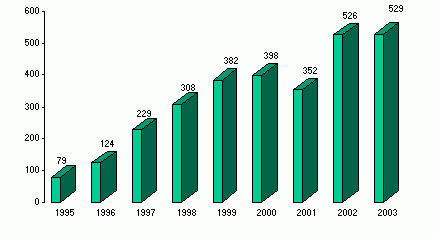
Since the WTO’s creation in 1995, the number of technical assistance activities has continuously increased. This increase is driven by rising demand from WTO member governments in the developing world.
Number of WTO technical assistance activities per year
back to top
The Doha mandate
When WTO members launched a new round of negotiations in Doha, they acknowledged developing countries’ increasing need for technical cooperation in order to allow them to participate fully in the negotiations. At Doha, donors — developed countries and international organizations active in trade issues — pledged to provide the needed support to developing countries.
Paragraph 41 of the Doha Declaration lists all the reference to commitments on technical cooperation within the declaration. Under this heading, WTO member governments reaffirm all technical cooperation and capacity building commitments made throughout the declaration and add general commitments:
- The Secretariat, in coordination with other relevant agencies, is to encourage WTO developing country members to consider trade as a main element for reducing poverty and to include trade measures in their development strategies.
- The agenda set out in the Doha Declaration gives priority to small, vulnerable, and transition economies, as well as to members and observers that do not have permanent delegations in Geneva.
- Technical assistance must be delivered by the WTO and other relevant international organizations within a coherent policy framework.
Since the launch of the Doha Development Agenda in November 2001, activities have increased even more. This reflects developing countries’ desire to participate actively in the negotiations. It also shows the increase in sectors covered by the WTO — investment, competition, trade facilitation and government transparency, for example, are four new topics.
Funding for technical cooperation has risen in line with the accelerating demand from members. Since the establishment of the Doha Development Agenda Global Trust Fund at the beginning of 2002, funding has increased to cover all activities related to the negotiations.
back to top
Reference Centres
Since 1997, the WTO Secretariat has installed Reference Centres in developing countries. These allow government officials to access essential documents instantly via the WTO website. WTO Secretariat officials provide governments with hardware, software and the training required to efficiently access such documents. By June 2003, 122 centres had been established in 100 countries including 54 in Africa, 16 in the Caribbean, 18 in Asia, 11 in the Middle East, 10 in the Pacific, eight in Latin America, and two in Eastern Europe.
Funding for WTO technical assistance
Million Swiss francs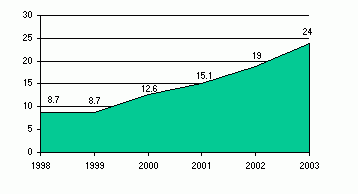
back to top
Training Institute
The WTO Institute for Training and Technical Cooperation provides junior government officials with an important foundation of knowledge in WTO matters. These training courses, held at WTO headquarters in Geneva, run as long as 12 weeks and cover the full range of WTO issues. Many trainees have returned to Geneva as ambassadors representing their countries in the WTO. In 2002, 325 officials went through WTO training programmes.
back to top
Geneva weeks
In 1999, Director-General Mike Moore initiated a programme known as Geneva Week, which is a special week-long event bringing together representatives of WTO member countries who do not have permanent missions in Geneva. These sessions cover all WTO activities and include presentations by other international organizations based in Geneva, including the International Trade Center (ITC), the United Nations Conference on Trade and Development (UNCTAD), the World Intellectual Property Organization (WIPO) and the International Organization for Standardization (ISO). Geneva Week usually coincides with important activities already on the agenda including preparations for Ministerial Conferences or other negotiations. In 2002, for the first time, there were two Geneva Weeks. Since 2002, the Geneva Weeks have been funded by the regular WTO budget — previously they were funded from trust fund contributions.
Other material:
> WTO assistance for developing countries
> Doha
declaration