RECHERCHE ET ANALYSE
The implications for bananas of the recent trade agreements between the EU and Andean and Central American countries
Giovanni Anania
(uniquement en anglais)
Earlier this year the European Union (EU) concluded with Colombia and Peru and, later, with six Central American countries (Costa Rica, El Salvador, Honduras, Guatemala, Nicaragua and Panama) trade negotiations that begun in 2007. These trade agreements are part of wider Association Agreements which include two other ‘pillars’: a ‘cooperation’ and a ‘political dialogue’ agreement. Before implementation ratification is needed, namely by the European Council and the European Parliament in the EU, and by the respective legislatures of the Central and Latin American partners.
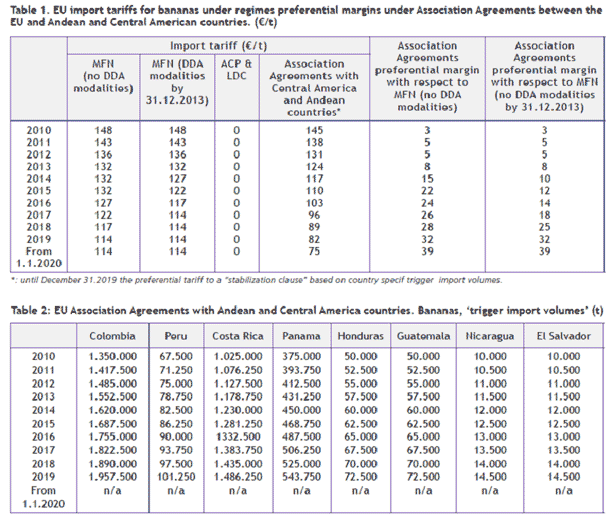
The provisions on bananas are considered among the key elements in the agreements from the perspective of the American countries. EU concessions on bananas are the same for all eight countries: the EU has agreed to progressively reduce its import tariff on bananas originating in these countries to 75 €/t by 1 January 2020. In the absence of any agreement, the import tariff to be applied to their exports in 2020 would have been 114 €/t (the MFN tariff), whereas now the preferential margin will increase progressively from 3 €/t in 2010 to 39 €/t from 2020 on (table 1). However, between the entry into force of the agreement and 2020 a ‘safeguard’ clause will apply to prevent larger than anticipated increases in EU banana imports. If imports from a specific country in a given calendar year exceed that country-specific ‘trigger import volume’ (TIV) for that year, then the EU may suspend for up to three months or until the end of the calendar year (whichever comes first) the preferential import regime and revert to the MFN tariff. If, for example, a country’s exports exceed the TIV for that year in July, the EU is allowed to impose the MFN tariff only for the following three months, after which the preferential tariff will be reapplied for the remaining part of the year. The fact that the preferential tariff can be suspended for no more than three months is the only thing which makes the safeguard mechanism different from a country specific tariff rate quota.
While the TIVs, which are given in table 2, are obviously linked to each country’s recent exports to the EU, their actual values suggest that the same rule has not been equally applied to all countries. In particular, when the TIVs for the major exporters (Colombia, Costa Rica, Panama and Peru) are compared with their recent export volumes to the EU, it becomes clear that those for Colombia are much less generous than those for the other three countries. In addition, not only Peru (the smallest, by far, of the four players) has the most generous TIV in 2010 with respect to its historical exports to the EU, but its TIVs expand between 2010 and 2020 by 50%, while those of all other countries increase by 45% only.
The 39 €/t preferential margin eventually granted by the agreements
will significantly improve the competitiveness of the eight Andean and
Central American countries on the EU market vis a vis other exporters.
From 2020 onwards, the benefits for those countries already exporting
bananas to the EU will be conspicuous, as both their exports and the
price they are paid for their bananas will increase. This should be
the case for countries such as Colombia, Costa Rica and Peru. However,
increased banana exports to the EU will not translate into an equal
increase of total exports, as some trade diversion will occur in
addition to trade creation (total exports will increase, but part of
the increased exports to the EU will come from exports previously
directed to other markets; in markets different from the EU their
exports should be expected to decline, while prices and exports by
countries which do not benefit from the agreements will increase).
Countries that currently do not export bananas to the EU, or that are
only marginal exporters, will benefit from the agreements only if the
increase in
their competitiveness on this market, as a result of the preferential
margin granted, is sufficient to overcome the negative factors that
currently make their exports unprofitable.
The assessment of the effects of the agreements in the short run (between 2010 and 2020) is more complicated, because of the safeguard provision. A given country’s benefits from the agreement with the EU will depend on the volume of its exports which would have occurred if the agreement had not been signed. Four cases are possible:
1. In the absence of any agreement exports to the EU subject to the MFN tariff would be equal to, or larger than, the TIV. In this case exports and equilibrium prices would remain unchanged under the agreements, the only effect being an income transfer from the EU budget to (most likely) banana traders, in the form of ‘rents’ deriving from the lower tariff applied on the country’s exports up to the TIV.
2. In the absence of any agreement exports to the EU subject to the MFN tariff would be above zero but below the TIV. In this case the agreements will lead to an increase in the country’s production, exports and price received, while the opposite will occur for the EU domestic price and for the import price paid for bananas originating in countries whose exports remain subject to the MFN tariff. In this case too, depending on the equilibrium reached, part of the reduction in EU tariff revenue may well become ‘rents’ to be captured (again, most likely) by banana traders.
3. In the absence of any agreement no exports to the EU would occur at the MFN tariff, but they become profitable under the preferential tariff.
4. In the absence of any agreement no exports to the EU would occur at the MFN tariff, and the preferential margin granted by the agreements is not sufficient to make them profitable.
The agreements will generate benefits for the Andean and Central American countries in the first three cases (assuming, somehow optimistically, that in case 1 ‘rents’, no matter who will capture them, will induce indirect benefits in the exporting country), but production and trade will increase only in cases 2 and 3.
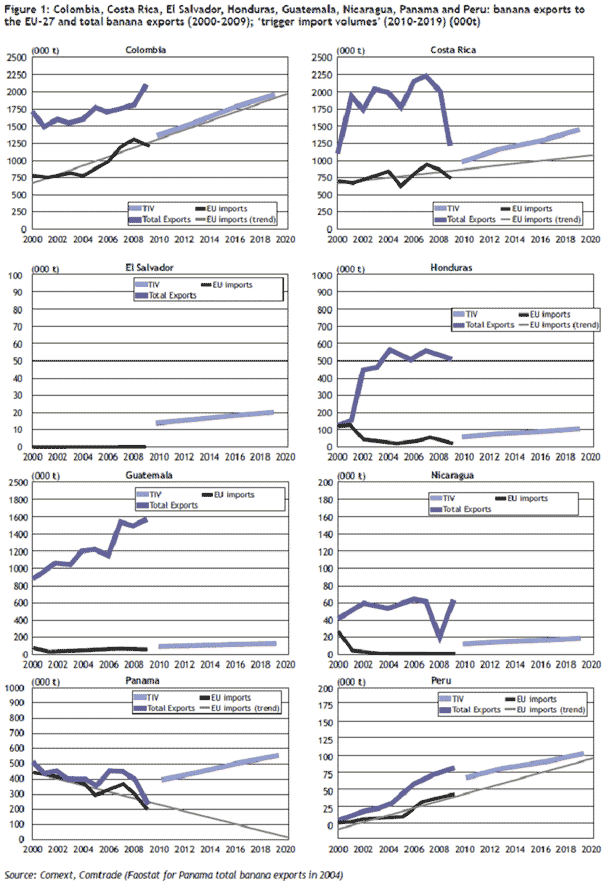
To help assess which case may apply to which country, figure 1 gives, for each of the eight countries, total banana exports and exports to the EU between 2000 and 2009, and TIVs from 2010 to 2019 (the safeguard mechanism applies to this period only).
Colombia appears as a possible ‘case 1’ candidate. In fact, based on recent trends, expected banana exports to the EU appears very close to the TIVs it will face(1); in addition, its overall exports have been increasing and under the new import regime it will become profitable to divert some of its exports from other destinations to the EU market. The reduction in EU tariff revenue which will become ‘rents’, likely to be transferred to banana traders, will equal 4 million euro in 2010, but will reach 76 million euro by 2019.1 For all countries, when recent developments in their banana exports to the EU are used to forecast future developments, one should keep in mind that in recent years they have been subject to two major changes in the EU import regime for bananas, with opposite effects on their competitiveness: the introduction, on 1 January 2006, of the ‘tariff only’ import regime for bananas originating in MFN countries, and, on 1 January 2008, of the tariff — and quota — free regime for ACP countries’ exports.
Peru, Costa Rica and Panama seem likely ‘case 2’ examples. Costa Rica and Peru, on different scales, show upward trends both for their exports to the EU market and overall, but expected exports to the EU under the current import regime remain below the TIVs. Panama, on the contrary, shows a negative trend for its banana exports, both to the EU and overall; all things being equal, the agreement with the EU should help contain this trend.
Because of their current ability to export bananas, though not to the EU, Guatemala, Honduras and Nicaragua seem to fall under ‘case 3’, while El Salvador can either be a ‘case 3’ or a ‘case 4’.
The effects of the agreements will be felt beyond the boundaries of the signatory countries. Other MFN exporters to the EU (the most important, by far, being Ecuador), as well as ACP and LDC countries, are all expected to see their relative competitiveness on this market fall with respect to the signatories; ceteris paribus, they will export less to the EU and receive a lower price for their exports. In markets different from the EU, imports will decline and prices increase, as a result of the trade diversion of some of the exports of the Andean and Central American countries; other countries are expected to expand their exports to these markets, but this will only partially compensate for the decline of their exports to the EU. Production in the EU (the EU produces, mostly in Guadeloupe, Martinique and Canary Islands, roughly 1/6 of the bananas it consumes) will not be significantly affected by the agreements because of the specific provisions of the EU domestic policy regime for bananas. Nevertheless, EU producers will see their incomes decline because of the lower domestic price.
Since the beginning of this decade, banana exports by ACP countries, as a whole, to the EU have been growing significantly; moreover, recent developments show that they have been able to take advantage, probably more than many had anticipated, of the quota- and duty-free access to the EU market thanks to the implementation of the Economic Partnership Agreements. The extent to which the recent trade agreements signed by the EU and the Andean and Central American countries will have a negative impact on ACP exports will depend on these countries’ capacity to continue to improve the market competitiveness of their bananas, in terms of product qualities and efficient logistical infrastructures. In this respect, making an effective use of the financial resources made available by the EU in the framework of the December 2009 WTO deal will probably prove to be a crucial factor.
Originally the negotiations involved all four member countries of the CAN (Comunidad Andina de Naciones); however, Bolivia pulled out from the negotiations in 2007 and Ecuador ‘suspended’ its participation in 2009. Ecuador being the largest exporter of bananas to the EU, an agreement similar to that signed by Colombia and Peru would bring considerable benefits to its banana industry. Not surprisingly, in fact, after Colombia and Peru had concluded the agreement, Ecuador declared an interest in resuming negotiations with the EU. Yet such a development would hardly be in the interest of the other exporters to the EU, which would prefer an agreement between the latter and Ecuador not to materialize, as this would either reduce the preferential margin which they have just secured (the eight Andean and Central American countries), or further reduce the competitiveness of their banana exports to the EU (ACP countries and the other MFN exporters, such as Brazil).
References:
G. Anania (2010), “EU Economic Partnership Agreements and WTO
Negotiations. A Quantitative Assessment of Trade Preference Granting
and Erosion in the Banana Market”, Food Policy, (35), 2, 2010, pp.
140-153.
G. Anania (2010),“The implications for bananas of the recent trade
agreements between the EU and Andean and Central American countries”,
Policy Brief Number 5, International Center for Trade and Sustainable
Development.
Note:
1. For all countries, when recent
developments in their banana exports to the EU are used to forecast
future developments, one should keep in mind that in recent years they
have been subject to two major changes in the EU import regime for
bananas, with opposite effects on their competitiveness: the
introduction, on 1 January 2006, of the ‘tariff only’ import regime
for bananas originating in MFN countries, and, on 1 January 2008, of
the — and quota — free regime for ACP countries’ exports. back to text

G. Anania is Professor in the Department of Economics and Statistics at the University of Calabria, Italy. His fields of interest are: International Trade, Agricultural Policy, Analysis and Agricultural Policies of the EU, Agricultural and trade policy modelling and WTO negotiations on Agriculture. Among others, he has been a consultant for various international organizations and governments agencies such as the European Union, the Italian National Institute of Agricultural Economics (INEA) or the FAO. He holds a PhD in Agricultural Economics from the University of California, Davis.