

17 September 2002
Commission report is food for thought on intellectual property — Supachai
WTO Director-General Supachai Panitchpakdi said the report by the UK Commission on Intellectual Property Rights makes an important contribution to the debate on how developing countries can best make use of the WTO agreement and its flexibilities, and how the international framework might be improved.
He was speaking on 16 September 2002 at the report’s launch in Geneva. These are his speaking notes:
SEE
ALSO:
> press
releases
> news
archives
> Supachai
Panitchpakdi’s speeches
The Commission has been asked to tackle a difficult subject. It is difficult at the national level to establish in the field of intellectual property a proper balance conducive to public welfare and development and even more difficult at the multilateral level. I am not one of those who thinks that intellectual property protection is a zero-sum game, but it would be foolish not to recognize that any set of rules that establishes a multilateral rule of law in this area will involve finding a balance which takes account of all legitimate interests involved. Of course, the Commission has been tasked with looking at this question from the angle of development policy and this, as you know, is also very much the focus of the WTO in the light of the Doha Development Agenda.
We have had a very brief opportunity to look at the report and, viewed from a WTO and TRIPS (trade-related aspects of intellectual property rights) angle, it certainly seems to make an important contribution to the ongoing debate on two issues:
- One is the question of how the TRIPS Agreement, and in particular the flexibility and options available in it, can be best applied by developing countries in the light of their own development needs. As you know, this has been a particularly important issue in the context of access to medicines, where it led to the adoption at Doha of the Declaration on the TRIPS Agreement and Public Health, but it is of course a broader issue.
- The second ongoing debate is that on how the TRIPS Agreement in particular and the international framework in the area of intellectual property more generally can be improved, especially in the light of the development dimension.
The TRIPS Agreement, like other WTO agreements, is a living instrument, capable of evolution and adaptation in the light of the needs and priorities of Members. In fact, the WTO has an ambitious and active work programme in this area. This is based, in part on the built-in agenda under the TRIPS Agreement itself, in part on requirements in the Doha Declaration to address or act upon implementation issues raised in the TRIPS area and in part on other decisions in the Doha Declaration establishing negotiations or other work on TRIPS matters.
Let me just mention three of these areas which are particularly active at the moment:
- The problem identified in paragraph 6 of the Doha Declaration on the TRIPS Agreement and Public Health of how WTO Members with limited manufacturing capacity in the pharmaceutical sector can make effective use of compulsory licensing. The TRIPS Council has to find a solution and report to the General Council before the end of this year.
- The nexus of issues relating to the protection of biotechnological inventions, biodiversity and traditional knowledge and folklore. These cover matters on which the TRIPS Council has to report to the TNC (Trade Negotiations Committee) by the end of this year.
- The protection of geographical indications. This includes, in particular, the negotiation of a notification and registration system for geographical indications for wines and spirits by the next Ministerial Conference and the work on issues related to the extension of the protection provided for in Article 23 to products other than wines and spirits, on which the TRIPS Council has to again report to the TNC by the end of this year.
The report, quite rightly, sets the issue of integrating intellectual property rights and development policy in its full context which goes far beyond WTO matters, but let me just mention two other important areas of WTO work on which the report contains interesting analysis and ideas. One is that in the new Working Group on Trade and Transfer of Technology. The other is the role that an effective competition policy and law can play in balancing and complementing intellectual property regimes. The WTO Working Group on the Interaction between Trade and Competition Policy provides a forum in which this question can be further explored.
Before concluding, let me mention one other point which is also addressed in the report, namely the importance of developing the internal capacity within developing countries to be able to provide training and undertake research in the area of intellectual property. This is something to which I attach considerable importance in this area of the WTO, as in others. In this regard, I hope that the WTO, perhaps in cooperation with other intergovernmental organizations, will be able to organize, annually, a briefing session for university teachers from developing countries in the area of intellectual property so as to help them to be as well informed as possible about international issues facing their countries.
Let me conclude by expressing my appreciation to Professor Barton and the other Commissioners for the report that has been presented today and for their having come to Geneva to launch it.
See
also, on the WTO website:
> The Doha
Development Agenda
> Intellectual
property
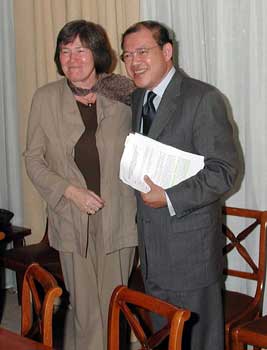
D-G Supachai and Clare Short, UK Secretary of State for International Development
Click
for larger image