

WTO: 2009 NEWS ITEMS
The Fifth Triennial Review
The main purpose of the TBT Agreement is to ensure that regulatory measures (e.g. labelling requirements, technical specifications, methods of certification) do not constitute unnecessary barriers to international trade. Every three years, delegations in the TBT Committee review how the Agreement has been working and consider what should be done next. Essentially, they set out the Committee's future work programme. This process, mandated in Article 15.4 of the Agreement, states:
“Not later than the end of the third year from the date of entry into force of the WTO Agreement and at the end of each three-year period thereafter, the Committee shall review the operation and implementation of this Agreement, including the provisions relating to transparency, with a view to recommending an adjustment of the rights and obligations of this Agreement where necessary to ensure mutual economic advantage and balance of rights and obligations, without prejudice to the provisions of Article 12. Having regard, inter alia, to the experience gained in the implementation of the Agreement, the Committee shall, where appropriate, submit proposals for amendments to the text of this Agreement to the Council for Trade in Goods.”
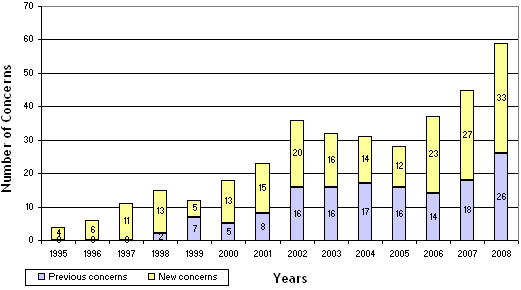
At this meeting, most of the Committee's discussion was structured around 13 proposals from Members (see the Agenda for references to the text of the submissions). In particular, delegations discussed transparency: Members continue to seek ways to refine existing procedures for both the notification of draft measures and the potential trade effects of these. The increasing number of notifications and specific trade concerns raised in the TBT Committee has prompted a more streamlined procedure for the handling of TBT-related specific trade concerns in the Committee. It is therefore no surprise that some proposals on the table put emphasis on various regulatory cooperation initiatives between Members; such mechanisms are generally aimed at achieving “regulatory convergence” between countries as a means, inter alia, of avoiding the use of unnecessary barriers to trade that may cause trade tensions between WTO Members.
The issue of private standards was raised for discussion. Some Members would like this issue discussed in the Committee, and the terminology clarified — others are more hesitant, questioning both the role of the Committee and the scope of the TBT Agreement with respect to “private standards”.
The number of “Specific Trade Concerns” raised in the TBT Committee is growing
The wide range of issues discussed in the TBT Committee reflects the broad scope of the Agreement which covers trade in industrial as well as agricultural goods. Hence, many different types of issues are discussed in the Committee. At this particular meeting 48 trade concerns were discussed; 17 of these were new. One of the new concerns is about China's “Green Dam” software.
Green Dam: The United States, European Communities and Japan expressed concern about China's “Green Dam” software. This is a software application which China intends to make mandatory on all personal computers sold in China; the software is expected to work as an internet content filter. While the complainants do not dispute the stated objective of the measure — preventing children from exposure to inappropriate content on the internet — concern was expressed about issues relating to transparency (WTO notification, stakeholder consultations); reliability and compatibility of the software, and network security.
The full list of issues raised at the meeting — old
and new — is contained in the
Agenda.
> Problems viewing this page?
Please contact [email protected] giving details of the operating system and web browser you are using.