

4 April 1997
After two outstanding years, world trade growth in 1996 returned to earlier levels
Stronger
trade growth expected this year.
The volume of world merchandise trade increased by 4 per cent in 1996 - a gain
similar to the trade growth recorded during 1990-93. The 4 per cent increase in 1996
comes after two years of unusually strong growth in world trade volume. The growth rate of
world merchandise production was marginally slower for the second consecutive year, but
remained well above the rates recorded in the first four years of the decade.
*Slowdown in Asian trade growth: Since 1990, world trade has grown much faster than world output. This gap narrowed in 1996, largely due to trade developments in Asia, as the region's export and import volume growth fell below output growth.
*Other regions fare better: Growth in trade volume remained at least twice as large as GDP growth in North America, Latin America and Western Europe, while in the transition economies as a group, trade growth was above the world average despite a further contraction of output.
*Goods export value tops $5 trillion: In value terms, world merchandise exports passed the $5,000 billion mark for the first time, increasing 4 per cent to $5,100 billion. The slower volume growth contributed to the sharp deceleration in value terms to 4 per cent from the nearly 20 per cent increase in 1995, but the main explanation is the "valuation effect" of the dollar's appreciation last year vis-à-vis the currencies of other major traders.
*Services exports slow but also reach new high: Similar developments are behind the slowdown in the expansion of the value of world exports of commercial services, from 14 per cent in 1995 to about 5 per cent in 1996. The estimated total value reached $1,200 billion.
*Office/telecom and metals among slowest sectors: The deceleration in the growth of export value was particularly pronounced for office and telecom equipment, iron and steel, and non-ferrous metals.
*Oil prices lift fuel export values: Boosted by a marked increase in oil prices, the value of exports of fuels rose by more than 10 per cent in 1996, the biggest annual gain in trade since 29 per cent in 1990.
*Regional differences: Latin America and the Middle East recorded merchandise export and import growth of 10 per cent or more in value terms. Among the seven geographic regions, the sharpest import growth was in the transition economies, with imports up 12.5 per cent.
*Africa beats world average: For the first time since 1990, the value of Africa's exports and imports expanded more rapidly than total world trade, largely on the basis of increased fuel exports.
I. Overview of world
trade in 1996 and the outlook for 1997 See footnote 1
Back to top
Overview of world trade in 1996
The deceleration in world trade last year turned out to be much stronger than was forecast at the beginning of 1996 by all the leading analysts. See footnote 2 World merchandise exports increased by an estimated 4 per cent in volume terms, slightly less than half the rate recorded in 1995. As is evident from Chart 1, however, the trade growth recorded in 1994 and 1995 was unusually strong, and the 1996 increase is similar to the volume growth reported for the first four years of the decade. See footnote 3 While the growth of world merchandise output continued to decelerate marginally in 1996 - despite a strengthening of industrial output in the course of the year - the 2½ per cent gain was well above the growth recorded during 1990-93. See footnote 4
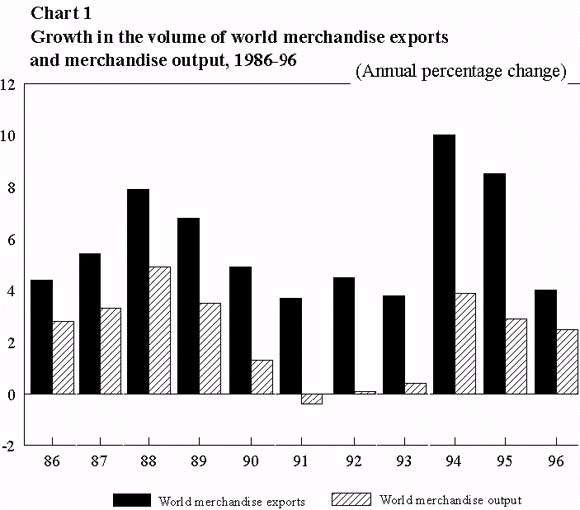
As a result, the large excess of trade growth over output growth observed each year since 1990 was sharply reduced in 1996. This change can be attributed primarily to developments in Asia, where trade growth (both exports and imports) fell below GDP growth. While the gap between trade and GDP growth also narrowed in other regions, trade growth (exports and imports combined) remained at least twice as large as GDP growth in North America, Latin America and Western Europe. For the transition countries as a group, estimated GDP growth was negative - due to the further contraction of output in Russia and the Ukraine - while trade growth was above the world average.
The slowdown in the growth of world merchandise exports in value terms from nearly 20 per cent in 1995 to 4 per cent in 1996 (Table 1) exceeded by a wide margin the deceleration in volume terms, as dollar prices of globally traded goods stagnated in 1996 after increasing by 10 per cent in 1995. Changes in the exchange rate of the US dollar vis-à-vis the currencies of several major traders (in particular France, Germany, Japan and the Republic of Korea), together with smaller increases in export prices in domestic currencies, offset price increases for crude oil and certain other primary products (including wheat and maize). See footnote 5
Trade in products which had benefited from exceptionally strong demand and/or price trends in 1995 - office and telecom equipment, iron and steel, and non-ferrous metals - was affected by price declines and weaker demand in 1996. See footnote 6 Consequently, the growth in the value of trade in these products, which ranged from 25 to 33 per cent in 1995, was less than 5 per cent in 1996. In contrast, exports of fuels increased by more than 10 per cent in value terms - the biggest annual gain in trade since the 29 per cent recorded in 1990 - due to the 19 per cent increase in crude oil prices in 1996.
Table 1
World exports of merchandise and commercial services, 1995-96
| Value (Billion dollars) |
Annual
percentage change |
|||
| 1995 | 1996 | 1995 | 1996 | |
| Merchandise | 4920 | 5100 | 19 .5 | 4 |
| Commercial servicesa | 1170 | 1200 | 14 | 5 |
aGrowth rates are adjusted for breaks in the continuity of the statistics due to methodological changes.
On a preliminary basis it is estimated that the value of world exports of commercial services rose by 5 per cent to $1,200 billion in 1996. See footnote 7 The slowdown in commercial services exports and imports was particularly pronounced in Western Europe and Asia. North America's exports and imports expanded faster than the world average in 1996 and at roughly the same rates as in 1995. Available data for Latin American countries suggest a recovery in services imports - largely due to Mexico - and an above-average growth of exports. Overall, the deceleration of the growth in the value of world trade in commercial services in 1996 can be attributed both to the valuation effect of the dollar's appreciation vis-à-vis a number of major currencies, and to the sluggish economic activity in Western Europe which alone accounts for one-half of the world's trade in commercial services.
Preliminary information on the value of commercial services exports in 1996 by the three major sectors indicates that transportation recorded the lowest growth rate, travel an about average growth rate, while "other services" (including financial and insurance services, royalties and license fees, construction services, and other business services) continues to be the most dynamic sector. See footnote 8 For the three sectors, this was a continuation of trends evident since the beginning of the decade.
Outlook for 1997
Recent forecasts for 1997 anticipate an economic recovery in Western Europe, roughly unchanged growth in North America and a slight deceleration of GDP growth in Japan. See footnote 9 For the OECD area as a whole, GDP is projected to expand in 1997 at the same rate as it did last year. In China and the group of "six East Asian traders", where GDP growth rates are two to three times faster than in the OECD area, growth is projected to pick-up marginally. See footnote 10 Sharper improvements in output growth are forecast for Russia - where growth is projected to be positive for the first time in several years - and Latin America.
If these GDP growth forecasts are realized, the volume of world trade this year should expand somewhat faster than the 4 per cent gain in 1996, led by a stronger trade performance in Western Europe and an expansion of imports into Latin America and developing Asia. The increased export earnings of the oil exporting countries should also lead to increased imports in 1997.
II. World merchandise trade in 1996 by region and by leading trader Back to top
Volume developments by region
Although all seven geographic regions used in the Secretariat's statistics experienced a deceleration in the growth in the volume of their merchandise exports in 1996 as compared with 1995, the extent of the slowdown differed widely. While exports from Western Europe, Asia and the transition economies expanded last year at rates of one-fourth to one-half the rates recorded in 1995, the deceleration was less pronounced in North America and only very moderate in Latin America (Table 2).See footnote 11
The outstanding export performance of Latin America (nearly triple the world average) can be attributed largely to Mexico, where export volume expand for the second year in a row by more than 20 per cent. Excluding Mexico, Latin America's exports expanded by 5 per cent in both 1995 and 1996. In contrast to Mexico, Brazil's export volume has been stagnant in the last two years.
Latin America's imports, which grew in volume terms by only 3 per cent in 1995 due to the sharp recessions in Mexico and Argentina, recovered strongly in 1996 with an expansion of 10½ per cent. Among the major traders, Argentina's and Mexico's imports were up 17 per cent and 24 per cent respectively, with the result that the steep fall in imports provoked by the recession in 1995 has been completely offset. A particularly strong deceleration could be observed for Brazil where the volume of imports, after expanding by more than one-quarter annually between 1993 and 1995, increased by about 6 per cent in 1996.
Exports of the transition economies, which recorded the strongest export growth of all the major regions in 1995 (up 14½ per cent), decelerated sharply in 1996 to just under the global average of 4 per cent. Import growth, in contrast, reached 12 per cent in 1996, the highest level among the major regions.
Table 2
Growth in the volume of world merchandise trade by selected region, 1990-96
(Annual percentage change)
| Exports | Imports | |||||
| Average 1990-96 |
1995 |
1996 |
Average 1990-96 |
1995 |
1996 |
|
| 5 .5 | 8 .5 | 4 .0 | World | 6 .0 | 8 .5 | 4 .5 |
| 7 .0 | 9 .5 | 5 .5 | North Americaa | 7 .0 | 8 .0 | 5 .5 |
| 8 .5 | 12 .0 | 11 .0 | Latin America | 11 .0 | 3 .0 | 10 .5 |
| 5 .0 | 7 .5 | 4 .0 | Western Europe | 4 .0 | 6 .5 | 3 .0 |
| 5 .0 | 8 .0 | 4 .0 | European Union (15) | 4 .0 | 6 .0 | 2 .5 |
| 3 .5 | 14 .5 | 3 .5 | Transition economies | 2 .5 | 11 .5 | 12 .0 |
| 7 .0 | 9 .5 | 2 .5 | Asia | 9 .5 | 14 .0 | 4 .5 |
| 1 .0 | 3 .5 | -0 .5 | Japan | 6 .0 | 12 .5 | 2 .5 |
| 10 .0 | 14 .5 | 3 .5 | Six East Asian tradersb | 10 .5 | 15 .5 | 4 .0 |
aCanada and the United States.
bHong Kong, the Republic of Korea, Malaysia, Singapore, Chinese Taipei and Thailand.
Although North America's export and import volume growth decelerated to 5½ per cent in 1996, it remained above the global average. The trade deceleration for both exports and imports was pronounced for Canada but only very moderate for the United States. One of the main factors in the strong deceleration of Canada's trade performance was the slowdown in the booming exports and imports of the machinery and equipment sector (excluding automotive products).
Western Europe's sluggish demand led to an import growth of only 3 per cent in 1996, less than half the rate in 1995, and below the global average for the fifth consecutive year. As Western Europe accounts for roughly 40 per cent of world merchandise trade, the impact on global trade was marked. With roughly two-thirds of Western Europe's imports accounted for by intra-trade, the region's overall export growth was also affected. While intra-EU exports nearly stagnated in 1996, exports to third countries rose by more than 5 per cent, a rate significantly faster than imports from third countries. As in 1995, external demand helped to sustain output and employment in the EU during 1996.
The surprising feature among the 1996 trade developments in the geographic regions was the performance of Asia. Although the region's economic growth slowed somewhat, it still exceeded 5 per cent if Japan is excluded (including Japan, the growth is still close to 5 per cent as Japan recorded a GDP growth of 3½ per cent). Although output growth was still well above that of the six other regions, Asia's export growth in 1996 was not only below output growth, but also the smallest export growth among the regions. Asia's imports held-up somewhat better, matching the world average and exceeding export growth by 2 percentage points. Japan's export growth was negative, and in China, Hong Kong, Chinese Taipei, Thailand and Malaysia export and import growth rates were well below currently estimated GDP growth. The extent of the slowdown in Asia's trade growth was unexpected, considering that the deceleration in economic growth in the region was modest, and that intra-regional trade accounts for more than half of Asia's total merchandise trade. It should be noted in this regard that trade between China on one side, and Hong Kong, Chinese Taipei and Macao on the other, contracted sharply in 1996.
A full explanation of these trade developments in Asia will be possible only as more detailed data for 1996 become available. It does appear likely that part of the story is the above-average importance of office and telecom equipment in Asia's exports, which implies that the boom and bust cycle of this product group had a stronger impact in Asia than elsewhere. In addition, exchange rate developments, in particular the stronger dollar, reduced the competitiveness in Japan and Western Europe of those countries which peg their currency to the United States dollar.
Table 2 also provides figures on the growth in the volume of trade thus far in the 1990s. Three features stand out. First, the most dynamic trade growth - on both the export and import side - was in the group of six East Asian traders and in Latin America. Second, despite their above-average performance in the past two years, the transition economies reported the smallest export and import growth since 1990 of all the regions shown in Table 2. Third, by far the biggest difference between export growth and import growth over this period occurred in Japan, where in volume terms imports expanded six times faster than exports.
Value developments by region
In judging the significance of figures for the growth in the value of trade in 1996, it is important to keep in mind that the valuation effect of the dollar's appreciation varied considerably among regions and countries. Statistics for North America and Latin America were hardly affected, while those for Japan and Western Europe were strongly affected. The impact elsewhere depended on the extent to which currencies are pegged to one or the other of the major currencies, and the extent to which trade is invoiced in US dollars, yen or West European currencies. See footnote 12
Value figures for merchandise trade by geographic region reveal that all seven regions recorded slower nominal growth in 1996 than in 1995 (Table 3). The slowdown in volume growth clearly was a factor. However, a comparison of Tables 2 and 3 also reveals that there was much greater variation among the trade performances of the seven regions in 1996 on a value basis than on a volume basis. This is true both for the growth rates in 1996, and for the extent of the deceleration in growth rates between 1995 and 1996.
Table 3
Growth in the value of world merchandise trade by region, 1990-96
(Billion dollars and percentage)
| Exports (f.o.b.) | Imports (c.i.f.) | |||||||
| Value | Annual percentage change | Value | Annual percentage change | |||||
| 1996 | 1990-96 | 1995 | 1996 | 1996 | 1990-96 | 1995 | 1996 | |
| 5100 | 7 .0 | 19 .5 | 4 .0 | World | 5240 | 7 .0 | 19 .0 | 4 .0 |
| 826 | 8 .0 | 14 .5 | 6 .5 | North America | 995 | 7 .5 | 11 .0 | 5 .5 |
| 250 | 9 .5 | 21 .5 | 11 .5 | Latin America | 272 | 13 .5 | 11 .5 | 11 .0 |
| 96 | 15 .0 | 31 .0 | 20 .5 | Mexico | 90 | 14 .5 | -10 .0 | 23 .5 |
| 154 | 6 .5 | 17 .0 | 6 .5 | Other Latin America | 182 | 13 .5 | 24 .5 | 5 .5 |
| 2271 | 5 .5 | 22 .5 | 3 .0 | Western Europe | 2210 | 4 .5 | 21 .0 | 1 .5 |
| 2103 | 5 .5 | 23 .0 | 3 .0 | European Union (15) | 2031 | 4 .5 | 20 .5 | 1 .0 |
| 171 | 7 .0 | 29 .0 | 6 .0 | Transition economies | 172 | 5 .5 | 25 .0 | 12 .5 |
| 81 | 6 .5 | 26 .5 | 2 .0 | Central/Eastern Europe | 109 | 12 .0 | 29 .5 | 12 .5 |
| 113 | 1 .5 | 12 .5 | 8 .5 | Africa | 127 | 5 .0 | 18 .0 | 5 .5 |
| 28 | 3 .0 | 10 .5 | 2 .0 | South Africa | 30 | 8 .5 | 30 .5 | -0 .5 |
| 160 | 3 .0 | 13 .0 | 12 .5 | Middle East | 146 | 6 .5 | 13 .0 | 10 .0 |
| 1310 | 10 .0 | 18 .0 | 1 .0 | Asia | 1315 | 11 .0 | 23 .0 | 4 .5 |
| 413 | 6 .0 | 11 .5 | -7 .0 | Japan | 350 | 7 .0 | 22 .0 | 4 .0 |
| 151 | 16 .0 | 23 .0 | 1 .5 | China | 139 | 17 .5 | 14 .0 | 5 .0 |
| 531 | 12 .0 | 23 .0 | 3 .0 | Six East Asian tradersa | 580 | 13 .0 | 26 .0 | 3 .0 |
aHong Kong, the Republic of Korea, Malaysia, Singapore, Chinese Taipei and Thailand.
The explanation for this more varied performance involves primarily two factors. One was the valuation effect of the dollar's appreciation against a number of currencies, including the yen and ECU. As just noted, this is an important factor, for example, in explaining the figures for Western Europe and Japan relative to the figures for North America and Latin America. See footnote 13 The other factor was the 19 per cent increase in petroleum prices in 1996. See footnote 14 This played an important role in the relatively better trade figures for the Middle East and Africa - the latter's export and import growth in 1996 exceeded the world average for the first time since 1990, as did Middle East exports - as the share of fuels in these two regions' merchandise exports is about 70 and 40 per cent, respectively. As regards the figures for the Asia region, the sharply weaker demand and prices for office and telecom equipment should also be noted.
Also evident from Table 3 is the fact that import growth exceeded export growth by a wide margin in the Asia region (due mostly to the excess of import growth over export growth in Japan and China) and the transition economies, and by a narrow margin in Latin America.
Trade of the least-developed countries
Data reported by the least-developed countries on their trade performance in 1996 are extremely limited and statistics from their major trading partner - the European Union - are still incomplete. However, some indicators are available. The external conditions for many of the least-developed countries were negatively affected by price declines for many of their major traditional export items, in particular cotton, coffee and copper. These sharp price declines were only partly offset by price increases for tea and jute. Angola and Yemen - the two oil-exporters in the group - benefited from the oil price increase, in particular Angola which increased its oil output.
Despite the generally unfavourable commodity price developments and the sluggishness of Western Europe's imports, the limited number of African least-developed countries for which data are available increased their exports between 5 and 12 per cent in dollar terms last year. The United States and Japan, which together purchase about one-third of the least-developed countries' merchandise exports, increased their imports from this group of countries by about 15 per cent in value terms in 1996 (recall that overall, the value of total world merchandise trade was up 4 per cent). In contrast, the combined exports of the United States and Japan to this group of countries (they supply about one-tenth of the group's imports) decreased by about 5 per cent. Overall, for the least developed countries as a group, it is estimated that in 1996 their merchandise export value expanded somewhat faster than world trade. Import growth, however, appears to have been less dynamic than exports.
Trade of members of selected regional integration agreements See footnote 15
The European Union (15) - by far the largest regional integration agreement with total exports and imports accounting for 40 per cent of world merchandise trade - recorded a near stagnation of its intra-trade in dollar terms in 1996. With exports to and imports from third countries up by 6½ and 2½ per cent respectively, the share of intra-regional trade in total merchandise trade (exports plus imports) fell to 63 per cent, (the preceding peak level was reached in 1992 with 65 per cent). Price developments, sluggish internal demand and the valuation effect of the depreciation of West European currencies vis-à-vis the US dollar contributed to the moderate decline in the relative importance of intra-trade.
In 1996 the NAFTA countries recorded an expansion of their intra-regional exports of slightly more than 10 per cent while exports to third countries rose only by 5 per cent. Intra-regional exports -which in 1996 represented nearly 9 per cent of world merchandise exports - reached an estimated $480 billion or nearly 48 per cent of total exports, which is close to the previous record level in 1994 before the Mexican peso crisis. On the import side the share of intra-trade reached nearly 40 per cent - a record level not only for NAFTA as a whole but for each of the three members (NAFTA imports from third countries increased 4 per cent last year). Intra-area imports now range from nearly 30 per cent for the United States to about 70 per cent for Canada and nearly 80 per cent for Mexico.
The trade of each of the four MERCOSUR countries evolved quite differently again in 1996. The strength of import growth of the two major countries (in value terms, 18 per cent for Argentina and nearly 7 per cent for Brazil) assured a dynamic expansion of the intra-MERCOSUR trade, which is estimated to have reached about $17 billion or 0.3 per cent of world exports. The share of intra-regional exports in total MERCOSUR exports reached a record level of 22½ per cent, while on the import side the share recovered to the previous peak of nearly 20 per cent in 1993.
Value developments by individual trader
Appendix Table 1 provides data on the 1996 trade of the 30 leading merchandise exporters and importers. Among the countries reporting strong export growth were such petroleum exporters as Mexico (up 20½ per cent), the Russian Federation (8½ per cent), Saudi Arabia (14 per cent), Indonesia (10 per cent) and Norway (17 per cent). Other countries whose 1996 export growth measured in dollars was well above the world average were the United States (7 per cent), the United Kingdom (7 per cent), Italy (7 per cent), Spain (11½ per cent), Sweden (6 per cent), Malaysia (6 per cent), Australia (14 per cent) and Ireland (12½ per cent).
The dollar figures clearly reflect not only the slower volume growth last year, but also the valuation effect of the dollar's appreciation against the yen and ECU and (on the export side especially) the sharp increase in petroleum prices. Japan and four West European countries (Germany, Belgium-Luxembourg, Switzerland and Denmark), plus Thailand, recorded declines in the dollar value of merchandise exports last year. Five West European countries (Germany, France, the Netherlands, Switzerland and Denmark) recorded declines in the dollar value of imports, as did Chinese Taipei and Thailand.
Increases in imports of more than double the 4 per cent world average were reported by seven countries - ranging from Poland and Mexico (up about 25 per cent) to India (up 8½ per cent), and including Turkey, the Republic of Korea, Ireland and the Russian Federation.
For reference purposes, Appendix Table 2 lists the 30 largest merchandise exporters and importers when intra-EU trade is excluded from EU and world total trade figures, and the EU is treated as a single trading entity (in contrast, Appendix Table 1 lists the 15 EU members individually). On this basis, the EU is the leading exporter and the United States the leading importer, with Japan in third place for both exports and imports.
Value developments thus far in the 1990s
The figures in Table 4, also based on dollar value data, indicate the most dynamic traders thus far in the 1990s. Nine traders - Argentina, China, Indonesia, the Republic of Korea, Malaysia, Mexico, the Philippines, Singapore and Thailand - appear on both the export and import side. Of the total of 21 traders in the table, only five are OECD members: Ireland, Spain and Turkey, plus Mexico and the Republic of Korea (the two newest members).
Table 4 - The fastest growing traders in 1990-96a
(Annual average growth rates based on dollar values)| Exporters | Importers | ||
| Malaysia | 18 | Argentina | 34 |
| Philippines | 17 | Poland | 22 |
| China | 16 | Malaysia | 18 |
| Thailand | 16 | Philippines | 18 |
| Singapore | 15 | China | 17 |
| Mexico | 15 | Brazil | 17 |
| Ireland | 13 | Colombia | 16 |
| Kuwait | 12 | United Arab Emirates | 15 |
| Korea, Rep. of | 12 | Chile | 15 |
| Indonesia | 12 | Mexico | 14 |
| Argentina | 12 | Singapore | 14 |
| India | 11 | Korea, Rep. of | 14 |
| Spain | 11 | Thailand | 13 |
| Indonesia | 12 | ||
| Turkey | 11 | ||
| Israel | 11 | ||
| Chinese Taipei | 11 | ||
aTraders on the list (i) had exports or imports in excess of $10 billion in 1996, and (ii) a growth rate of exports or imports of at least one-and-a-half times the annual world average of 7 per cent during 1990-96.
III. World trade in Commercial services in 1996 Back to top
The value of world exports of commercial services is estimated to have grown by 5 per cent in 1996 following the 14 per cent increase in 1995. The deceleration of commercial services exports was particularly pronounced in Western Europe and Asia. Partly due to the valuation effect of exchange rate developments, these two regions saw trade growth rates in 1996 reduced by two-thirds. Western Europe, which accounted in 1995 for one-half of world commercial services exports, recorded below average growth in 1996. Exports of commercial services of North America and Latin America are estimated to have grown at roughly the same rates as in 1995 (6 and 8 per cent respectively) which in 1996 were above the global average.
As regards imports of commercial services, Western Europe's sluggish economies contributed to a steep deceleration from the 15 per cent growth in 1995 to a rate well below the global average of 5 per cent in 1996. While Asia recorded also a strong deceleration of its import growth, it nevertheless remained above the world average. In the case of Japan, however, the deceleration was even stronger than in Western Europe as a whole, namely from 15 per cent in 1995 to about 2 per cent in 1996. North America's imports of commercial services expanded by about 6 per cent to nearly $170 billion, a growth rate only slightly less than in 1995. Latin America's import growth accelerated in 1996 as the strength of the recovery in Mexico more than offset a deceleration in the growth of services imports in Brazil, the region's largest importer.
Appendix Table 3 provides data on the trade of the 30 leading exporters and importers of commercial services in 1995 (the latest year for which reasonably complete data are available).
Back to topAppendix Table 1
Leading exporters and importers in world merchandise trade, 1996(Billion dollars and percentage)
| Rank | EXPORTERS | Value (f.o.b.) |
Share | Change in value in 1996 |
Rank | IMPORTERS | Value (c.i.f) |
Share | Change in value in 1996 |
| 1 | United States | 624.8 | 11.9 | 6 .8 | 1 | United States | 817.8 | 15.2 | 6 .1 |
| 2 | Germany | 521.2 | 9.9 | -0 .3 | 2 | Germany | 456.3 | 8.5 | -1 .5 |
| 3 | Japan | 412.6 | 7.9 | -6 .9 | 3 | Japan | 349.6 | 6.5 | 4 .1 |
| 4 | France | 290.3 | 5.5 | 1 .3 | 4 | United Kingdom |
278.6 | 5.2 | 5 .0 |
| 5 | United Kingdom |
259.1 | 4.9 | 7 .0 | 5 | France | 275.3 | 5.1 | -0 .2 |
| 6 | Italy | 250.7 | 4.8 | 7 .1 | 6 | Italy | 207.0 | 3.8 | 0 .4 |
| 7 | Canada | 201.2 | 3.8 | 4 .7 | 7 | Hong Kong | 202.0 | 3.7 | 3 .0 |
| 8 | Netherlands | 197.1 | 3.8 | 0 .9 | - retained importsb |
48.5 | 0.9 | -7 .0 | |
| 9 | Hong Kong | 180.9 | 3.4 | 4 .0 | 8 | Canada | 175.0 | 3.2 | 3 .9 |
| - domestic exports |
27.4 | 0.5 | -8 .4 | 9 | Netherlands | 174.1 | 3.2 | -1 .0 | |
| 10 | Belgium- Luxembourg |
166.7 | 3.2 | -1 .8 | 10 | Belgium- Luxembourg |
154.6 | 2.9 | -0 .4 |
| 11 | China | 151.1 | 2.9 | 1 .5 | 11 | Korea, Rep. of | 150.3 | 2.8 | 11 .2 |
| 12 | Korea, Rep. of | 129.8 | 2.5 | 3 .8 | 12 | China | 138.8 | 2.6 | 5 .1 |
| 13 | Singapore | 125.1 | 2.4 | 5 .8 | 13 | Singapore | 131.5 | 2.4 | 5 .6 |
| - domestic exports |
73.6 | 1.4 | 5 .7 | - retained importsb |
79.9 | 1.5 | 5 .4 | ||
| 14 | Chinese Taipei | 116.0 | 2.2 | 3 .9 | 14 | Spain | 121.9 | 2.3 | 6 .1 |
| 15 | Spain | 102.1 | 1.9 | 11 .4 | 15 | Chinese Taipei | 102.5 | 1.9 | -1 .1 |
| 16 | Mexico | 95.9 | 1.8 | 20 .6 | 16 | Mexico | 90.3 | 1.7 | 23 .6 |
| 17 | Sweden | 84.2 | 1.6 | 5 .8 | 17 | Malaysia | 78.6 | 1.5 | 1 .0 |
| 18 | Switzerland | 80.0 | 1.5 | -2 .0 | 18 | Switzerland | 78.5 | 1.5 | -2 .1 |
| 19 | Malaysia | 78.4 | 1.5 | 5 .8 | 19 | Thailand | 68.3 | 1.3 | -3 .5 |
| 20 | Russian Fed.a | 70.4 | 1.3 | 8 .6 | 20 | Austria | 66.0 | 1.2 | 1 .0 |
| 21 | Australia | 59.9 | 1.1 | 13 .8 | 21 | Sweden | 65.8 | 1.2 | 2 .0 |
| 22 | Austria | 58.0 | 1.1 | 1 .0 | 22 | Australia | 65.5 | 1.2 | 6 .9 |
| 23 | Saudi Arabia | 56.3 | 1.1 | 13 .9 | 23 | Brazil | 57.5 | 1.1 | 6 .9 |
| 24 | Thailand | 54.8 | 1.0 | -2 .9 | 24 | Russian Fed.a | 44.4 | 0.8 | 9 .9 |
| 25 | Ireland | 50.0 | 1.0 | 12 .3 | 25 | Denmark | 43.2 | 0.8 | -0 .7 |
| 26 | Indonesia | 49.9 | 0.9 | 9 .8 | 26 | Indonesia | 42.8 | 0.8 | 4 .5 |
| 27 | Norway | 48.7 | 0.9 | 16 .8 | 27 | Turkey | 42.0 | 0.8 | 17 .6 |
| 28 | Denmark | 48.1 | 0.9 | -1 .4 | 28 | Poland | 38.3 | 0.7 | 26 .0 |
| 29 | Brazil | 47.8 | 0.9 | 2 .7 | 29 | India | 37.5 | 0.7 | 8 .5 |
| 30 | Finland | 40.5 | 0.8 | 1 .3 | 30 | Ireland | 36.1 | 0.7 | 10 .0 |
| Total of abovec | 4651.0 | 88.5 | 3 .3 | Total of abovec | 4590.0 | 85.2 | 3 .7 | ||
| Worldc | 5254.0 | 100.0 | 3 .8 | Worldc | 5390.0 | 100.0 | 4 .1 |
aData exclude trade with the Baltic States and the CIS. Including trade with these states would lift Russian exports and imports to $89.6 billion and $64.3 billion respectively.
bRetained imports are defined as imports less re-exports.
cIncludes significant re-exports or imports for re-export.
Back to top
Appendix Table 2
Leading exporters and importers in world merchandise trade (excluding European Union intra-trade), 1996(Billion dollars and percentage)
| Rank | EXPORTERS | Value (f.o.b.) |
Share | Change in value in 1996 |
Rank | IMPORTERS | Value (c.i.f.) |
Share | Change in value in 1996 |
| 1 | European Union (15) |
800 .0 | 20 .2 | 6 .5 | 1 | United States | 817 .8 | 20 .0 | 6 .1 |
| 2 | United States | 624 .8 | 15 .8 | 6 .8 | 2 | European Union (15) |
725 .0 | 17 .8 | 1 .7 |
| 3 | Japan | 412 .6 | 10 .4 | -6 .9 | 3 | Japan | 349 .6 | 8 .6 | 4 .1 |
| 4 | Canada | 201 .2 | 5 .1 | 4 .7 | 4 | Hong Kong | 202 .0 | 4 .9 | 3 .0 |
| 5 | Hong Kong | 180 .9 | 4 .6 | 4 .0 | - retained imports b |
48 .5 | 1 .2 | -7 .0 | |
| - domestic exports |
27 .4 | 0 .7 | -8 .4 | 5 | Canada | 175 .0 | 4 .3 | 3 .9 | |
| 6 | China | 151 .1 | 3 .8 | 1 .5 | 6 | Korea, Rep. of | 150 .3 | 3 .7 | 11 .2 |
| 7 | Korea, Rep. of | 129 .8 | 3 .3 | 3 .8 | 7 | China | 138 .8 | 3 .4 | 5 .1 |
| 8 | Singapore | 125 .1 | 3 .2 | 5 .8 | 8 | Singapore | 131 .5 | 3 .2 | 5 .6 |
| -domestic exports |
73 .6 | 1 .9 | 5 .7 | - retained imports b |
79 .9 | 2 .0 | 5 .4 | ||
| 9 | Chinese Taipei | 116 .0 | 2 .9 | 3 .9 | 9 | Chinese Taipei | 102 .5 | 2 .5 | -2 .2 |
| 10 | Mexico | 95 .9 | 2 .4 | 20 .6 | 10 | Mexico | 90 .3 | 2 .2 | 23 .6 |
| 11 | Switzerland | 80 .0 | 2 .0 | -2 .0 | 11 | Malaysia | 78 .6 | 1 .9 | 1 .0 |
| 12 | Malaysia | 78 .4 | 2 .0 | 5 .8 | 12 | Switzerland | 78 .5 | 1 .9 | -2 .1 |
| 13 | Russian Fed.a | 70 .4 | 1 .8 | 8 .6 | 13 | Thailand | 68 .3 | 1 .7 | -3 .5 |
| 14 | Australia | 59 .9 | 1 .5 | 13 .8 | 14 | Australia | 65 .5 | 1 .6 | 6 .9 |
| 15 | Saudi Arabia | 56 .3 | 1 .4 | 13 .9 | 15 | Brazil | 57 .5 | 1 .4 | 6 .9 |
| 16 | Thailand | 54 .8 | 1 .4 | -2 .9 | 16 | Russian Fed.a | 44 .4 | 1 .1 | 9 .9 |
| 17 | Indonesia | 49 .9 | 1 .3 | 9 .8 | 17 | Indonesia | 42 .8 | 1 .0 | 4 .5 |
| 18 | Norway | 48 .7 | 1 .2 | 16 .8 | 18 | Turkey | 42 .0 | 1 .0 | 17 .6 |
| 19 | Brazil | 47 .8 | 1 .2 | 2 .7 | 19 | Poland | 38 .3 | 0 .9 | 26 .0 |
| 20 | India | 33 .3 | 0 .8 | 8 .3 | 20 | India | 37 .5 | 0 .9 | 8 .5 |
| 21 | South Africa | 28 .5 | 0 .7 | 1 .8 | 21 | Philippines | 34 .5 | 0 .8 | 21 .8 |
| 22 | United Arab Emirates |
25 .4 | 0 .6 | 14 .1 | 22 | Norway | 33 .9 | 0 .8 | 3 .5 |
| 23 | Poland | 24 .7 | 0 .6 | 8 .0 | 23 | Israel | 31 .1 | 0 .8 | 5 .3 |
| 24 | Argentina | 23 .8 | 0 .6 | 13 .7 | 24 | South Africa | 30 .4 | 0 .7 | -0 .7 |
| 25 | Venezuela | 22 .2 | 0 .6 | 20 .5 | 25 | Saudi Arabia | 29 .8 | 0 .7 | 8 .5 |
| 26 | Turkey | 22 .0 | 0 .6 | 1 .9 | 26 | Czech Rep.c | 27 .8 | 0 .7 | 10 .1 |
| 27 | Czech Rep. | 21 .9 | 0 .6 | 1 .2 | 27 | United Arab Emirates |
26 .5 | 0 .6 | 12 .5 |
| 28 | Philippines | 20 .7 | 0 .5 | 18 .2 | 28 | Argentina | 23 .8 | 0 .6 | 18 .0 |
| 29 | Israel | 20 .2 | 0 .5 | 6 .2 | 29 | Chile | 17 .5 | 0 .4 | 9 .7 |
| 30 | Iran, Islamic Rep. of |
18 .3 | 0 .5 | 15 .1 | 30 | Hungary | 16 .3 | 0 .4 | 4 .1 |
| Total of above d | 3645 .0 | 92 .2 | 4 .7 | Total of above d | 3706 .0 | 90 .8 | 5 .1 | ||
| Worldd | 3950 .0 | 100 .0 | 4 .8 | Worldd | 4084 .0 | 100 .0 | 5 .3 |
aData exclude trade with the Baltic States and the CIS. Including trade with these states would lift Russian exports and imports to $89.6 billion and $64.3 billion respectively.
bRetained imports are defined as imports less re-exports.
cImports are valued f.o.b.
dIncludes significant re-exports or imports for re-export.
Back to topAppendix Table 3
Leading exporters and importers of world trade in commercial services, 1995(Billion dollars and percentage)
| Rank | EXPORTERS | Value | Share | Change | Rank | IMPORTERS | Value | Share | Change |
| 1 | United States | 189 .5 | 16 .2 | 8 | 1 | Germany | 130 .3 | 10 .7 | 20 |
| 2 | France | 96 .0 | 8 .2 | 8 | 2 | United States | 128 .3 | 10 .5 | 7 |
| 3 | Germany | 79 .5 | 6 .8 | 25 | 3 | Japan | 121 .6 | 10 .0 | 15 |
| 4 | United Kingdom |
69 .4 | 5 .9 | 13 | 4 | France | 76 .9 | 6 .3 | 11 |
| 5 | Italy | 64 .7 | 5 .5 | 17 | 5 | Italy | 62 .9 | 5 .2 | 17 |
| 6 | Japan | 63 .9 | 5 .4 | 13 | 6 | United Kingdom |
57 .8 | 4 .7 | 10 |
| 7 | Netherlands | 47 .2 | 4 .0 | 12 | 7 | Netherlands | 45 .3 | 3 .7 | 11 |
| 8 | Spain | 39 .6 | 3 .4 | 17 | 8 | Belgium- Luxembourga |
33 .7 | 2 .8 | ... |
| 9 | Hong Kong | 36 .1 | 3 .1 | 16 | 9 | Canada | 29 .3 | 2 .4 | 4 |
| 10 | Belgium- Luxembourga |
35 .3 | 3 .0 | ... | 10 | Korea, Rep. of | 27 .5 | 2 .3 | 36 |
| 11 | Austriab | 31 .5 | 2 .7 | ... | 11 | China | 24 .6 | 2 .0 | 57 |
| 12 | Singapore | 29 .3 | 2 .5 | 26 | 12 | Chinese Taipei | 23 .8 | 2 .0 | 13 |
| 13 | Switzerland | 26 .1 | 2 .2 | 14 | 13 | Austriab | 23 .1 | 1 .9 | ... |
| 14 | Korea, Rep. of | 25 .1 | 2 .1 | 33 | 14 | Spain | 21 .6 | 1 .8 | 17 |
| 15 | Canada | 21 .2 | 1 .8 | 10 | 15 | Hong Kong | 21 .2 | 1 .7 | 17 |
| 16 | China | 18 .4 | 1 .6 | 14 | 16 | Russian Fed. | 20 .2 | 1 .7 | 31 |
| 17 | Chinese Taipei | 15 .6 | 1 .3 | 15 | 17 | Thailand | 18 .6 | 1 .5 | 22 |
| 18 | Sweden | 15 .2 | 1 .3 | 13 | 18 | Australia | 17 .2 | 1 .4 | 12 |
| 19 | Australia | 15 .1 | 1 .3 | 13 | 19 | Sweden | 17 .1 | 1 .4 | 17 |
| 20 | Thailand | 14 .7 | 1 .2 | 28 | 20 | Singapore | 16 .5 | 1 .4 | 23 |
| 21 | Turkey | 14 .5 | 1 .2 | 35 | 21 | Norwayb | 15 .9 | 1 .3 | ... |
| 22 | Denmark | 14 .3 | 1 .2 | 4 | 22 | Switzerland | 15 .4 | 1 .3 | 21 |
| 23 | Norwayb | 14 .2 | 1 .2 | ... | 23 | Denmark | 14 .0 | 1 .1 | 17 |
| 24 | Russian Fed. | 11 .6 | 1 .0 | 30 | 24 | Indonesia | 13 .2 | 1 .1 | 18 |
| 25 | Greece | 9 .5 | 0 .8 | 4 | 25 | Brazil | 13 .2 | 1 .1 | 34 |
| 26 | Philippines | 9 .3 | 0 .8 | 38 | 26 | Malaysia | 10 .6 | 0 .9 | 21 |
| 27 | Mexico | 8 .8 | 0 .7 | 1 | 27 | Ireland | 10 .5 | 0 .9 | 27 |
| 28 | Poland | 8 .6 | 0 .7 | 92 | 28 | Finland | 9 .7 | 0 .8 | 39 |
| 29 | Egypt | 8 .3 | 0 .7 | 7 | 29 | Mexico | 9 .3 | 0 .8 | -27 |
| 30 | Portugal | 8 .1 | 0 .7 | 21 | 30 | Israel | 9 .2 | 0 .8 | 14 |
| Total of above | 1040 .0 | 88 .8 | 14 | Total of above | 1039 .0 | 85 .2 | 15 | ||
| World | 1170 .0 | 100 .0 | 14 | World | 1220 .0 | 100 .0 | 14 |
aNot comparable to previous years due to change in methodology.
bEstimate. Back to top
Footnote: 1 This is the WTO Secretariat's first examination of the evolution of world trade in 1996, based on statistics available as of early March. A more detailed and extensive analysis of trade developments in 1996 will be published in November in the WTO Annual Report.
Footnote: 2 For example, the OECD's December 1995 forecast for world trade growth in 1996 was 8.2 per cent; by December 1996, the forecast for 1996 had been scaled back to 6.1 per cent (see the December 1995 and December 1996 OECD Economic Outlook).
Footnote: 3 It is not possible to make credible estimates of growth rates for the volume of world trade in commercial services. An estimate of the growth in the value of trade in commercial services is given below.
Footnote: 4 Merchandise output growth is estimated on the basis of global production indices for agriculture, mining and manufacturing - that is, it does not include services and construction (which are included in GDP). In contrast to the marginal slowdown in merchandise output growth, GDP growth is estimated to have increased modestly to 2½ per cent in 1996.
Footnote: 5 In 1996, the US dollar appreciated against the Japanese yen and the ECU by 16 and 3 per cent, respectively, which automatically reduces the dollar value of trade flows measured in those (and other) depreciating currencies. This is in contrast to the depreciation of the US dollar against the yen and ECU by 8 and 9 per cent, respectively, in 1995.
Footnote: 6 United States' import prices for iron and steel, and non-ferrous metals, declined by 2 and 10 per cent respectively in 1996, compared with increases of 10 and 20 per cent in 1995. For details on the product composition of the main product groups, and on the country composition of the various regional and country groupings, see the "Technical Notes" in Volume II of the 1996 WTO Annual Report.
Footnote: 7 Statistics for commercial services trade are taken from balance-of-payments statistics, while the statistics for merchandise trade are taken from customs data. Because the two sets of data are not directly comparable, the combined figure for the two categories of trade must be treated as a rough estimate. Changes in methods and revisions on the country level have lowered the global value of commercial services exports. Growth rates are based on adjusted data in order to preserve the comparability of the year-to-year growth rates.
Footnote: 8 A factor in the near stagnation in the value of trade in transportation services was the weakness of merchandise trade and the associated depressed prices for transportation services.
According to the World Tourism Organisation, world tourism receipts (a category of services which overlaps largely with "travel") rose by 7.6 per cent to $423 billion in 1996. For the EU (15) as a whole, receipts were up by 4.5 per cent to $165 billion. This average conceals large differences among member countries. Portugal and Italy are estimated to have experienced an absolute decrease in earnings, while Spain reported an increase of more than 10 per cent. North America's receipts are estimated to have grown by nearly 6 per cent to $73 billion. Above average growth in tourism receipts also appears to have occurred in the transition economies, Asia and Africa. See World Tourism Organisation, International Tourism Overview, Highlights 1996.
Footnote: 9 The GDP projections are based primarily on the OECD Economic Outlook, December 1996.
Footnote: 10 The group of six East Asian traders consists of Hong Kong, the Republic of Korea, Malaysia, Singapore, Chinese Taipei and Thailand.
Footnote: 11 Throughout this report, North America consists of Canada and the United States.
Footnote: 12 In general, changes in volume figures are a more reliable guide to the production and employment effects of trade than are value figures, especially in years in which there are large movements in the exchange rates of major currencies against the US dollar.
Footnote: 13 The 7 per cent decline in the dollar value of Japan's exports in 1996, coupled with the 4 per cent increase in the value of imports, caused Japan's annual trade surplus to decline for the second consecutive year and the current account surplus to decline for the third consecutive year.
Footnote: 14 Spot market prices as reported by the IMF. Crude oil import prices in the United States and Germany increased 18 per cent.
Footnote: 15 Because of a lack of data, it was not possible to include a discussion of trade developments in the members of ASEAN. Back to top