

Press/128
16 April 1999
World trade growth slower in 1998 after unusually strong growth in 1997
The rate of growth in the volume of world merchandise exports slowed to 3.5 per cent in 1998, from over 10 per cent in 1997, due largely to continuing economic contraction in much of Asia.
World output growth slipped to 2 per cent in 1998, compared to 3 per cent in 1997. Although trade growth still exceeded output growth in 1998, it was by a smaller margin than the average for the 1990s
Export growth in 1999 is expected to match that of 1998, but for this projection to be realized, trade growth will have to accelerate during the course of 1999. This projection also assumes that slowing output growth in the United States and Western Europe will be offset somewhat by recovery in Asia. A faster than expected slowdown in the United States or Western Europe, or slower recovery in Asia, would clearly imply export volume growth below 3.5 per cent in 1999.
These are among the findings of the WTO's first report on trade developments last year and the outlook for this year (reproduced below). Other highlights include the following:
Trade contraction in Asia has been the biggest factor in the global trade slowdown: But there has been a marked slowdown in global export expansion throughout 1998, reflected in the performance of all major regions.
Trade performance measured in volume terms differed widely among regions in 1998, particularly on the import side: Imports into Asia fell by 8.5 per cent, stagnated or fell slightly in Africa and the Middle East, and expanded by 7.5 per cent in Western Europe and by some 10 per cent in North America, Latin America and the transition economies. Export volume growth was strongest in the transition economies and Latin America, at 10 per cent and 6.5 per cent respectively, and increased marginally in Asia (1 per cent). Western Europe's export growth was slightly above the global average, at 4.5 per cent, and that of North America was below the average, at 3 per cent.
Exports of merchandise and commercial services amounted to US$6.5 trillion in 1998: In value terms, merchandise exports amounted to US$5.2 trillion and commercial services to US$1.3 trillion. This represents a fall of almost 2 per cent in dollar terms over exports in 1997, but still exceeds the level attained in 1996. This is the strongest decrease since 1982. Exports of commercial services recorded the first annual decline in value terms since comprehensive statistics became available in the mid-1980s.
Commodity prices fell sharply in 1998, pushing the share of primary products in world exports below 20 per cent in current price terms for the first time in the post-war period: Oil prices fell by 30 per cent in 1998, or 40 per cent from a year-end to year-end basis. This picture has been mitigated by increased oil prices in the first quarter of 1999. Non-oil primary commodity prices fell by 15 per cent on a yearly average basis in 1998, and by some 10 per cent on a year-end basis. Prices of internationally traded manufactured goods and services also declined in 1998, but by considerably less than those of primary products.
Reduced commodity prices have particularly affected the export earnings of African and Middle Eastern countries: In addition to the 11 member countries of OPEC, some eight other countries depend on fuel exports for more than 50 per cent of their export earnings. Over twenty, mostly developing countries, depend on agricultural exports for 35 per cent or more of their export earnings, but these countries are generally not as severely affected as the oil exporters by commodity price falls.
I. Main features of world trade in 1998 Back to top
World GDP and trade growth slowed in 1998 as the Asian crisis deepened and its repercussions were felt increasingly outside Asia. The volume of world merchandise exports grew by 3.5 per cent in 1998 after an outstanding growth rate of 10.5 per cent in 1997. This export volume growth rate compares with an average growth rate of 6.0 per cent in the period 1990-95. The deceleration in global output growth was less pronounced than for international trade in 1998, as world GDP rose by 2 per cent, or by 1 percentage point less than in 1997 (Chart 1).
Chart 1
Growth in the volume of world merchandise exports and GDP, 1990-98
Annual percentage change
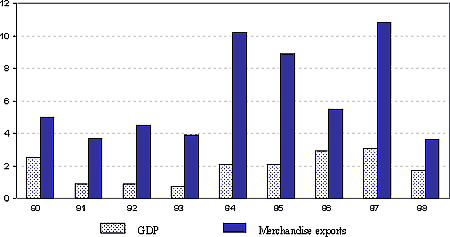
The deceleration of global merchandise trade growth continued throughout the year, leaving the global trade level in the fourth quarter of 1998 only slightly above the level reached at the end of 1997. All major regions experienced a marked slowdown of their trade growth in the course of 1998.
The recent cyclical fall in commodity prices, which started in early 1997, continued unabated throughout 1998. Oil prices fell by 30 per cent and non-oil commodity prices by 20 per cent in 1998, with very different implications for various countries and regions of the world. While the share of primary commodities (including processed food) in world merchandise trade was only slightly above one-fifth in 1997, it was more than two-thirds for the Middle East, Africa and Latin America (excluding Mexico). In a sample of 91 developing countries, 67 of them recorded a share of primary products in total merchandise exports above 50 per cent, reaching as high as 95 per cent in some cases.
Prices of internationally traded manufactured goods and services also have declined in 1998, though considerably less than those of primary products. Exchange rate variations, which were large in the course of 1998, can have a major impact on the dollar prices of internationally traded goods. However, as the dollar's average annual appreciation vis-à-vis the ECU (now the Euro) was considerably smaller in 1998 than in 1997, West European export prices measured in dollar terms decreased far less last year than in 1997. This smaller decrease in Europe's export prices more than offset the stronger price declines in all other regions. Therefore, despite the accelerated fall in commodity prices in 1998, the global price decline for all merchandise exports was 5.5 per cent, which was somewhat less pronounced than in 1997.
Trade performance in 1998 differed widely among regions. While oil-exporting regions recorded the strongest annual value declines in merchandise exports, countries directly affected by the Asian financial crisis reported the strongest import decline. The contractionary forces of the Asian crisis and falling commodity prices were, however, attenuated by the robustness of continued economic growth in the United States and strengthened demand in Western Europe. The reversal of private capital flows away from the emerging markets contributed to low interest rates in North America and Western Europe. In addition, falling fuel prices led to weaker import prices and real income gains for net-fuel importing countries.
Western Europe, the world's largest regional trader, was the only region not to record a deceleration in import growth in 1998 compared to 1997. Western Europe's import growth rate of 7.5 per cent was, however, less than the 10 per cent rate recorded by North America, Latin America and the transition economies. In a sharp contrast, imports into Asia fell by nearly 8.5 per cent, and a stagnation or a decrease in import volumes is estimated for Africa and the Middle East.
Regional differences in the volume growth of exports are far less pronounced than for imports. All regions recorded a lower export expansion in 1998 than in the preceding year. The transition economies and Latin America recorded the strongest volume growth. Asia's export volume increased marginally, as the strong contraction of intra-Asian trade was only just offset by a sharp rise in extra-regional flows. Western Europe's export growth remained somewhat above the global average of 3.5 per cent, while that of North America fell below the average.
The dollar value of world merchandise trade declined by 2 per cent, the strongest decrease since 1982. The export value of manufactured goods continued to rise slightly while that of agricultural products, metals and fuels declined. These divergent developments by product category in 1998 pushed the share of primary products below 20 per cent in current price terms for the first time in the post World War II period.
Exports of commercial services recorded the first annual decline in dollar value since 1983. All the three major services categories (i.e., transport, travel and other commercial services) saw a decrease. Exports of goods and commercial services both decreased slightly but at $5225 and $1290 billion respectively, but were still above the levels reached in 1996 (Table 1).
Table 1
World
exports of merchandise and commercial services, 1996-98
(Billion dollars and percentage)
Value |
Annual change |
|||||
1996 |
1997 |
1998 |
1996 |
1997 |
1998 |
|
Merchandise |
5150 |
5325 |
5225 |
4.5 |
3.5 |
-2.0 |
Commercial services |
1275 |
1320 |
1290 |
6.7 |
3.5 |
-2.0 |
II. World trade developments by country and region Back to top
In its seventh year of expansion, the United States economy experienced an acceleration in private consumption and continued double-digit investment growth. GDP growth was almost 4 per cent, unchanged from 1997. The booming U.S. economy stimulated intra-NAFTA trade, and sustained exports and output in other regions. North America's merchandise import volume rose by 10.5 per cent in 1998, which was the strongest growth of all regions (Table 2).
Table 2
Growth in the volume of world merchandise trade by selected region, 1990-98
(Annual percentage change)
Exports |
Imports |
|||||||
Average |
1996 |
1997 |
1998 |
Average |
1996 |
1997 |
1998 |
|
6.0 |
5.5 |
10.5 |
3.5 |
World |
6.5 |
6.0 |
9.5 |
4.0 |
7.0 |
6.0 |
11.0 |
3.0 |
North Americaa |
7.0 |
5.5 |
13.0 |
10.5 |
8.0 |
11.0 |
11.0 |
6.5 |
Latin America |
12.0 |
8.5 |
22.0 |
9.5 |
5.5 |
5.5 |
9.5 |
4.5 |
Western Europe |
4.5 |
5.5 |
7.5 |
7.5 |
5.5 |
5.5 |
9.5 |
5.0 |
European Union (15) |
4.5 |
5.0 |
7.0 |
7.5 |
5.0 |
6.5 |
12.5 |
10.0 |
Transition economies |
2.5 |
16.0 |
17.0 |
10.0 |
7.5 |
5.0 |
13.0 |
1.0 |
Asia |
10.5 |
6.0 |
6.0 |
-8.5 |
1.5 |
1.0 |
12.0 |
-1.5 |
Japan |
6.5 |
5.5 |
1.5 |
-5.5 |
11.5 |
7.5 |
11.5 |
2.0 |
Six East Asian tradersb |
12.0 |
4.5 |
6.5 |
-16.0 |
aCanada
and the United States.
bChinese Taipei; Hong Kong, China; Malaysia; the Republic of Korea; Singapore
and Thailand.
Note: Separate volume data are not available for Africa and the Middle East, although estimates for these regions have been made in order to calculate the world total.
In value terms, North America's merchandise exports decreased slightly in 1998, as volume growth decelerated and prices declined. North America's merchandise imports, however, increased by 4.5 per cent in value terms, leading to a widening of the region's merchandise trade deficit to $253 billion (Table 3). The evolution in North America's commercial services trade mirrored that of merchandise trade, with exports increasing only very slightly and imports rising by 4.5 per cent, reducing further the region's surplus in services trade.
Latin America's GDP and trade growth slowed sharply in 1998 from the exceptionally high levels recorded in 1997. Falling commodity prices, a slowdown in private capital inflows in the second half of 1998 and weaker export markets within the region and in Asia contributed to this development. Marked differences in economic performance occurred for the two largest economies in the region, with trade and output growth slowing strongly in Brazil, while Mexico's trade and output performance remained well above the regional average. Better access to the rapidly expanding United States market and a higher share of manufactures in its merchandise exports are among the factors which explain why Mexico's trade and output developments were, for the fourth year in a row, superior to those of the other Latin American economies.
For Latin America as a whole, the growth in the volume of merchandise imports continued to exceed that of merchandise exports by a large margin, and the region's trade expansion – both imports and exports – remained stronger than the global average. Latin America's merchandise export value, on the other hand, decreased by 2 per cent in 1998, as the expansion of Mexico's exports was more than offset by the decline in exports of all other Latin American countries combined. In particular, Ecuador and Venezuela, the two major oil exporting countries in Latin America, experienced the strongest setback, with decreases in excess of 20 per cent. Latin America's outstandingly strong import growth performance throughout the 1990-97 period became less dynamic last year, although at 5 per cent, this region, together with Western Europe, recorded the highest import growth rate of any region. Mexico's import growth rate of 14 per cent contrasted with the relative stagnation of imports in other Latin American countries. As Mexico has enjoyed an above average rate of growth in trade for a number of years, its share of total trade in the region has risen considerably, accounting for 40 per cent in 19981. Latin America's exports and imports of commercial services are estimated to have expanded by 4 to 5 per cent in 1998.
Table 3
Growth in the value of world merchandise trade by region, 1990-98
(Billion dollars and percentage)
Exports (f.o.b.) |
Imports (c.i.f.) |
|||||||||
Value |
Annual percentage change |
Value |
Annual percentage change |
|||||||
1998 |
1990-95 |
1996 |
1997 |
1998 |
1998 |
1990-95 |
1996 |
1997 |
1998 |
|
5225 |
7.5 |
4.5 |
3.5 |
-2.0 |
World |
5410 |
7.5 |
5.0 |
3.0 |
-1.0 |
898 |
8.5 |
6.5 |
9.5 |
-1.0 |
North America |
1151 |
8.0 |
6.0 |
10.5 |
4.5 |
274 |
9.0 |
12.5 |
10.0 |
-2.0 |
Latin America |
339 |
14.5 |
9.5 |
19.0 |
5.0 |
118 |
14.0 |
20.5 |
15.0 |
6.5 |
Mexico |
129 |
12.5 |
25.5 |
23.5 |
14.0 |
157 |
7.0 |
8.0 |
7.0 |
-7.0 |
Other Latin America |
211 |
15.5 |
2.5 |
16.5 |
0.5 |
2338 |
6.0 |
3.5 |
-0.5 |
2.5 |
Western Europe |
2359 |
5.5 |
3.5 |
-1.5 |
5.0 |
2171 |
6.5 |
3.5 |
-0.5 |
3.0 |
European Union (15) |
2163 |
5.5 |
3.0 |
-2.0 |
5.5 |
178 |
7.0 |
6.5 |
5.0 |
-1.0 |
Transition economies |
207 |
5.0 |
17.0 |
9.5 |
3.0 |
99 |
7.5 |
6.0 |
8.0 |
9.0 |
Central/Eastern Europe |
133 |
11.5 |
17.0 |
7.0 |
11.5 |
106 |
0.5 |
16.5 |
2.0 |
-16.0 |
Africa |
129 |
5.5 |
-1.0 |
6.0 |
-1.5 |
26 |
3.5 |
5.5 |
6.0 |
-15.0 |
South Africa |
29 |
10.5 |
-1.5 |
9.5 |
-11.0 |
138 |
1.5 |
17.0 |
4.0 |
-21.0 |
Middle East |
139 |
5.5 |
7.0 |
6.5 |
-6.0 |
1294 |
12.0 |
0.5 |
5.5 |
-6.0 |
Asia |
1090 |
12.0 |
4.5 |
0.5 |
-17.5 |
388 |
9.0 |
-7.5 |
2.5 |
-8.0 |
Japan |
281 |
7.5 |
4.0 |
-3.0 |
-17.0 |
184 |
19.0 |
1.5 |
21.0 |
0.5 |
China |
140 |
20.0 |
5.0 |
2.5 |
-1.5 |
504 |
14.0 |
3.0 |
2.5 |
-7.5 |
Six East Asian tradersa |
438 |
15.0 |
3.0 |
0.5 |
-25.0 |
aChinese Taipei; Hong Kong, China; Malaysia; the Republic of Korea; Singapore and Thailand.
Stronger demand growth in Western Europe contrasted with a weaker global economy in 1998, leading to an import expansion which, for the first time since 1992, exceeded the region's export growth rate. Western Europe was the only major region which recorded an increase in the dollar value of its exports. Imports in value terms increased by 5 per cent, very close to the expansion recorded by both North America and Latin America. The share of Western Europe in world merchandise trade recovered to 44 per cent following a marked decrease between 1990 and 1997. Commercial services imports expanded by 4 per cent in 1998, and commercial services exports by 3 per cent.
The interaction between trade and output in the transition economies in recent years has been unique among the major regions. Sluggish overall economic activity, including a decline in regional output in recent years, has been accompanied by export and import growth rates above the global average. Merchandise imports have expanded significantly faster than world trade in both real and nominal dollar values. Merchandise export growth, at 10 per cent in volume terms, was the highest among all regions. Due to the sharp decline in the dollar export prices, however, the dollar export value of the region decreased slightly.
Several factors have contributed to this situation, where trade growth has been above the world average, while output growth has been lower than the world average. First, inflows of private capital have been strong, in particular foreign direct investment (FDI) and portfolio investment. Second, FDI has been associated with a strong increase in capital goods imports, which over recent years has supported the expansion of exports. Third, a number of East European countries advanced considerably with their integration into the EU market, in particular Poland, the Czech Republic and Hungary. The strong trade performance of these countries masked a rather mixed picture in other transition economies.
The commercial services trade of the transition economies has been far less dynamic than merchandise trade in the last two years, with exports decreasing slightly and imports rising moderately. The Russian Federation, the region's largest commercial services trader, reported a decline in exports and imports of about 7 per cent in 1998. For Central and Eastern Europe, an increase of 4 per cent was recorded last year.
Africa and the Middle East have suffered the brunt of the decline in primary commodity prices in 1998. Despite a moderate recovery in Africa's GDP - linked to the recovery of agricultural output - Africa's trade remained sluggish. Export values in the region decreased by 16 per cent in 1998. Oil-exporting African countries recorded a decrease in exports exceeding one-quarter. Import values declined only slightly in 1998, but higher trade deficits raise the question whether the 1998 level of import demand can be sustained in 1999. Available data on commercial services also indicate decreases in the value of both exports and imports. As was observed for merchandise trade, exports of services decreased faster than imports.
Being the region with the highest share of fuels in its merchandise exports, the Middle East recorded the strongest contraction in export value of all regions. Exports for the region as a whole shrank by one-fifth. The decline in the dollar export value was, however, associated with an increase in the export volume. The increase in the supply of oil from the region in a period of weak demand has contributed to a steep erosion of oil prices. The region's merchandise imports adjusted to some degree to lower export revenues, falling by 6 per cent in 1998 (Table 4).
Asia recorded the strongest import contraction in volume and value terms of all regions. Import volume decreased by about 8.5 per cent under the impact of Japan's import contraction of 5.5 per cent, and that of the Asia (5)2 of more than 20 per cent. It is estimated that within Asia only a few countries recorded an increase in import volumes (e.g. Australia, China and India). As intra-Asian trade accounts for about one half of Asia's merchandise exports, the contraction of the area's imports also held down export growth. Asia's export volume rose marginally as the volume decrease for Japan, Chinese Taipei and Hong Kong, China were more than offset by the strong growth of exports of the Republic of Korea and the Philippines. China's exports are also estimated to have expanded moderately in volume terms.
Table 4
Merchandise exports of emerging markets by product category, 1997
(Percentage shares)
Fuels |
Metals and minerals |
Agricultural products |
Manufactures |
Total |
|
|
Middle East |
73 |
2 |
4 |
21 |
100 |
|
Africa |
44 |
8 |
19 |
29 |
100 |
|
Latin Americaa |
19 |
11 |
36 |
34 |
100 |
|
Emerging Asiab |
5 |
2 |
10 |
83 |
100 |
World |
9 |
2 |
11 |
78 |
100 |
aExcluding
Mexico.
bAsia, excluding Japan, Australia and New Zealand.
The dollar value of Asia's imports registered an unprecedented decline of 17.5 per cent. In 1998 Asia (5) imports contracted by one-third, and those of Japan by 17 per cent (Appendix Charts 1 and 2). Only certain South Asian countries recorded a slight increase in their imports (e.g. India and Sri Lanka). The trade performance of most Asian countries improved in the last quarter of 1998, partly due to the strengthening of the yen and other Asian currencies vis-à-vis the U.S. dollar.
The sharp import contraction in the Asia (5) countries (almost one-third in value terms) is largely explained by the turnaround in private capital flows and the associated drop in domestic investment and consumption levels. The decrease in exports of the Asia (5) countries, however, was stronger than expected even if one takes into account the high share of intra-regional trade in total trade. Despite the strong currency devaluations which boosted the price competitiveness of enterprises in the Asia (5) countries, the combined exports of these countries did not increase their market shares in the major developed markets. In fact, China's exports to the United States, Japan and major European markets expanded faster than those of the Asia (5) countries in 1998.
One of the striking features of world trade in 1998 was the exceptionally large variation in the growth rates among countries measured in value terms. Consequently, the ranking of the leading traders changed dramatically for both merchandise and commercial services trade (see Appendix Tables 1, 2 and 3). The reversal of capital flows in 1997-1998 forced many East Asian economies to cut back sharply on their imports in 1998. Import declines ranged from 26 to 35 per cent (e.g. the Republic of Korea 35 per cent, Thailand 33 per cent, Indonesia 34 per cent and Malaysia 26 per cent). Retained imports of Hong Kong, China and Singapore also contracted in this range, despite their current account surplus position and stronger internal demand.
Contractionary conditions in Japan and the fall in oil prices led to a fall of 17 per cent in the dollar value of imports, to a level below that of Germany, the United Kingdom and France. In general, Canada, Mexico and many West European countries improved their position among the leading importers (and exporters), while those of Asian countries and Russia deteriorated.
Fuel exporters generally recorded the strongest decline in merchandise export value among all countries. For a number of them, the dollar value of export earnings decreased by one-quarter to more than one-third in 1998 (e.g. Saudi Arabia, Libya, Nigeria and Venezuela). Oil exporters and the East Asian traders lost, while Mexico and most West European countries gained in market share.
Last year, China's merchandise exports exceeded those of Hong Kong, China for the first time. The contraction of Russia's trade under the impact of the fall in fuel prices and the outbreak of the financial crisis have lowered Russia's (extra-CIS) exports to below those of Ireland and its imports to less than those of Poland.
Despite the decrease in the nominal value of world trade, a few countries continued to expand their exports by more than 15 per cent. This group comprises Ireland, the Philippines, Hungary and Costa Rica. Throughout the 1990-98 period these countries expanded their exports two times faster than the global average.
The United States consolidated its position as the world leading trader in 1998, accounting for nearly one-sixth of merchandise imports and services exports and one-eighth of merchandise exports and services imports.
East Asian countries' exports of commercial services decreased in 1998 significantly faster than their merchandise exports. One explanation for this development might be that intra-Asian trade is more important for services than for merchandise exports and thereby more affected by the contraction of Asian demand. However, the lack of statistical information on the destination of services exports precludes confirmation of this possibility.
Although price variations in commercial services are estimated to be far smaller than those for merchandise trade in 1998, the variations in the performance of individual services traders were at least as large as those for merchandise traders. Among the leading commercial services exporters, the strongest declines were recorded by Singapore and Malaysia, while India and Spain recorded increases in excess of 10 per cent. The Asia (5) countries recorded contractions in their services imports ranging from about 20 per cent to more than 30 per cent. India, Spain and Ireland recorded import increases between 10 and 20 per cent. Given the provisional nature of the above data and the past experience of substantial revisions even for year-old data, caution is called for in interpreting current services statistics.
III. Repercussions of the fall in commodity prices Back to top
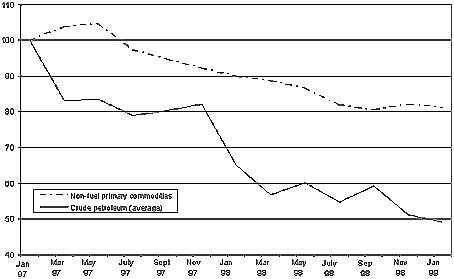
In 1998, an increase in the supply of many primary commodities coincided with a slowdown in economic activity, leading to a sharp drop in commodity prices. Prices of non-fuel commodities and crude oil fell by 15 per cent and more than 30 per cent, respectively. Although prices of manufactures decreased as well, prices of primary commodities decreased much faster (for the second year in a row).
As the oil price decline accelerated during the course of the year, the year-over-year change in December 1998 exceeded 40 per cent. For non-fuel primary commodities, the period of weaker prices started earlier and moderated in the second half, with the result that the decline at the end of the year (about 10 per cent) was smaller than the annual average for 1998 (Chart 2). Oil exporters have yet to feel the full impact of lower spot oil prices on their export earnings. Investment and government expenditure is likely to be curtailed in 1999. Import levels will contract further, as such a steep price decline cannot be fully absorbed by a reduction in foreign exchange reserves.
Chart 2
Recent Commidity Price Developments, January 97-January 99
Indices, January 1997 = 100
 Source:
IMF, International Financial Statistics
Source:
IMF, International Financial Statistics
As noted earlier, the steep fall in fuel prices affects in particular the export earnings of the Middle East and Africa. Besides the 11 member countries of OPEC, in about another eight countries fuel exports account for more than one half of export earnings. It is important to note that in the first quarter of 1999, the spot oil price recovered from its low level in December 1998 following the announcement of production cuts by oil producers. It remains to be seen whether this upward trend will continue or the present price gains will prove sustainable. While these trends will lead to downward adjustments in the imports of oil-exporting countries in 1999, related income gains in oil-importing countries will at least partially offset this contractionary tendency in world trade.
Exporters of agricultural products are a larger group than oil exporters. The decline in agricultural prices therefore affected a larger number of countries, but generally less dramatically than the oil exporters. This is for two reasons. First, the decline in agricultural product prices was less steep than for oil. Second, the exporters of agricultural products generally depend less on a single commodity than do the fuel exporters (Appendix Table 4).
IV. Global trade outlook for 1999 Back to top
The slowdown of world trade and output growth had not been reversed by the end of 1998. While Japan's GDP continued to shrink in the fourth quarter of 1998 and many West European countries recorded a weakening in their economic performance, the U.S. economy accelerated.
Significantly slower GDP growth in Brazil in 1998 and contraction in Russia will negatively affect the growth of neighbouring economies with whom they have extensive trade ties. The sharp contraction of output and trade in the Asia (5) countries appears to have bottomed out, and a moderate recovery is the most likely scenario for 1999. As there is generally a time-lag between reduced export earnings and lower import levels, the steep fall of oil and commodity prices will have its full impact on investment and consumption in the commodity exporting countries only in 1999. The extent of this impact may be mitigated in the case of oil prices, however, should the recent increases in prices prove sustainable.
Global output growth may weaken slightly in 1999. Moderately weaker growth in the United States and Western Europe may not be offset by a lower rate of contraction in Japan. Given the size of the Russian and Brazilian economies in regional output, production levels in the transition economies and Latin America is likely at best remain unchanged from the preceding year.
On the basis of this sluggish output growth, overall trade expansion may not differ much in 1999 from the 3.5 per cent observed in 1998. Even this moderate expansion, however, is associated with major downside risks and would imply an acceleration of trade growth in the course of 1999. If slower output growth in the United States or Western Europe turns out to be more pronounced than presently expected, and if the recovery in East Asia (including Japan) is more delayed than projected by most observers, world trade expansion could be below 3.5 per cent. The United States is expected to record the highest growth rate among the industrial countries in 1999, but on the condition that U.S. consumers do not rapidly correct their historically low savings rate, and that any stock market correction will not have a major impact on investor and consumer confidence.
Click below for
Appendix Table 1
Appendix Table 2
Appendix Table 3
Appendix Table 4
Appendix Chart 1
Appendix Chart 2
Footnotes: Back to top
1 Mexico's share in Latin America's merchandise exports in 1998 was 43 and that for merchandise imports was 38 per cent.
2. These are the countries that were most immediately affected by financial crisis that broke in mid-1997 - Indonesia, Malaysia, Philippines, the Republic of Korea and Thailand.