

MANAGING THE CHALLENGES OF WTO PARTICIPATION: CASE STUDY 38
The Reform of South Africa’s Anti-Dumping Regime
Niel Joubert*
Disclaimer:
Opinions expressed in the case studies and any errors or omissions
therein are the responsibility of their authors and not of the
editors of this volume or of the institutions with which they are
affiliated. The authors of the case studies wish to disassociate the
institutions with which they are associated from opinions expressed
in the case studies and from any errors or omission therein.
> Case
Studies main page
> Introduction
ON THIS PAGE:
> I. The problem in context
> The history of the use of trade remedies in South Africa
> South Africa’s increasing use of anti-dumping measures
> South Africa’s obligations under the WTO
> Changes in regional dynamics
> II. The local and external players and their roles
> Anti-dumping in South Africa under the 1996 SACU Agreement
> Anti-dumping under the 2002 SACU Agreement
> The domestic adoption of the International Trade Administration
(ITA) Act and
the SACU Agreement
> III. Challenges faced and the outcome
> Defending South Africa’s anti-dumping legislation in the WTO
> Implementing the new anti-dumping system in SACU
> IV. Lessons for others
> Annex I
> Bibliography
This case study examines the development and reform of South Africa’s anti-dumping regime as an example of a country’s participation in the WTO. The long history of the use of trade remedies by South Africa illustrates the fact that developing countries can successfully participate in the global trading system. By using the WTO’s Anti-dumping Agreement (ADA) as a model for its own anti-dumping system, South Africa also serves as an example of how a country can make use of WTO instruments to ensure that its domestic legislation is complying with its international obligations.
The first section takes a brief look at the history of the use of trade remedies in South Africa, international developments on anti-dumping rules and the various legislative changes South Africa has undertaken in the past century that have helped shape its current anti-dumping system. It examines the factors that necessitated the reform of the South African anti-dumping regime, and briefly discusses the impact of the change in regional dynamics on the anti-dumping process in South Africa.
Section 2 gives an overview of the government, business and civil society players involved in the process of reforming the South African anti-dumping system. It also briefly touches on the roles of the various parties responsible for the administration of the system in the pre-apartheid and post-apartheid periods.
Section 3 identifies the challenges faced by these different players in the process of reforming the existing anti-dumping regime. Special attention is given to the impact of regional developments on the progress of South Africa’s reform. It evaluates the suitability of the new regime that is currently being put into place and the rationale behind the design of the new system to administer anti-dumping duties. Finally, it takes a look at whether the interests and concerns of various stakeholders were adequately addressed in the new system.
Section 4 concludes the study by reflecting on the process South Africa has been through and identifying the experience that can be transferred to other countries. This section argues that proper consultations between government and the various national stakeholders are important for effective policy-making.
I. The problem in context
The history of the use of trade remedies in South Africa
South Africa is one of the earliest users of trade remedies in the world. The first references to such remedies as anti-dumping actions, subsidies and countervailing actions can be found in section 8 of the Customs Tariff Act of 1914.(1) These remedies were administered by the then Customs Department, which later became the South African Revenue Service (SARS).(2)
The responsibility for dealing with anti-dumping remedies was taken over by the Board on Trade and Industries (BTI) in September 1923. South Africa was a very early and prolific user of anti-dumping measures; in the period between 1921 and 1947 more than 90 anti-dumping and countervailing investigations were undertaken, while another 818 investigations were undertaken between 1948 and October 2001.(3) The exact number of anti-dumping investigations cannot be ascertained, as prior to 1992 no distinction was made between anti-dumping and countervailing investigations. The first anti-dumping investigation considered the imposition of anti-dumping duties on cement.
At the time of the negotiation of the International Trade Organization (ITO) and the General Agreement on Tariffs and Trade (GATT) in the 1940s, anti-dumping as a trade remedy was a well-known and accepted practice, and was included in the GATT of 1947 as Article VI:
The Contracting Parties recognize that dumping, by which the products of one country are introduced into the commerce of another country at less than the normal value of the products, is to be condemned if it causes or threatens to cause material injury to an established industry in the territory of a contracting party or materially retards the establishment of a domestic industry.
As Article VI only included some basic rules for the determination and imposition of anti-dumping duties, contracting parties to the GATT agreed to its review. This led to agreement on the Anti-dumping Code (to which South Africa was not a signatory) in the Kennedy Round of multilateral trade negotiations that ran from 1963 to 1967, which in turn was replaced by the Agreement on the Implementation of Article VI of the General Agreement on Tariffs and Trade (Anti-dumping Agreement) in the Tokyo Round ending in 1979.
In 1977 the BTI recommended in its annual report that all anti-dumping duties in place in South Africa should be withdrawn as of 1 January 1978. They argued that these measures had been in place for such a long time that their removal would not pose any threat to South African industries, and that any disruptive competition could be addressed through the use of formula duties.(4) In the five years leading up to the recommendation the board had only twice approved the imposition of anti-dumping duties. The decrease in the use of anti-dumping measures during the 1970s and 1980s is explained by the fact that South African producers were protected by very high tariff barriers.(5) Trade sanctions imposed on South Africa because of its apartheid policies also encouraged the government to provide protection to industries it considered to be of ‘strategic’ importance.(6) Import surcharges, among other things, were used for this purpose and diminished the need for anti-dumping measures.
This situation led to the decision by South Africa’s then Minister of Trade and Industry to remove all existing anti-dumping duties as of 1 January 1978, as he considered that the high tariffs in place at the time provided sufficient protection for domestic companies.(7) All incidents of disruptive competition after 1978 were therefore treated as tariff cases. Whenever the prices of certain imports would drop below a specific point, a formula duty would apply which effectively would increase to a pre-determined level the price of the imported goods.(8)
The Board on Tariffs and Trade Act replaced the BTI with the Board on Tariffs and Trade (BTT) in September 1986.(9) In 1992 a Directorate of Dumping Investigations was established within the Department of Trade and Industry (DTI) to assist the BTT by conducting anti-dumping and countervailing investigations on its behalf.(10) The BTT published a ‘Guide to the Policy and Procedure with regard to Action against Unfair International Trade Practices: Dumping, Subsidies and other forms of Disruptive Competition’ in 1992. This was followed by a second guide in 1995 entitled ‘Guide to the Policy and Procedure with Regard to Action against Unfair International Trade Practices: Dumping and Subsidized Export’. The latter guide was, however, withdrawn from the South African Customs Union (SACU) in 1996.(11)
South Africa’s increasing use of anti-dumping measures back to top
South Africa returned to the global community in the early 1990s after facing decades of trade sanctions. Its transformation to a democracy led to the removal of these sanctions. It started opening its economy to become more competitive and to integrate into the world economy. South Africa actively participated in the Uruguay Round of trade negotiations and was a founding member of the WTO.
South Africa embarked on a process of rapid liberalization by introducing tariff offers aligned with those of developed countries. This left domestic firms facing increased competition from both fair and unfair international trade. South Africa’s average most favoured nation (MFN) tariff rates for all goods fell from over 14% in 1996 to 8% in 2001; the MFN rates for industrial goods also fell by 50% and 55% for textiles and clothing respectively over the same period. The weighted average MFN tariff rate came down from a level of 8.6% in 1996 to 5% in 2001.(12)
With tariff protection falling away, trade remedies such as anti-dumping and countervailing measures became increasingly important for domestic producers, to protect them from the rise in imports. This led to a sharp increase in South Africa’s application of trade remedies, in particular anti-dumping measures. South Africa reported initiating 157 anti-dumping investigations and applying 106 anti-dumping measures between 1 January 1995 and 30 June 2002.(13) This makes it the fifth-largest user of anti-dumping actions (after the United States, the European Union (EU), India and Argentina).(14)
South Africa’s obligations under the WTO back to top
By joining the WTO South Africa became a party to all WTO agreements, including the Agreement on Implementation of Article VI of GATT 1994 (the Anti-dumping Agreement). Article VI of GATT 1994 provides for the right of contracting parties to apply anti-dumping measures, that is measures against imports of a product at an export price below its ‘normal value’ (usually the price of the product in the domestic market of the exporting country) if such dumped imports cause injury to a domestic industry in the territory of the importing country. Even though all the WTO agreements were ratified by the South African Parliament, they do not form part of South African public law, as they were never promulgated. The South African Constitution, however, explicitly states that international agreements should be used as reference and guidelines in the interpretation of domestic laws.(15)
Article 1 of the ADA requires that members will only apply anti-dumping measures under the circumstances provided for in Article VI of GATT 1994 and only after investigations which have been initiated and conducted in accordance with the provisions of the Agreement. The ADA provides detailed rules in relation to the method of determining whether a product is dumped; the criteria to be taken into account in a determination that dumped imports cause injury to a domestic industry; the procedures to be followed in initiating and conducting anti-dumping investigations; and the implementation and duration of anti-dumping measures. Where a member country institutes measures that are not in accordance with the WTO rules, these measures are subject to dispute resolution in the WTO.
Article 16 of the ADA establishes the Committee on Anti-dumping Practices (CADP). It requires members to notify the Committee immediately of all preliminary and final actions taken in anti-dumping investigations and to submit semi-annual reports of any anti-dumping actions taken in the previous six months.(16) Article 18(4) furthermore requires WTO members to bring their laws, regulations and administrative procedures into conformity with the ADA by the date of entry into force of the Agreement.(17) Under Article 18.5, members are also required to notify the CADP of any changes in their anti-dumping laws and regulations and in the administration of these laws and regulations.
Already in 1994 South Africa’s National Economic Forum (NEF) — a tripartite body consisting of representatives from business, government and labour — stressed the need for national legislation on anti-dumping and countervailing measures and the need to establish an anti-dumping authority.(18)
The Board Amendment Act of 1995 made small amendments to South African legislation in an effort to bring the country’s anti-dumping regime more in line with the ADA.(19) The definition of dumping was changed to correspond with the definition of dumping in the ADA, and certain new concepts such as ‘normal value’ were introduced. It still, however, did not provide for any procedural framework or regulations for the conducting of anti-dumping investigations. As mentioned earlier, the BTT did publish a guide on anti-dumping procedures in 1995, but it was withdrawn in 1996.(20)
With the growing use of anti-dumping measures, South Africa started experiencing increased pressure from other WTO members to bring its legislation and the administration of these measures in line with the ADA. In April 1996 South Africa announced in the WTO Committee on Anti-dumping Practices that it intended to amend its legislation on anti-dumping to ensure its compliance with the relevant WTO agreements.(21)
The South African Ministry of Trade and Industry subsequently instructed the BTT to investigate the restructuring of the South African anti-dumping regime. Small amendments were made to existing legislation in 1997 to give the minister the power to make regulations on trade remedies and to provide for the application of provisional safeguard measures.(22)
Professor Colin McCarthy, acting head of the International Trade Administration Commission (ITAC), highlighted the fact that South Africa had always done its best to act in strict conformity with the WTO rules in conducting anti-dumping investigations; the requirements of Article VI of GATT and the ADA, especially the notice requirements, have always been strictly adhered to.(23) Although this might have been the case in practice, South Africa’s existing legislation did not fully reflect South Africa’s obligations under GATT 1994 and the WTO. The Department of Trade and Industry’s invitation for comments on South Africa’s draft anti-dumping regulations stressed the fact that proper legislation and regulations were required to inform all stakeholders of the substance and the procedures involved in anti-dumping investigations.(24)
The restructuring of the anti-dumping regime finally became a reality with publication of the International Trade Administration (ITA) Act on 22 January 2003, creating a new body, the International Trade Administration Committee (ITAC), for the administration of trade remedies within South Africa. This was followed by the promulgation of detailed anti-dumping regulations in November 2003 to guide ITAC in conducting its anti-dumping investigations.
Changes in regional dynamics back to top
South Africa concluded in 1999 a free trade agreement — the Trade, Development and Co-operation Agreement (TDCA) — with the EU that provisionally entered into force on 1 January 2000. It also entered into a free trade agreement with eleven members of the Southern African Development Community (SADC) on 1 September 2000 by becoming a member of the SADC Trade Protocol. These free trade agreements provide preferential access to the South African market for all EU and SADC member states, and bring with them increased competition for domestic producers. Both these agreements contain provisions on anti-dumping, countervailing and safeguard measures.
South Africa is a member of SACU together with Botswana, Lesotho, Namibia and Swaziland (BLNS countries). These countries signed a new SACU Agreement in 2002 that entered into force on 15 July 2004. Negotiations for this agreement were officially launched soon after South Africa elected its first democratic government in 1994. The aim was to democratize SACU and to create institutions that would enable the BLNS countries to participate more fully in the decision-making processes in the customs union.
The new SACU Agreement has important implications for the anti-dumping regime within the customs union. It changed the way in which tariff decisions, including anti-dumping tariffs, are made, and it also requires member states to develop legislation on contingency trade remedies such as anti-dumping for the region, and to establish national bodies to administer these remedies within the different countries.
As mentioned above, South Africa enacted the ITA Act in January 2003.(25) Its aim is to provide an institutional basis for the conduct of trade policy and the application of customs tariffs in line with South Africa’s obligations under international agreements, that is agreements under the WTO, the Southern African Development Community (SADC) and SACU. We take a more detailed look below at the implications of this change in the administration of international trade affairs in South Africa.
II. The local and external players and their roles
Anti-dumping in South Africa under the 1996 SACU Agreement
Under the 1996 SACU Agreement, South Africa was solely responsible for the setting of customs duties, as well as any anti-dumping, countervailing and safeguard measures for the customs union. As members of the customs union BLNS countries were obliged to apply these measures, although they were not always beneficial to the BLNS countries since the relevant items were mostly not produced by their domestic industries.
As the body in South Africa responsible for the determination of customs duties and the administration of anti-dumping measures,(26) the BTT initiated anti-dumping investigations at the request of a domestic industry within SACU. Importers, exporters and foreign producers would then be provided with an opportunity to submit information for consideration in any such investigation. After conducting the investigation the BTT would make a recommendation to the South African Minister of Trade and Industry, and that ministry would then request the Ministry of Finance to impose anti-dumping duties. In 1992 a Directorate for Dumping Investigations was established within the Department of Trade and Industry to assist the BTT by conducting anti-dumping and countervailing investigations on its behalf. As the board never had a set of published regulations to work from, it made use of its enabling legislation — Article VI of GATT and the ADA — to conduct its investigations.
Anti-dumping under the 2002 SACU Agreement back to top
ITAC was established on 1 June 2003 by the ITA Act. ITAC replaced the BTT and will act as South Africa’s national body in terms of Article 14 of the 2002 SACU Agreement. It currently acts as the tariff body for the whole of SACU and is responsible for previous BTT functions such as the investigation and evaluation of applications for the amendment of customs duties, duty and tax concessions, and import and export controls, and for administering anti-dumping, safeguard and countervailing measures.
The 2002 SACU Agreement provides for a number of new institutions for the customs union. SACU will now have a Council of Ministers, a Secretariat (based in Windhoek, Namibia), a Tariff Board, a Tribunal, a Customs Union Commission and a number of technical committees. When South Africa wants to impose an anti-dumping measure, ITAC is responsible for conducting the investigation, and under the new SACU Agreement, ITAC is now obliged to make any recommendations directly to the SACU Tariff Board.
The Tariff Board will be a supra-national SACU institution, consisting of experts drawn from member states. It will make its own recommendation to the council based on that of the national body. The final decision will then lie with the Council of Ministers, comprising at least one minister from each member state. Council decisions are then referred back to the member states for implementation. As the new SACU Agreement is still far from being fully implemented, member states have agreed upon an interim solution. The current situation is discussed in more detail in section 3 below.
The domestic adoption of the International Trade Administration (ITA) Act and the SACU Agreement back to top
The ITA Act had to be adopted by Parliament for it to become law in South Africa. A series of briefings and public hearings were held jointly by the Parliamentary Portfolio Committee on Trade and Industry and the Economic Affairs Select Committee to explain the rationale behind the Act to stakeholders and to address their concerns. Submissions were received from the South African Chamber of Business (SACOB) on behalf of the private sector and from the Congress of South African Trade Unions (COSATU) on behalf of organized labour. After extensive consultations and debates both inside and outside Parliament, the bill was passed in November 2003.
The 2002 SACU Agreement had to be ratified by Parliament before it could enter into force in South Africa, as required by section 231 of the South African Constitution.(27) The Parliamentary Portfolio Committee on Trade and Industry again held a number of briefings and public hearings to give all stakeholders the opportunity to comment on the proposed ratification. Written submissions were received from SACOB, the Trade Law Centre for Southern Africa (Tralac), academics, the National Economic Development and Labour Council (Nedlac), COSATU and from Agri-SA on behalf of agricultural producers.
Nedlac submitted its report after holding discussions in its Trade and Industry Chamber on both the new SACU Agreement and the ITA Act. Nedlac is South Africa’s primary institution for social dialogue and organizes exchanges between the business community, government, trade unions and civil society on issues of social and economic policy.(28) Nedlac has to consider all proposed labour legislation before it is introduced into Parliament, as well as any legislation that may have a significant impact on social and economic policy.(29) It is also the primary forum for discussion on all trade agreements. Nedlac provides a platform on a national level for these different stakeholders to reach consensus on these issues. The aim is to make economic decision-making more inclusive and to promote the goals of economic growth and social equity. Other chambers in which Nedlac’s work is conducted are the Labour Market Chamber, the Development Chamber and the Public Finance and Monetary Policy Chamber.
Nedlac’s predecessor, the NEF, has also played a very important role in the formulation of South Africa’s policies. It provided valuable inputs in the determination of South Africa’s tariff offers to other WTO members when South Africa joined the WTO in 1995. Since then the effectiveness of Nedlac in the formulation of policies has been in steady decline. Nedlac needs to be refocused and reorganized and also to be better resourced.
III. Challenges faced and the outcome
Defending South Africa’s anti-dumping legislation in the WTO
The promulgation of the ITA Act and the anti-dumping regulations for ITAC was an attempt to bring South Africa’s anti-dumping legislation in line with the requirements of the WTO.(30) ITAC published the draft anti-dumping regulations for public comment in March 2003. It used the ADA as a model and it looked at the anti-dumping regimes of the EU, the United States, New Zealand and Australia as examples in drafting the regulations.(31) ITAC’s investigations are therefore based on the ADA, while the regulations serve as a procedural guide. Inputs on the draft regulations were received from several lawyers from Canada, the United States and New Zealand, as well as local lawyers and academics. According to Professor McCarthy the draft regulations were discussed and commented on in detail within ITAC as well.(32) The regulations in their final form were approved by the Minister of Trade and Industry on 12 November 2003.
As required by Article 18(5) of the ADA the anti-dumping regulations, together with the new International Trade Administration Act were notified to the WTO’s Committee on Anti-dumping Practices (CADP) on 20 January 2004.(33) These notifications included the full texts of the relevant laws and regulations, and are, like other official WTO documents, made available by the WTO to members in all three WTO languages for purposes of the review.(34)
The new legislation and regulations were subject to review in the CADP. This review takes the form of written questions from other members; questions can also be put to the notifying country during the meeting of the CADP. ITAC had to provide satisfactory written answers to all these questions and ITAC officials had to appear before the CADP to address additional questions put forward by members.(35) Written questions were submitted by the EU, the United States and Venezuela, with additional questions tabled in the CADP by Turkey. South Africa successfully defended its new legislation and regulations in the CADP by providing members with satisfactory answers and explanations addressing all their noted concerns.
Implementing the new anti-dumping system in SACU back to top
The new SACU institutions have not all been established. The Secretariat is currently in the process of being set up in Windhoek, Namibia. The Council of Ministers exists ipso facto, but the Tariff Board, the Tribunal and the Customs Union Commission still need to be established. South Africa is also the only member state of SACU that has established a national body to date. According to Professor McCarthy it is important for the BLNS countries to establish these bodies, as only they can make recommendations through to the SACU Tariff Board. The Tariff Board will not be able to function unless such national bodies are in place. In the light of these difficulties, the SACU Council of Ministers requested ITAC on 1 July 2004 to continue with the administration of anti-dumping investigations for an interim period of twelve months. The only proviso was that all anti-dumping investigations should be undertaken in consultation with the BLNS countries.(36)
One of the main objectives of the new SACU Agreement is to democratize the decision-making process within the customs union. The final decision on matters such as anti-dumping duties lies with SACU’s supreme decision-making mechanism, the Council of Ministers. This means that decisions by all SACU institutions ‘shall be made by consensus’.(37) This amounts to a right of veto for member states; as there are only five this should facilitate consensus, but they have divergent interests.(38)
This change in the process of imposing anti-dumping duties has been a cause of serious concern to various stakeholders in South Africa. Business and labour associations have raised several issues during the public hearings on the ITAC Bill regarding the new SACU institutions, particularly as these would affect the functioning of ITAC.(39) The South African Chamber of Business (SACOB) pointed out in its submission to Parliament that it remains concerned about potential delays in decision-making in other SACU member states with regard to anti-dumping and other trade remedies, due to the cumbersome and time-consuming decision-making structure. The competitiveness of South African industry and that of the region is highly dependent on the speed of decision-making, especially in these times of increased trade liberalization and globalization.(40)
This issue was also taken into account in the drafting of the anti-dumping regulations for ITAC, as the ADA prescribes strict time periods for the conducting of anti-dumping investigations. The regulations therefore include stricter timelines for the allowed duration of investigations.
ITAC aims to complete its investigations within twelve months, although the anti-dumping regulations allow investigations to take up to eighteen months.(41) In practice these deadlines are often missed. Colin McCarthy has pointed out that there are valid reasons for this: the Commission plays an active role in these investigations; it often has to refer submissions back to the parties involved when it is not entirely happy with the contents, and this creates delays. Interested parties also take maximum advantage of the opportunity to ask for a postponement.(42) SACU’s new decision-making process is not yet in place; no one has, therefore, had the opportunity to evaluate its effectiveness. We shall have to wait and see whether or not the concerns about the process are justified.
IV. Lessons for others
Countries should always keep in mind that it is the private sector that trades, not governments. A common problem faced by all countries is a lack of proper consultation between government and stakeholders to ensure that their concerns are addressed when government determines trade policies. It is important that a government establish opportunities for public-private dialogue in order to involve all spheres of society in its decision-making processes, as policy-making cannot take place in a vacuum.
South Africa has a number of existing national frameworks in place, such as Nedlac and the parliamentary hearings described above, to ensure the effective participation of different stakeholders in the legislative process. The question is, however, whether this amounts to effective consultations and to what extent government takes note of stakeholders’ concerns. In SACOB’s submission to the Parliamentary Portfolio Committee on the new SACU Agreement, it expressed concern that the parliamentary hearings only served to rubber stamp something which had already been decided upon. It based this concern on the fact that very few of business’s concerns on the draft SACU Agreement had been taken into account in the final Agreement signed by the government.
While these are legitimate concerns, it must be remembered that the SACU Agreement is a product of lengthy negotiations with other member states and that this limits the government on what it can seek to have included in the Agreement. A need exists for better consultations between government and stakeholders. According to Marion Hummel, SACOB’s international trade and investment executive, SACOB is often not given sufficient time by government to consider and comment on important issues affecting business.(43) SACOB, along with other organizations, has capacity constraints and cannot give quality inputs without adequate time for research and discussions.
The whole policy-making process needs to take more of a bottom-up approach. There should be a free flow of information between government and stakeholders, as they cannot anticipate all upcoming issues. The government should also move away from its individual approach to business issues. Business cannot be neatly divided into sectors, as this often leads to cross-cutting issues being disregarded.
Discussions with stakeholders should not only focus on micro issues, but also strive to include issues that will affect the whole economy. Currently there is a lack of strategic multi-sectoral planning by business and government in South Africa. This should include debate on South Africa’s national trade policy. The various business sectors have to become more involved. The recent restructuring of business associations in South Africa has had a negative impact on this process of co-operation, but this should now improve.
The use of the ADA as a model for South Africa’s legislation is an example of how a country can make use of WTO instruments to ensure that it complies with its WTO obligations. Countries can adjust these instruments to suit their various needs without having to reinvent the wheel. The history of the use of anti-dumping measures by South Africa and the whole process it has undergone, both domestically and in the WTO, shows that developing countries can successfully participate in the world trading system.
Annex I
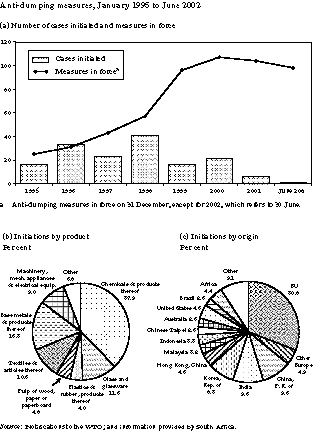
Source: Notifications to the WTO; and information provided by South Africa.
Bibliography
Barral et al. (2004), Anti-dumping in Brazil,
China, India and South Africa — Rules, Trends and Causes, Sweden:
National Board of Trade
Brink, Gustav (2002), Anti-dumping and
Countervailing Investigations in South Africa: A Practitioner’s Guide
to the Practice and Procedures of the Board on Tariffs and Trade
COSATU (2003), ‘Submission on the Southern
African Customs Union (SACU) Agreement’, 20 Nov
Erasmus, Gerhard (2004), ‘New SACU
Institutions: Prospects for Regional Integration’, available at
www.tralac.org
Erasmus, Gerhard (2004), ‘The New SACU
Structures Get Under Way’, available at
www.tralac.org
International Trade Centre (2003), ‘Business
Guide to Trade Remedies in South Africa and the Southern African Customs
Union’
SACU Trade Policy Review, WTO 2002 WT/TPR/S/114
South African Chamber of Business (SACOB)
(2003), ‘Comments on the Proposed Ratification of the Final SACU
Agreement by South Africa’, November
‘Southern African Customs Union Agreement:
Briefing. Trade and Industry Portfolio Committee, 16 April 2003’,
available at http://www.pmg.org.za
NOTES:
1.- Act 26 of 1914. The Act also referred to ‘subsidies’
and ‘countervailing action’ as ‘bounties’ and ‘bounty
anti-dumping duties’. back to text
2.- International Trade Centre (ITC) (2003), ‘Business
Guide to Trade Remedies in South Africa and the Southern African Customs
Union’. back to text
3.- Gustav F. Brink (2002), Anti-dumping
and Countervailing Investigations in South Africa: A Practitioner’s
Guide to the Practice and Procedures of the Board on Tariffs and Trade.
back to text
4.- ITC (2003), p. 2. back to text
5.- Brink (2002), p. 3. back to text
6.- Barral et al. (2004), ‘Anti-dumping in
Brazil, China, India and South Africa — Rules, Trends and Causes’, p.
49. National Board of Trade, Sweden. back to text
7.- Brink (2002), p. 4. back to text
8.- Interview with Gustav Brink, director,
trade remedies policy, ITAC, 31 Aug. 2004. back to text
9.- Act 107 of 1986. back to text
10.- Board on Tariffs and Trade Amendment Act
1992 (Act 60 1992) and the Customs and Excise Amendment Act 1992 (Act 61
1992). back to text
11.- ITC (2003), p. 2. back to text
12.- Barral et al. (2004), p. 51. back to text
13.- See Annex I. back to text
14.- WTO (2002). SACU Trade Policy Review,
WT/TPR/S/114 ,
p. 34. back to text
15.- ITC (2003), p. 3. back to text
16.- Art. 16(4) of Anti-dumping Agreement. back to text
17.- The Anti-dumping Agreement, as with all
the other WTO agreements concluded during the Uruguay Round, came into
force on 1 Jan. 2005. back to text
18.- The NEF was replaced by Nedlac on 18 Feb.
1995. See further below for a discussion of Nedlac. Interview with
Brink. back to text
19.- Brink (2002), p. 5. back to text
20.- ‘Guide to the Policy and Procedure with
Regard to Action against Unfair International Trade Practices: Dumping
and Subsidized Export’. back to text
21.- WTO SACU Trade Policy Review p. 33,
WT/TPR/S/114.
Under the 1969 SACU Agreement, South Africa’s customs tariffs and
legislation on trade remedies were directly applicable to all SACU
countries. back to text
22.- ITC (2003), p. 4. back to text
23.- Interview with Professor Colin McCarthy,
acting head of ITAC, 31 Aug. 2004. back to text
24.- Comments on anti-dumping law invited, 4
April 2003, Trade Law Centre for Southern Africa,
www.tralac.org. back to text
25.- Act 71 of 2002. back to text
26.- Board on Tariffs and Trade Act, Act 107
of 1986. back to text
27.- Act 108 of 1996. back to text
28.- Nedlac’s website:
www.nedlac.org.za. back to text
29.- Ss. 4(1)(c) and (d) Nedlac Constitution.
back to text
30.- Comments invited on law on 4 April 2003,
Trade Law Centre for Southern Africa,
www.tralac.org. back to text
31.- Interview with McCarthy. back to text
32.- Interview with McCarthy. back to text
33.- WTO
G/ADP/N/1/ZAF/2, 20 Jan. 2004. The
official WTO languages are English, French and Spanish. back to text
34.- Interview with Brink. back to text
35.- For the detailed questions and answers,
see WTO documents
G/ADP/Q1/ZAF/2,
G/ADP/Q1/ZAF/4,
G/ADP/Q1/ZAF/3,
G/ADP/Q1/ZAF/5 and
G/ADP/Q1/ZAF/1. back to text
36.- Interview with McCarthy. back to text
37.- Art. 17, SACU Agreement 2002. back to text
38.- Gerhard Erasmus (2004), ‘New
SACUInstitutions: Prospects for Regional Integration’, available at
www.tralac.org, p. 5. back to text
39.- Briefing on the Southern African Customs
Union Agreement, Trade And Industry Portfolio Committee, 16 April 2003. back to text
40.- Comments by SACOB on the Proposed
Ratification of the Final SACU Agreement by South Africa, November 2003,
para. 2.2. back to text
41.- Reg. 20, ITAC anti-dumping regulations. back to text
42.- Interview with McCarthy. back to text
43.- Interview with Marion Hummel,
international trade and investment executive, SACOB. back to text
* Researcher, Trade and Law Centre of Southern Africa (Tralac).

