

MANAGING THE CHALLENGES OF WTO PARTICIPATION: CASE STUDY 6
Inter-Agency Policy Co-ordination in Botswana
Kennedy K. Mbekeani*
Disclaimer:
Opinions expressed in the case studies and any errors or omissions
therein are the responsibility of their authors and not of the
editors of this volume or of the institutions with which they are
affiliated. The authors of the case studies wish to disassociate the
institutions with which they are associated from opinions expressed
in the case studies and from any errors or omission therein.
> Case
Studies main page
> Introduction
ON THIS PAGE:
> I. The problem in context
> Participation in the WTO
> Interagency co-ordination
> Economic background
> II. Local and external players and their roles
> Government
> Non-government bodies
> Foreign external players
> III. Challenges faced and the outcome
> Negotiating capacity
> Analytical capacity
> Involvement of other stakeholders
> IV. Lessons for others
> Capacity of the Ministry of Trade and Industry
> Intra-governmental co-ordination
> Consultation with other stakeholders
I. The problem in context
Botswana is a founding member of the WTO; it joined the General Agreement on Tariffs and Trade (GATT) in 1987 and opened its mission in Geneva in 2001. The mission also serves other Geneva-based UN and specialized agencies. The Ministry of Trade and Industry is responsible for foreign trade policy formulation and implementation, negotiations on bilateral agreements, licensing and regulation of domestic trade and regulation, and monitoring of domestic consumer issues. Within the Ministry, the Department of International Trade is responsible for foreign trade policy, including co-ordination of WTO negotiations.
Botswana’s new foreign trade policy is aimed at achieving free and dependable access for its exports and lowering the cost of importing goods by reducing tariffs and trade barriers. Reduction of tariffs on imported inputs is aimed at promoting manufacturing for export and domestic consumption.
Botswana’s foreign trade policy has been influenced by the concentration of the direction of its exports (to Europe and South Africa). Diamonds, the main export commodity, are exported to the United Kingdom under a special arrangement with De Beers, while beef enters the European Union (EU) market under preferential access under the Cotonou Agreement (formerly the Lomé Agreement). The little that Botswana manufactures is exported mainly to South Africa duty free under the Southern African Customs Union (SACU) Agreement. The bulk of Botswana’s imports (almost 80%) come from South Africa.
The advisor in the Ministry of Trade indicated that
For a long time, because the market for the main export commodity [diamonds] trades as a monopoly through De Beers and the other significant export product [beef] receives preferential market access, Botswana did not see the need to actively participate in WTO negotiations. South Africa was setting external tariffs for all of the SACU member states and to a large extent negotiating in the WTO on their behalf. For a long time, because of the SACU set-up, the Ministry of Trade and Industry was not considered important. SACU issues were handled by the Ministry of Finance.
Botswana’s own domestic market has been under threat since South Africa emerged from the apartheid era and has gradually opened up its market to foreign competition. The first real test was when South Africa negotiated a free trade agreement with the EU; this agreement was a de facto free trade agreement with all the SACU member states. The second eye-opener was the challenge faced by the EU in the WTO on its discriminatory preferential market access (under the Lomé Agreement) to a select number of African, Caribbean and Pacific (ACP) countries. This meant that preferences enjoyed by Botswana (mainly for its beef exports) were coming to an end.
Jay Salkin, a leading Botswana economist based at the Botswana Institute for Development Policy Analysis (BIDPA), believes that Botswana’s renewed interest in the WTO is due to the low level of employment in the diamond sector and the erosion of preferences to the European market:
While the diamond sector is by far the leading sector of the Botswana economy in terms of its contribution to gross domestic product and foreign exchange earnings, its contribution to employment is extremely low (under 3.6%) due to the high capital intensity of diamond mining and the fact that most of the diamond is exported in rough form. As a result of the low contribution to employment and fear of losing the market for beef in the EU, the authorities have adopted an industrial strategy aimed at promoting non-diamond industries both for export and local consumption.
He also feels that ‘The strategy could only be achieved through active participation in the WTO to gain access to new markets and at the same time opening up its own (SACU) market.’
Others feel that the current Minister of Trade (Jacob Nkate) and his predecessor (Tebelelo Seretse) provided renewed interest in WTO issues and exposed capacity constraints within the Department of International Trade. Seretse played a key role during the Doha Ministerial Conference (she was one of the vice-chairs), while Nkate was the spokesperson for the ACP group in Cancún.
Interagency co-ordination back to top
The Department of International Trade is responsible for overall co-ordination of WTO negotiations. This co-ordination is carried out via ad hoc contacts between officials appointed by the relevant ministries and ad hoc meetings with relevant representatives from the public and private sectors. The department selects which other ministries participate in the consultative process. Consultations are based on briefings by the department as well as background papers, draft national positions prepared by the Ministry of Trade and negotiating proposals from other WTO members.
Although the core functions of the Department of International Trade deal with foreign trade, especially the WTO, the conclusion from the interviews is that it is not capable of performing its functions as would be desired. All the stakeholders interviewed were dissatisfied with the adequacy of its services, efficiency of delivery and overall effectiveness. Most people interviewed had complaints regarding its operations.
The advisor for the Ministry of Trade feels that the capacity constraints within the department limit its ability to co-ordinate WTO issues:
The Department of International Trade is not considered very effective because it has a limited number of staff to deal with, among others, WTO matters, the EU, the Cotonou Agreement, SADC, SACU [Southern African Customs Union] and bilateral agreement matters. The majority of the staff do not have a good understanding of trade issues, especially the WTO. Their academic training was not in economics or law. This has, therefore, made it difficult for the Department to perform its task effectively.
The stakeholders cite several examples of lack of consultation between the lead ministry and other stakeholders. The Director of Planning in the Ministry of Agriculture indicated that the Department of International Trade does not include their input in the country’s position:
There are many instances where the Ministry of Trade officials have attended important WTO General Council meetings without consulting the Ministry of Agriculture, even when the issues under consideration are related to agriculture. The mechanisms for intra-government co-ordination and consultation with domestic stakeholders are weak. The country’s positions in the WTO are formulated through ad hoc consultative processes, which include a select number of government departments and the business society. A senior trade official in the Ministry of Trade drafts a position paper which is then shared between government departments and the permanent representative to the WTO. The paper is then passed on to Cabinet for approval without input from the stakeholders.
Others interviewed indicate that the lack of interest in WTO issues is explained by the absence of political leadership. Ministers of Trade do not hold their portfolios long enough to appreciate WTO issues and in turn fail to provide the necessary political leadership. The executive director of the Exporters Association of Botswana (EAOB) feels that the high turnover of trade ministers allowed officials of the ministry, who did not consult with other stakeholders, to become passive participants in WTO processes:
Between the Singapore Ministerial and Cancún Ministerial, we have had six ministers of trade. Our ministers are always having to catch up and are therefore unable to provide the political leadership that is required to ensure that we effectively participate in the WTO processes.
The lack of inter-agency co-ordination in Botswana is evident in the fact that the country has not made any commitments in the services negotiations despite liberalizing the telecommunications and banking sectors.
Economic background back to top
Botswana’s growth performance has been very impressive. During the 1980s the country experienced real GDP growth averaging 10% a year, before slowing down in the 1990s to 5.4% per year due to slower growth in mineral sector activity. The rapid growth of real GDP has lifted Botswana from being a low-income to a middle-income country. GDP per capita has increased from US$1, 150 in 1980 to US$3, 066 in 2003.
Exports have played a very important role in the economic development of Botswana, growing at an impressive annual average of 21% since 1980 (Figure 1). Exceptionally high growth rates in exports (25% per year) were recorded between 1983 and 1987.
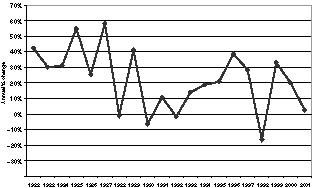
Figure 1. Annual export growth 1982-2001
The value of exports increased from P348 million in 1982 to P8.3 billion in 1996; and to P14.6 billion in 2001. A slowdown in world demand for diamonds between 1990 and 1993 affected overall growth in exports.
Botswana’s exports are concentrated around seven major products: diamonds, vehicles, copper-nickel, meat and meat products, soda ash, hides and skins and live animals, and textiles.
Diamonds dominate Botswana’s exports. From the mid-1980s to the late 1990s, the average annual share of diamonds in total exports was 75% (Table 1). In recent years, the share has increased to 84%. Other traditional exports, such as meat and copper-nickel, have either levelled off or decreased in importance. The share of textiles has also been declining.
Table 1
Botswana’s exports, as percentage of total
|
Product |
1996 |
1998 |
2000 |
2001 |
| Diamonds | 70.97 | 70.26 | 82.73 | 84.84 |
| Vehicles | 13.78 | 10.78 | 1.91 | 2.02 |
| Copper-nickel | 5.37 | 4.89 | 5.84 | 4.08 |
| Textiles | 2.34 | 3.39 | 1.71 | 1.31 |
| Soda ash | 0.84 | 1.10 | 0.69 | 0.88 |
| Cereals | 0.05 | 0.14 | 0.13 | 0.11 |
| Fruits and vegetables | 0.02 | 0.01 | 0.01 | 0.00 |
| Milk and milk products | 0.00 | 0.00 | 0.00 | 0.00 |
| Live animals, meat and related products | 2.85 | 3.76 | 2.17 | 2.96 |
| Other products | 3.78 | 5.66 | 4.81 | 3.79 |
Source: Central Selling Organization.
Botswana’s direction of exports has remained highly concentrated. Until 2000, the United Kingdom, Switzerland and South Africa took up over 90% (see Table 2). The only major change in the direction of Botswana exports was a shift in the destination of diamonds from Switzerland to the United Kingdom.(1)
Table 2
Direction of Botswana’s exports (as a percentage of total exports)
|
1995 |
1998 |
2000 |
2001 |
|
| South Africa | 21.13 | 16.54 | 6.50 | 6.42 |
| Switzerland | 30.75 | 16.33 | 13.33 | 0.01 |
| United Kingdom | 37.26 | 55.59 | 69.92 | 85.83 |
| Rest of the world | 10.86 | 11.54 | 10.24 | 7.75 |
Source: Central Selling Organization.
The share of exports to South Africa has been steadily declining in recent years; in the period from 1995 to 2001, they fell from 21% to just over 6.4%. This has been mainly due to the decline in motor vehicle exports.
Despite several efforts by the government to promote non-traditional exports, Botswana’s export basket remains highly concentrated. The high proportion of diamonds in total exports remains a major concern to both policy-makers and the business community.
II. Local and external players and their roles
The Ministry of Trade and Industry
The Department of International Trade in the Ministry of Trade and Industry is the institution responsible for the overall co-ordination of WTO negotiations. Co-ordination of WTO negotiations is carried out through ad hoc contacts between officials appointed by the relevant ministries and ad hoc meetings with relevant representatives from the public and private sectors (i.e. industry associations selected by the Ministry of Trade). Consultations occur on a needs basis and circumstances determine who is consulted. Consultations are based on briefings by the Ministry of Trade as well as on background papers, draft national positions prepared by the Ministry of Trade, and negotiating proposals from other WTO members.
According to the Advisor in the Ministry of Trade, inter-agency co-ordination is poor due to weaknesses in the Department of International Trade. Other stakeholders share the same view.
The Ministry of Trade and Industry is crucial to
Botswana’s effective participation in the WTO. However, its internal
weaknesses, as well as its poor linkages with stakeholders, make it a
liability in the process. (Executive director, Exporters Association of
Botswana)
The Ministry of Trade is unable to provide guidance to the Geneva mission on issues of interest to the country. This may be attributed to shortage of qualified staff. As a consequence, Botswana’s participation in the WTO is severely constrained. (Permanent Secretary, Ministry of Foreign Affairs)
The Exporters Association of Botswana also complained about the slow response of the Trade Ministry’s staff, the lack of transparency and the inaccessibility of senior ministry officials.
There is a general feeling that the Department of International Trade does not have the necessary capacity and competence to co-ordinate WTO issues. The department has only four people working on international trade issues, including the WTO.
Ministers of trade
The high turnover of ministers of trade is also seen as one of the main reason for weak inter-agency co-ordination on WTO issues. Botswana had six different ministers of Trade in the period between the Singapore Ministerial conference and the Cancún Ministerial conference. The Executive Director of the Exporters Association of Botswana has cited this as a reason for the lack of consultation by the Department of Trade (see above). The high turnover does not provide the necessary political leadership to deal with WTO issues and consult widely.
South Africa has maintained the same Minister of Trade since the Geneva Ministerial (Conference) and you could see that with time his knowledge of WTO issues grew and so was the knowledge of his officers. With us, it is one Minister per WTO Ministerial conference. They always have to catch up but with a weak support structure in the Ministry, we always end up observers. (Director of Planning, Ministry of Agriculture)
Jacob Nkate and Tebelelo Seretse have shown an interest in WTO issues. This has led to the setting up of new structures for consultations on WTO issues. The Cabinet recently approved the establishment of a high-level trade negotiating committee composed of heads of ministries, state organizations and industry leaders.
However, others are sceptical of the new arrangement. They feel that without improving the competence of the officials in the lead ministry — the Ministry of Trade and Industry — the committee will fail to provide the necessary guidance to negotiators and the mission in Geneva.
Non-government bodies back to top
Consultations with non-government bodies occur on a needs basis, and circumstances determine who is consulted. Participants are industry and business associations, and research institutions (e.g. the Botswana Institute for Development Policy Analysis (BIDPA) and the University of Botswana) selected by the Ministry of Trade.
The Ministry of Trade and Industry indicated that they find it difficult to attract sufficient industry interest and attendance at WTO consultations; these consultations normally occur before ministerial conferences and attendance is normally very low. The ministry feels that industry does not see the relevance of WTO negotiations.
However, the industry and other non-governmental institutions feel that the ad hoc nature of the meetings does not warrant the allocation of scarce resources. They also feel that their institutions have little, if any, impact on the preparatory process for negotiations.
Two institutions are key to providing analytical support on WTO issues: the University of Botswana and BIDPA. The University of Botswana indicated that it is not consulted by the Ministry of Trade. The head of the Economics Department stated that
We have never made any formal input into Botswana’s position at the WTO, nor have we been notified of planned changes to current activities and practices. Excessive government control accounts for its inefficiency and ineffectiveness. The department would, ideally, have a role to play, especially in terms of research and analysis. The dearth of analysts to tackle issues related to trade and exports requires that we should seek to venture into this important area (WTO issues).
BIDPA indicates that it is only consulted just before WTO ministerial conferences. Its executive director comments that ‘We would like to collaborate more with the Ministry of Trade on WTO issues and avoid the current ad hoc arrangement.’
Foreign external players back to top
A number of external players are involved in formulating Botswana’s position at the WTO.
SACU
Even though the Ministry of Trade and Industry is responsible for foreign trade and SACU member states are individually represented in the WTO, Botswana’s foreign trade policy has traditionally been determined by South Africa. Under the SACU Agreement, other member states of SACU — Botswana, Lesotho, Namibia and Swaziland — applied import duties set by South Africa and were provided with compensation for surrendering their tariff-setting powers to South Africa. South Africa’s Department of Trade and Industry (DTI) has traditionally formulated and co-ordinated SACU’s trade policy. The Industrial Development Corporation (IDC) — the business arm of the DTI — and the South African Parliamentary Committees assist the DTI in carrying out periodic reviews and assessments of trade polices.
However, the SACU Agreement allows smaller members to make submissions in sectors where they need protection (including protection from South African exports).
Even though South Africa was setting external tariffs for all of us [SACU member states] we were able to protect certain areas of interest to us such as beef. The situation was not as it is portrayed. We could make submissions to South Africa and the submissions were almost always taken on board. In addition, we did not have the necessary expertise and capacity compared to South Africa’s Board of Tariff and Trade to effectively participate in tariff setting. (Secretary for Financial Affairs in the Ministry of Finance, Botswana)
Recently the SACU Agreement has been renegotiated to allow active participation of the smaller member states in the formulation of trade policy. SACU member states are now required to negotiate jointly with third countries and participate in setting common external tariffs. However, there is a feeling that South Africa will take the lead because Botswana and other SACU states have the capacity neither to negotiate a series of trade agreements nor to provide analytical backup.
SADC Council of Ministers and African Trade Ministers’ meeting
The SADC Council of Trade Ministers usually meets before key meetings of the WTO to prepare a regional position, formulated on the basis of country positions. Botswana has traditionally not been very active in promoting positions at the regional level, as it usually followed South Africa’s position.
Once a SADC position has been agreed upon it is taken to the annual meeting of African Trade Ministers which then formulates an African position.
ACP coalition
African, Caribbean and Pacific countries meet before key WTO ministerial conferences to formulate a joint position. Such a coalition ensured the renewal of the Cotonou waiver which was of interest to Botswana. But it also blocked the launching of negotiations on the new issues, of which trade facilitation was of benefit to Botswana. At the Cancún Ministerial Conference, the Botswana Minister of Trade was the spokesperson for the ACP.
III. Challenges faced and the outcome
Considerable capacity is needed for effective participation in the design, enforcement and use of the rules and institutional mechanisms that shape the global economy. As a latecomer to full participation in the trading system and negotiating rounds, Botswana has experienced great difficulty in participating effectively in the WTO processes. The Doha Round presents complex challenges to Botswana: the broadening of the new issues will require additional human and institutional capacity and bring a number of challenges in its wake.
A shortage of staff explains the deficiencies in trade-related expertise and negotiating skills. The country lacks the capacity for effective participation in the negotiation process, and has had a limited impact on the design of the new rules. Knowledge of multilateral and regional trade policies, institutions and agreements is limited. As the WTO process becomes even more complex and technical, it is essential that Botswana develop the capacity to articulate its interests and defend its rights within the WTO framework.
The consensus emerging among the stakeholders who were interviewed is that the Ministry of Trade and Industry, as the co-ordinating ministry on WTO issues, needs to develop an internal capacity by training people to align their skills with the complexity of WTO negotiations. These must come from the non-governmental bodies, government and the private sector.
Trade ministers also tend to be poorly informed on the WTO and regional agreements and rules, and other government officials and private-sector actors tend to be even less knowledgeable. One reason is the high turnover of trade ministers.
Analytical capacity back to top
SADC countries face an enormous task in their efforts to manage the activities arising from the Doha Work Programme. Botswana needs to carry out careful analytical work that identifies what the policy issues are and what Botswana’s interests are in the many areas covered by the Doha Declaration. Such analytical issues must be complemented by a solid empirical foundation that accurately reflects local polices and practices.
There is a need to build greater analytical capacity in the research and policy communities, and ensure that this is designed to increase the number of researchers and analysts in the region who are familiar with modern analyses of trade and trade policy and the operation of the global trading system. Improving the quality of policy analysis will lead to better prepared negotiating briefs, through the preparation of high-quality analytical studies designed to illuminate key trade issues. Improved organization and availability of quantitative and qualitative data on trade-related issues and ‘demand-driven policy analysis’ will assist Botswana in preparing thorough and professional negotiating briefs.
Data limits our ability to do more analytical work on trade issues. For example, the latest trade data we have is for 2001. How do you expect us to advise on the flow of trade? How can you initiate any anti-dumping investigations with a lag of three years? (Johnson Maiketso, BIDPA researcher)
Involvement of other stakeholders back to top
There is widespread recognition of the need to involve a wide range of other ministries in the consultations in order to benefit from their expertise, sectoral knowledge and contacts. The effectiveness of trade policy-making is constrained by limited government and private-sector access to information on international trade developments, issues and agreements. The dissemination of policy-relevant trade information is often inconsistent.
IV. Lessons for others
It is evident that the Ministry of Trade and Industry is key to Botswana’s effective participation in the WTO. Weaknesses within it seem to be the root cause of the absence of formal and effective domestic inter-agency co-ordination. Key stakeholders that would otherwise provide valuable input into Botswana’s participation in the WTO are not consulted. It is therefore important that structures are instituted that will address the problem. These will include:
-
improving capacity within the Ministry of Trade
and Industry;
-
improving inter-government consultation; and
- improving consultation with other stakeholders.
Capacity of the Ministry of Trade and Industry back to top
Lack of capacity in the lead ministry on WTO issues translates into an inability to have effective inter-agency co-ordination. The Department of International Trade should be responsible for the country’s representative office in Geneva. It should be entrusted with the task of inter-ministerial co-ordination of all WTO-related issues, relying on Botswana’s permanent representative at the WTO to establish and maintain relationships with other WTO members and the WTO Secretariat.
The Botswana mission in Geneva requires clear instructions from the capital on the positions that should be taken in WTO meetings; and must be able to channel information and briefings to the Department, which in turn should transfer this to the government bodies affected and other stakeholders.
The mission in Geneva should be large enough to allow participation in all major WTO committees and meetings. The current arrangement, with one junior trade officer, is inadequate. The office should provide the Department with regular information and reports on the positions taken by other WTO members; furthermore, the Department should respond in a timely manner after consulting with all the key stakeholders.
The absence of an information centre in the Ministry of Trade and Industry is one of the reasons for poor dissemination of information to stakeholders. An information centre can be given the task of streamlining information flows within the government and to other non-government institutions on WTO-related issues.
Intra-governmental co-ordination back to top
Co-ordination of government positions for negotiations should be conducted through an inter-ministerial group, which should co-ordinate the different points of view of the ministries with an interest in the negotiating process and elaborate Botswana’s position for WTO negotiations. The group should also follow up on the implementation of agreements reached at the WTO and hold regular meetings and facilitate regular technical exchanges between relevant ministries.
Seminars on WTO issues and processes for ministry officials not directly involved in the negotiations should be organized; this will stimulate the interest of other government departments as they will begin to see their roles in WTO negotiations.
There is need to develop a strong co-ordination process between Geneva and the capital that will include reports, feedback and relevant minutes of meetings sent from Geneva to the capital and the sending of representatives. The inter-ministerial group should invite officials from Geneva, on an ad hoc basis, to brief meetings held in the capital.
Consultation with other stakeholders back to top
There is a great potential for private-sector organizations to contribute to Botswana’s participation in the WTO. For example, the Exporters Association of Botswana is an indigenous business organization with a wealth of knowledge on small to medium-sized business operations; BIDPA has established a reputation for rigorous, thorough and balanced policy research and analysis that informs major public policy initiatives.
Botswana should advocate an open and transparent approach to trade negotiations and use a broad range of consultation mechanisms to seek the views of stakeholders. The Ministry of Trade and Industry should meet frequently with all the stakeholders, including the country’s negotiating team for economic partnership agreements (EPAs) and other regional and multilateral trade agreements, to keep them informed of progress in the negotiations and to answer specific questions they may have. Through the Joint Integrated Technical Assistance Programme (JITAP), Botswana has set up a high-level national trade policy negotiating committee. The committee, expected to meet regularly for an update on all trade negotiations and to plan future trade negotiations, encompasses all relevant ministries and government departments, public institutions, private-sector organizations, NGOs and academic and research institutions. However, the Ministry of Trade and Industry has not provided this committee with the leadership it requires to ensure regular meetings and the exchange of information.
NOTES:
1.- The shift results from an internal
arrangement at De Beers, which exclusively markets Botswana’s
diamonds, and does not reflect a change in demand. In the past all
Botswana’s diamond exports went to Switzerland, but eventually ended
up in London at De Beers’ Central Selling Organization, now the
Diamond Trading Company. back to text
* Senior Research Fellow, Botswana Institute for Development Policy Analysis (BIDPA).

