|
|
|
|
n

|
DOHA DEVELOPMENT AGENDA
back to top
Dr. Supachai: Ministerial support must be translated into Geneva progress
-
Director-General Supachai Panitchpakdi, in his
opening remarks
to the Trade Negotiations Committee meeting on 30 June, said that the
many Ministers he had met since the last meeting have given strong
political commitment to the success of the negotiations. “The onus is
now fairly and squarely on negotiators in Geneva to do the deals that
our political leaders clearly want us to achieve,” he said.
He said: “Since our last meeting, I have attended the Third LDC Trade
Ministers’ Meeting in Dakar, Senegal, the OECD Ministerial meeting in
Paris, the Conference of the African Union Ministers of Trade in
Kigali, Rwanda, the meeting of APEC Ministers Responsible for Trade in
Pucón, Chile and UNCTAD XI in São Paulo, Brazil. I have just recently
returned from an official visit to India where I met the Prime
Minister and key Ministers of the new government. From this intensive
ministerial-level activity, we have a strong political commitment.
However, we still face the problem that it is not being translated
into progress here in the negotiations.”
Dr. Supachai told the negotiators that “to facilitate your efforts to
reach agreement, the General Council Chairman and I will hold an
intensive process of consultation leading up to the meetings of the
TNC and of the General Council towards the end of the month”.
At the UNCTAD XI in São Paulo, Brazil on 14 June, the Director-General
in his speech stressed
that “if we want trade to work as an engine for growth and
development, it is indispensable that we succeed in the Doha Round”.
He added that the negotiations are at “a crossroads, and common ground
must be found quickly”.
On 4 June, he commended negotiators for their success in narrowing
differences in critical agriculture negotiations during the week, but
urged them to make every effort to build on this progress and
cautioned that time is rapidly running out to achieve a framework
agreement in farm trade by the end of July.
> More
-
|
|
n

|
ACCESSIONS
back to top
Members praise Viet Nam’s new offers, but seek improvements and more
clarification
-
The 63 WTO members negotiating a membership package with Viet Nam
praised the Southeast Asian country on 15 June for considerably
improving its market access offers for goods and services, and its
programme for applying WTO agreements.
> More
The seventh meeting of the Working Party on the accession of Algeria to
the WTO was held on 25 June. The Working Party reviewed the state of
play in the bilateral market access negotiations on goods and services,
and examined an Elements of a Draft Report document prepared by the
Secretariat. Some Members indicated that they will be providing
additional comments and questions for the revision of the Secretariat
document. Algeria was requested to keep members updated on developments
on the legislative front, as well as to table revised offers on goods
and services prior to the next meeting.
The Working Party on the Accession of the Republic of Uzbekistan held
its second meeting on 29 June under the Chairmanship of H.E. Hyuck Choi
(Korea).The Working Party continued its examination of Uzbekistan's
foreign trade regime on the basis of additional replies to questions and
checklists or information provided on SPS, TBT and TRIPS. A plurilateral
meeting will be held on 30 June 2004, to discuss domestic support and
export subsidies in agriculture. Uzbekistan will be submitting a
Legislative Action Plan which will be regularly updated and considered
at the next meeting of the Working Party. The delegation of Uzbekistan
met with interested Members bilaterally on the fringes of the meeting of
the Working Party and is expected to table initial offers for the market
access negotiations on goods and services.
-
|
|
n

|
TRADE POLICY REVIEWS
back to top
Members encourage Benin, Burkina Faso and Mali to move ahead with reforms
-
WTO members, at the conclusion of the trade policy reviews of Benin,
Burkina Faso and Mali on 30 June 2004, emphasized trade as a tool for
development and encouraged the three African countries to pursue the
implementation of their reform programmes.
> Trade Policy Review of
Benin
> Trade Policy Review of
Burkina Faso
> Trade Policy Review of
Mali
|
|
 |
Singapore commended as “exemplary” member
-
WTO members, in concluding their trade policy review of Singapore on
16 June 2004, said the openness of its economy has helped it weather
recent economic shocks. They commended Singapore's continuing reforms
aimed at promoting an economy that is “globalized, entrepreneurial and
diversified”.
> More
|
|
n

|
DISPUTE SETTLEMENT
back to top
DSB considers panel requests by the United States and Canada
-
The DSB, on 22 June, considered for the first time two requests for
panels: by the United States to examine Mexican tax measures on soft
drinks and other beverages, and by Canada on US injury determination
concerning hard red spring wheat from Canada. The two requests were
blocked by the respondents.
> More
On 1 June, the DSB adopted the panel report on “Mexico—Measures
Affecting Telecommunications Services” (DS204).
> More
-
|
|
n
|
DEVELOPMENT
back to top
Ten Years After Marrakesh: the WTO and Developing Countries
-
Dr. Supachai Panitchpakdi, in a
speech to a conference
hosted by the Moroccan authorities to mark the 10th anniversary of the
signing of Marrakesh Agreement establishing the WTO said “we should be
immensely proud of the achievements of the last decade. The trading
system has shown its resilience in the face of financial turbulence
and it has contained and resolved over 300 trade disputes between its
Members, providing for greater stability and predictability in global
commercial exchanges”.
Technical assistance for acceding LDCs discussed
-
At the meeting of the Sub-Committee on Least-Developed Countries (LDCs)
on 7 June, members welcomed a Secretariat note “Technical Assistance
for Acceding LDCs”, which provided an overview of the type of
technical assistance required to assist LDCs in their accession
process as well as the type of assistance offered by the WTO and by
other organizations. The need to continue providing assistance to
newly acceded LDCs was underscored.
-
On market access for LDCs, Australia informed the meeting that they
would shortly circulate responses to questions raised at the previous
Sub-Committee meeting where the notification by Australia was
discussed. Canada informed Members that it had extended its General
Preferential Tariff and Least-Developed Country Tariff for a further
ten years and that the list of beneficiaries had been changed.
-
On trade-related technical assistance, discussions were based on the
note prepared by the Secretariat on “Assistance to Address Supply-Side
Constraints”. The document notes that whilst the issue of supply-side
constraints goes beyond the mandate of the WTO, the WTO has tried to
respond through co-operation arrangements with other institutions
including through initiatives such as JITAP and the Integrated
Framework. Members welcomed the note as a good basis for further
discussions on supply-side constraints. Representatives of UNIDO, the
World Bank and ITC briefed Members on how their organisations were
addressing supply-side constraints.
-
Fifth introduction course on WTO for LDCs concludes in Geneva
-
The Fifth introduction course on WTO for the least-developed
countries, organized by the Institute for Training and Technical
Co-operation of the WTO, concluded on 11 June in Geneva.
> More
-
WTO launches first Asia-Pacific trade course in Hong Kong, China
-
The WTO, in partnership with the University of Hong Kong, officially
launched its first Regional Trade Policy Course for Asia-Pacific on 9
June in Hong Kong, China.
> More
|
|
n

|
WTO ACTIVITIES
back to top
-
Among the meetings held in June were the following:
-
The Information Technology Agreement Committee, on 28 June 2004,
agreed to hold the WTO Information Technology Symposium on 18-19 October
2004 in Geneva.
> More
The European Communities announced, at the ITA Committee meeting on 4
June, that its commitment on zero tariffs for ITA products extends to
the enlarged EC membership, including Hungary and Malta, which were not
previously participants to the ITA.
> More
-
The Committee on Trade in Financial Services met on 25 June.
Three WTO Members have yet to accept the Fifth Protocol to the GATS,
namely Brazil, Jamaica and the Philippines. Norway and Turkey submitted
two informal documents for discussion under the item on “Recent
Developments in Financial Services Trade”. The Norwegian submission
focused on the liberalization and regulation of marine and energy
insurance; while the room document from Turkey highlighted e-insurance
initiatives by Turkish insurance companies. Finally, Members continued
their consideration of a proposal on international regulations and
financial services submitted by Antigua and Barbuda on behalf of a group
of Members (Antigua and Barbuda, Belize, Fiji Islands, Guyana, Papua New
Guinea, the Maldives, Solomon Islands, and St. Kitts and Nevis).
-
The Committee on Sanitary and Phytosanitary Measures (SPS), on
22-23 June, discussed a number of specific trade concerns raised by
various members. These included trade restrictions relating to avian
influenza and bovine spongiform encephalopathy (BSE), recognition of
animal disease free and plant pest free status, and various other plant
health concerns. The Committee agreed to procedures for the Second
Review of the operation of the SPS Agreement, and also adopted the sixth
annual report on the monitoring of the use of international standards.
The Committee further considered a number of documents regarding the
implementation of Article 6 on pest- or disease-free areas and agreed to
continue discussions at its next meeting. Other matters taken up by the
Committee included procedures to enhance transparency in special and
differential treatment; technical assistance and co-operation; and
relevant matters arising from the work of observer organizations.
In-depth discussions on issues related to transparency and
regionalization were held during informal meetings on 21 June. The next
regular meeting of the Committee is scheduled for 29-30 October 2004 and
will be preceded by informal meetings on special and differential
treatment, regionalization and on the review of the operation of the SPS
Agreement.
-
The TRIPS Council, on 16 June, took note of the status of
notifications of national laws and regulations by members whose
transitional period had expired in 2000 or who had acceded to the WTO
after that date, as well as of new notifications made under various
provisions of the TRIPS Agreement. The Council took note of the
outstanding material required to complete the pending reviews of the
legislation of 15 Members and of the new responses to certain follow-up
questions. The Council took up the review of the legislation of Armenia.
It continued its discussion of the agenda items on the review of the
provisions of Article 27.3(b), the relationship between the TRIPS
Agreement and the Convention on Biological Diversity, and protection of
traditional knowledge and folklore. > More
(Word document, 2 pages, 41KB).
|
|
n
 |
NEW PUBLICATIONS
back to top
WTO Secretariat publishes its first dispute-settlement guide
-
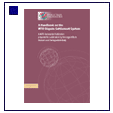
The WTO Secretariat, on 29 June, published
A Handbook on the WTO Dispute Settlement System. “The primary purpose
of this training guide is to explain the WTO dispute settlement system to
an interested person with little or no knowledge of how this system
functions,” according to WTO Legal Affairs Director, Mr. Bruce Wilson, in
his preface.
Report detects shifts in services and agricultural trade patterns
-
International trade patterns have changed in two significant areas over
the past two decades with growth in services trade no longer clearly
outstripping growth in goods, while agricultural trade has shifted away
from commodities towards processed products, according Recent Trends in
International Trade Policy Developments released on 11 June. The WTO
Secretariat report challenges a “general perception that world commercial
services trade is growing faster than trade in goods. Indeed trade in
commercial services expanded faster than goods trade in the second half of
the 1980s, but thereafter the record is mixed,” it says. Broadly, services
and merchandise trade growth have evolved in a roughly similar way since
1990. For 1990–2003, trade in commercial services and goods both grew by
about 6% per year on average, and therefore services’ share of
international trade remained at about 20% over the period. “Overall, there
is no indication that services categories in general have increased their
share in international trade,” the report says.
> More
|