See
also:
> Renato
Ruggiero's
speeches
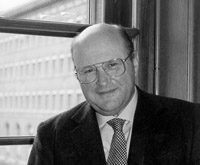
Renato Ruggiero took up his functions as WTO Director-General on 1 May 1995.
Born in Naples on 9 April 1930, he took a degree in law at Naples University in 1953.
He entered the Italian diplomatic service on 10 January 1955, and his first post abroad was at the Consulate-General in Sao Paolo, where he dealt with the problems that accompanied the final waves of Italian emigration to Brazil. In January 1959, he was posted to the Italian
Embassy in Moscow, where he followed the developments that led from the confrontation in Berlin to peaceful coexistence and the normalization of cultural and trade relations between the Soviet Union and Italy. These years saw destalinization and the emerging Sino-Soviet conflict.
In July 1962, he left Moscow for his new post at the Italian Embassy in Washington.
From there, he followed the Cuban crisis in October 1962 and was then given responsibility for continuing to monitor East-West relations and the crisis in Vietnam.
He returned to Rome at the end of 1964 as Head of the Political Affairs Secretariat and in 1966 went to the Italian Embassy in Belgrade with the particular task of following up developments in the communist world after the events of the Prague spring and its tragic repression.
After a short interval in Rome, he embarked in 1969 on the second phase of his diplomatic career, related to the construction of Europe. Posted to the Italian Mission to the European Community in Brussels, he negotiated and concluded the first major agreement on social security for migrant workers. In July 1970, he was appointed Chef de Cabinet of the President of the ‘European Commission, Franco Malfatti, and followed in particular the negotiations on the accession of the United Kingdom, Denmark and Ireland, and the developments that led to the first definition of the European Monetary Union and the launching of the European Union project (Paris, European Summit in 1972).
After a brief period as Political Adviser to the new President of the Commission, Sicco Mansholt of the Netherlands, he was appointed Director-General for Regional Policy.
Together with the European Commissioner, George Thompson, he negotiated and created the European Regional Development Fund.
In 1977, he became the spokesman for the President of the Commission, Roy Jenkins, and helped to launch the concept of the European monetary system and the subsequent negotiations. In 1978, he returned to Rome as Coordinator of Community Affairs at the Ministry of Foreign Affairs and in this post he personally helped to define and negotiate Italian participation in the European monetary system.
He was then appointed Chef de Cabinet of two ministers for Foreign Affairs and during this period, in addition to following European issues personally, he played an active part in the Italian decision to install Euromissiles. As the personal representative of the Prime Minister, he took part in preparing three economic summits of the seven most industrialized countries (G7).
In 1980, he was in charge of preparatory work for the economic summit in Venice.
During the same year he was appointed Ambassador and Permanent Representative of Italy in Brussels and in 1984 returned to Rome as Director-General of Economic Affairs and then Secretary-General of the Ministry of Foreign Affairs. During this period, he was also appointed
Chairman of the Executive Committee in Special Session of the OECD and continued to act as the personal representative of the Prime Minister for a further four economic summits, the last in 1987 again under the Presidency of Italy.
In 1987, he was appointed Minister for Foreign Trade and immediately became involved in trade and currency liberalization, a task which he completed before leaving the Government in 1991.
He then joined the Board of Directors of FIAT, following which he became Vice-Chairman of the International Advisory Board of FIAT, member of the Board of Directors of Kissinger Associated, member of the International Advisory Board of Booz Allen and of a number of other Italian and European companies.
Among the many high decorations conferred on him by foreign governments, he holds an honorary KCMG (Knight Commander, Order of St. Michael and St. George,) awarded to him by H.M. Queen Elizabeth II, the Grand Cordon of the Order of the Sacred Treasure bestowed by the Emperor of Japan, the Knight of the Gran Croce, awarded by the President of the Italian Republic and the Knight Grand Cross of the equestrian order of St. Gregory the Great, awarded by H. H. Pope John Paul II.
Mr. Ruggiero passed away on 4 August 2013.