trade and environment
Director-General: Leverage trade and partnerships to build a resilient ocean economy
More
- Trade and environment
- Fisheries subsidies
- Director-General Ngozi Okonjo-Iweala
 #fisheriessubsidies
- Follow @NOIweala
The ocean is both a vital natural asset and a major source of trade, food security and livelihoods, DG Okonjo-Iweala said, noting that the ocean economy is valued at US$ 2.6 trillion and supports around 133 million jobs, while more than 80% of globally traded goods travel by sea. When it comes to the ocean economy, "there is no trade-off. . If we are to be prosperous, we must be sustainable," the Director-General said, warning that the decline in marine biodiversity threatens the trade, food security and livelihoods that depend on it.
The Director-General pointed out that, despite current geopolitical turbulence, 72 per cent of world goods trade still takes place on WTO most-favoured-nation terms. She stressed that the multilateral trading system has delivered for sustainable ocean development, notably through the WTO Agreement on Fisheries Subsidies. The Agreement, which entered into force in September 2025, is the first WTO agreement with environmental sustainability at its core. It prohibits subsidies to illegal, unreported and unregulated fishing, fishing of overfished stocks, and fishing on the unregulated high seas.
She urged members to complete the remaining negotiations on fisheries subsidies, known as "Fish 2", which would further enhance the disciplines of the Agreement, she said.
DG Okonjo-Iweala also pointed to the importance of helping island and coastal economies move up the value chain in the ocean economy by improving access to technology, skills, infrastructure and finance needed to process products, obtain certification and reach markets.
"Trade already offers tools" for the development of the ocean economy, she said. These include the WTO Trade Facilitation Agreement, which supports rapid cross-border trade of perishable goods; the WTO Dialogue on Plastics Pollution, which is looking into issues such as single-use plastics and access to waste-management technologies; discussions on environmental sustainability and access to goods and services needed for the green transition; and development initiatives such as the Enhanced Integrated Framework and the Standards and Trade Development Facility.
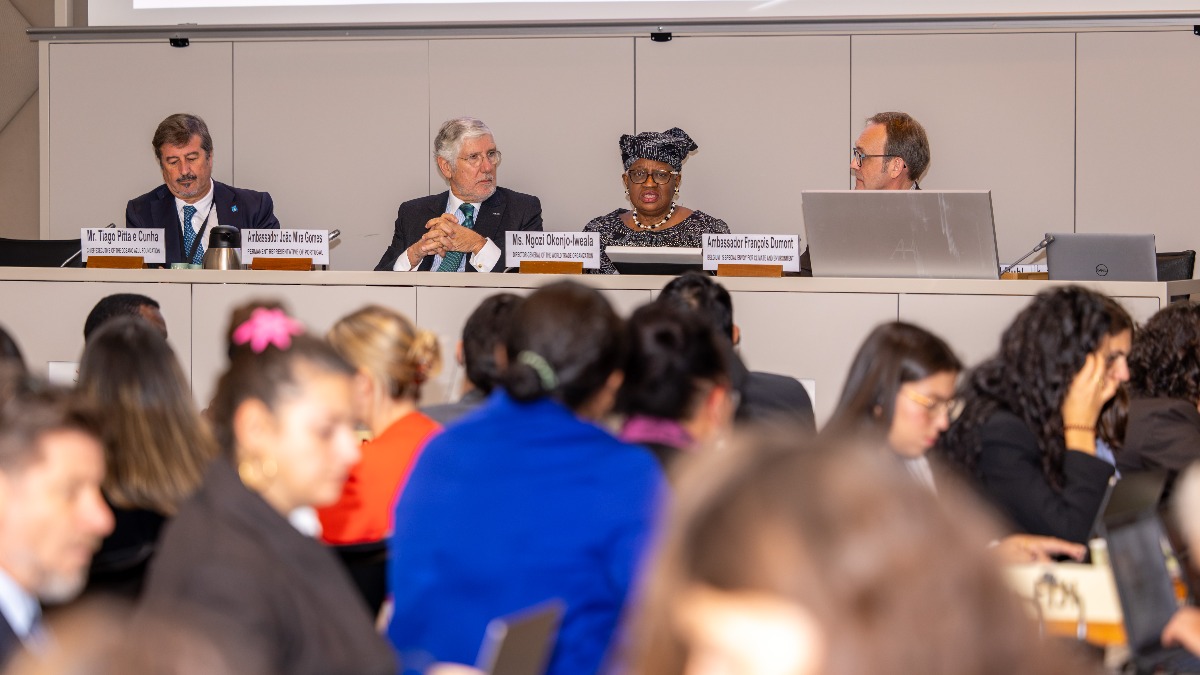
The Director-General highlighted the importance of partnerships for the sustainable development of the ocean economy, such as the Geneva Nexus, an informal knowledge-sharing group established by the Permanent Mission of Portugal and a number of other Missions to the United Nations in Geneva in June 2026. This initiative is focused on addressing issues of ocean governance, trade, biodiversity, health and food security. The organizers have organized sessions with a number of international organizations, namely the World Health Organization (WHO), the Food and Agriculture Organization of the United Nations (FAO), the United Nations Environment Programme (UNEP), the WTO, United Nations Trade and Development (UNCTAD), the World Intellectual Property Organization (WIPO) the International Union for Conservation of Nature (IUCN) and the World Wide Fund for Nature (WWF).
Looking ahead, DG Okonjo-Iweala called on partners to step up efforts and strengthen cooperation, bringing together the various resources available in Geneva and translating connections into action. "We have the instruments. We need to do more. Let's work together and deliver," she concluded.
The DG's speech was followed by a panel discussion with experts from partner organizations of the Geneva Nexus, moderated by Yuvan Beejadhur, Senior Advisor to the Director-General of the WTO.
Share
Problems viewing this page? If so, please contact [email protected] giving details of the operating system and web browser you are using.