- home
- trade topics
- building trade capacity
- aid for trade
- Japan: From seven days to 16 hours: Transforming trade at Kazungula border
Japan
From seven days to 16 hours: Transforming trade at Kazungula border
Ambassador NAGAI Katsuro of Japan shares how Japan’s Aid for Trade support to the One-Stop Border Post (OSBP) initiative advanced the implementation of the WTO's Trade Facilitation Agreement (TFA) and the African Continental Free Trade Area (AfCFTA) in Southern Africa.

Ambassador NAGAI Katsuro of Japan
Why does the Kazungula border matter for trade in Southern Africa?
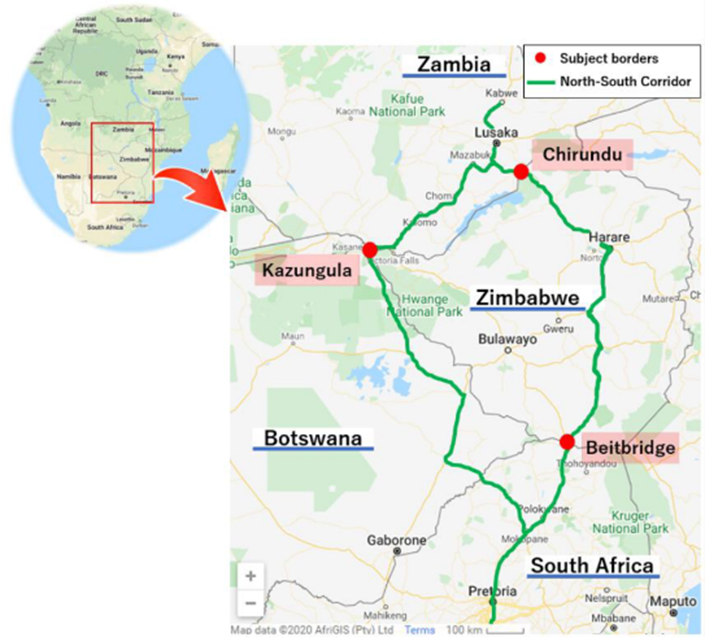
Kazungula is not an ordinary border crossing. It serves as a strategic export channel connecting Southern Africa’s mining hub to major seaports along the North-South Corridor. Copper and other critical minerals originating in Zambia and the Democratic Republic of the Congo pass through this route toward regional and global markets.
What was the challenge before the reform?
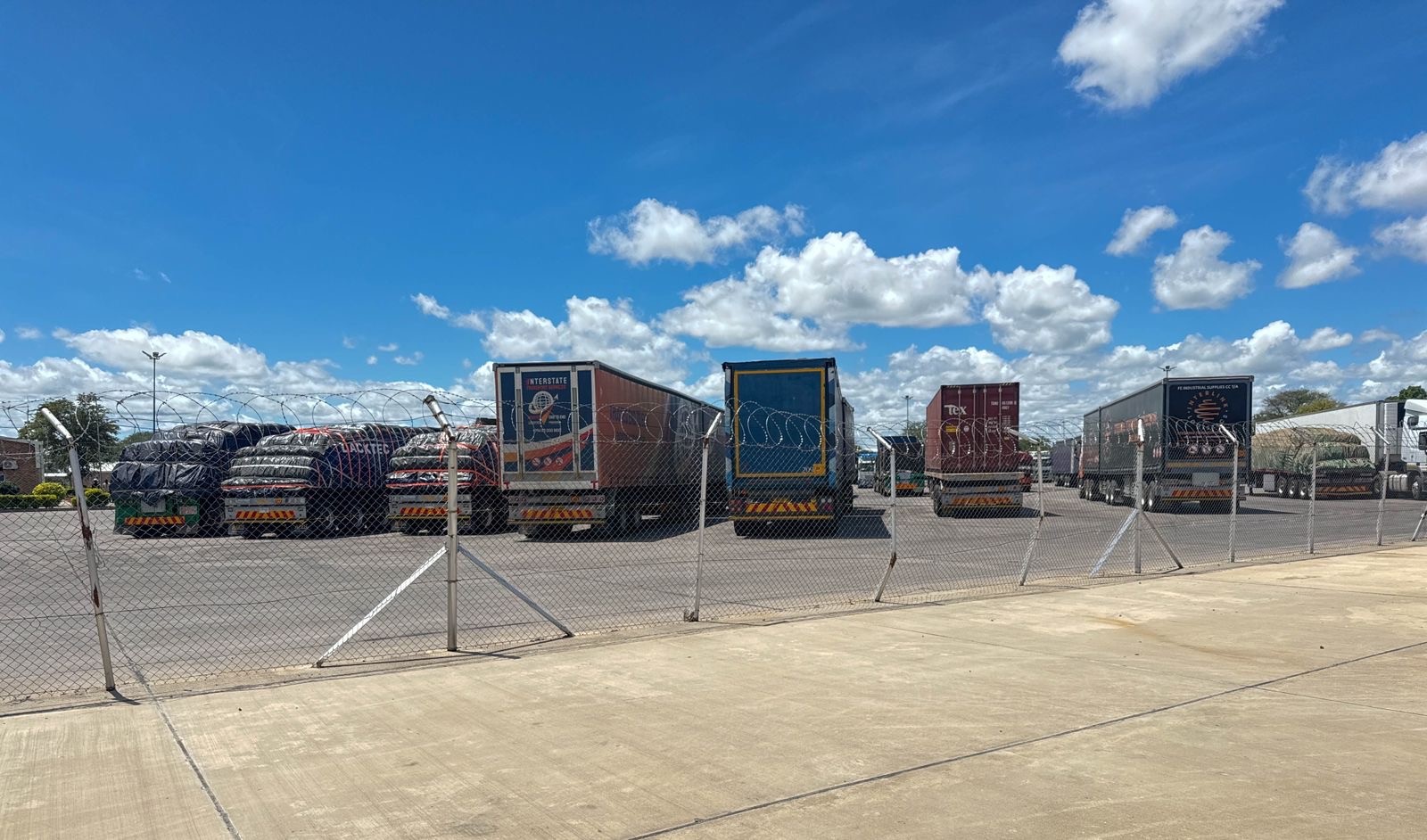
For years, freight operators crossing the Zambia–Botswana border at Kazungula faced waiting times of up to seven days. Trucks carrying goods queued for days because of limited coordination between border agencies, separate border facilities, and lengthy and unpredictable clearance procedures.
For Zambia, as a landlocked and mineral-exporting economy, such delays directly translated into higher transport costs and reduced competitiveness in global markets.
These constraints posed challenges to effective implementation of key provisions of the TFA, especially those related to Article 7 on release and clearance of goods and Article 8 on border agency cooperation.
© Source: JICA
What changed at Kazungula?
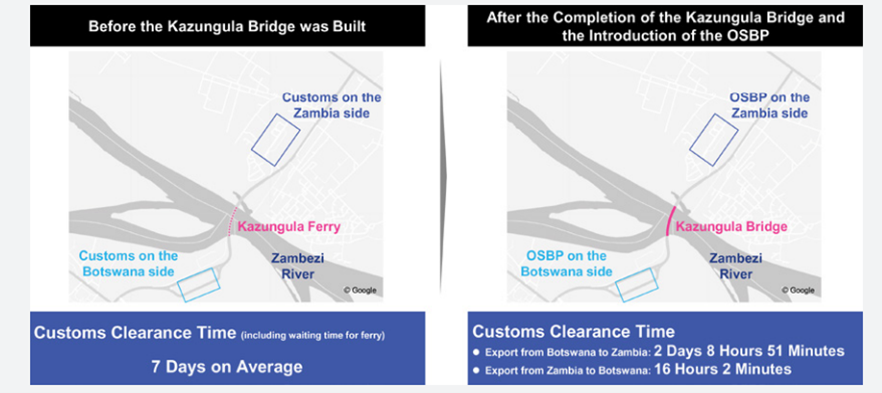
The opening of the Kazungula Bridge and OSBP facilities on 10 May 2021 marked a turning point. The OSBP enables joint processing of customs and border procedures by Zambian and Botswanan authorities within a single facility.
© Source: JICA and AUDA-NEPAD
How did Japan support this transformation?
Japan’s support exemplifies Aid for Trade in action by combining financial, technical and institutional assistance aligned with national priorities for both Botswana and Zambia. The project cost was approximately US$ 259 million, co-funded by the Japan International Cooperation Agency (JICA), the African Development Bank (AfDB), and the governments of Botswana and Zambia.
- First, Japan supported the modernization and operationalization of border infrastructure alongside the Kazungula Bridge project.
- Second, support went beyond physical construction to help harmonize customs procedures, strengthen inter-agency coordination, and support the legal framework needed for the OSBP to function.
- Third, Japan provided technical assistance and capacity building, so customs and border officials could implement coordinated border management in practice.
Through integrated financial, technical and institutional assistance, Japan’s contribution to the Kazungula OSBP offers a practical example of how trade facilitation reforms can enhance competitiveness, strengthen regional integration, and advance sustainable development.
What are some of the results achieved?
The impact is clear according to the OSBP Status Report jointly published by the JICA and the African Union Development Agency (AUDA-NEPAD) in 2024.
Clearance times fell sharply. On the Botswana-to-Zambia route, clearance was reduced from around seven days to two days. On the Zambia-to-Botswana route, it fell from around seven days to approximately 16 hours.
Commercial traffic also increased. After the OSBP became operational in 2021, daily truck traffic rose by about 54 per cent, from roughly 130 trucks per day to around 200 trucks per day.
Most importantly, this increase in traffic did not recreate the previous congestion challenge. Better infrastructure and coordination allowed the border to handle higher volumes more efficiently.
Why is this important for development?
The Kazungula OSBP project shows that trade facilitation is not only about faster paperwork. It can produce wider development gains. By reducing delays and uncertainty, the project lowered trade transaction costs, improved scheduling reliability for transport operators, strengthened corridor efficiency, and enhanced the competitiveness of mineral and non-mineral exports.
For a landlocked developing country, predictability can matter as much as speed. When firms can rely on border clearance times, they can plan shipments better, meet delivery deadlines, integrate into supply chains, and compete more effectively.
© Source: JICA
What are some of the lessons learned?
The first lesson is that there is no one-size-fits-all model. A One-Stop Border Post worked well at Kazungula because it responded to a specific corridor challenge, institutional setting, and trade pattern. Other borders may require different solutions. Trade facilitation challenges differ across regions depending on geography, trade patterns, institutional capacity and policy objectives. So, Aid for Trade interventions must therefore be context specific.
The second lesson is that Aid for Trade must be aligned with national priorities. The Kazungula experience underscores the importance of tailoring Aid for Trade to the specific priorities of beneficiary members. In this case, support for the Kazungula OSBP responded directly to the strategic objectives of both Botswana and Zambia to reduce customs clearance times and improve corridor efficiency. Aid for Trade is most effective when it reinforces nationally identified reform agendas rather than introducing externally designed solutions.
Beyond corridor and border modernization efforts, Japan contributes to continent-wide integration initiatives. These include:
- Critical energy transition minerals: Rapid assessment of value addition and diversification capacity in Southern Africa (UNCTAD)
- AfCFTA implementation support through the United Nations Economic Commission for Africa (ECA)
- Trade Facilitation and Regional Integration Support implemented with JICA and AUDA-NEPAD
Contributed by the Permanent Mission of Japan to the International Organizations in Geneva.