
AI case study
Maersk Global Trade and Customs Consulting
As trade compliance obligations multiply and cross-border data volumes grow beyond the reach of manual review, the trade and customs consulting arm of Maersk has embedded AI across its advisory services, helping importers and exporters identify compliance risks and duty-saving opportunities that conventional analysis may miss.
The Problem
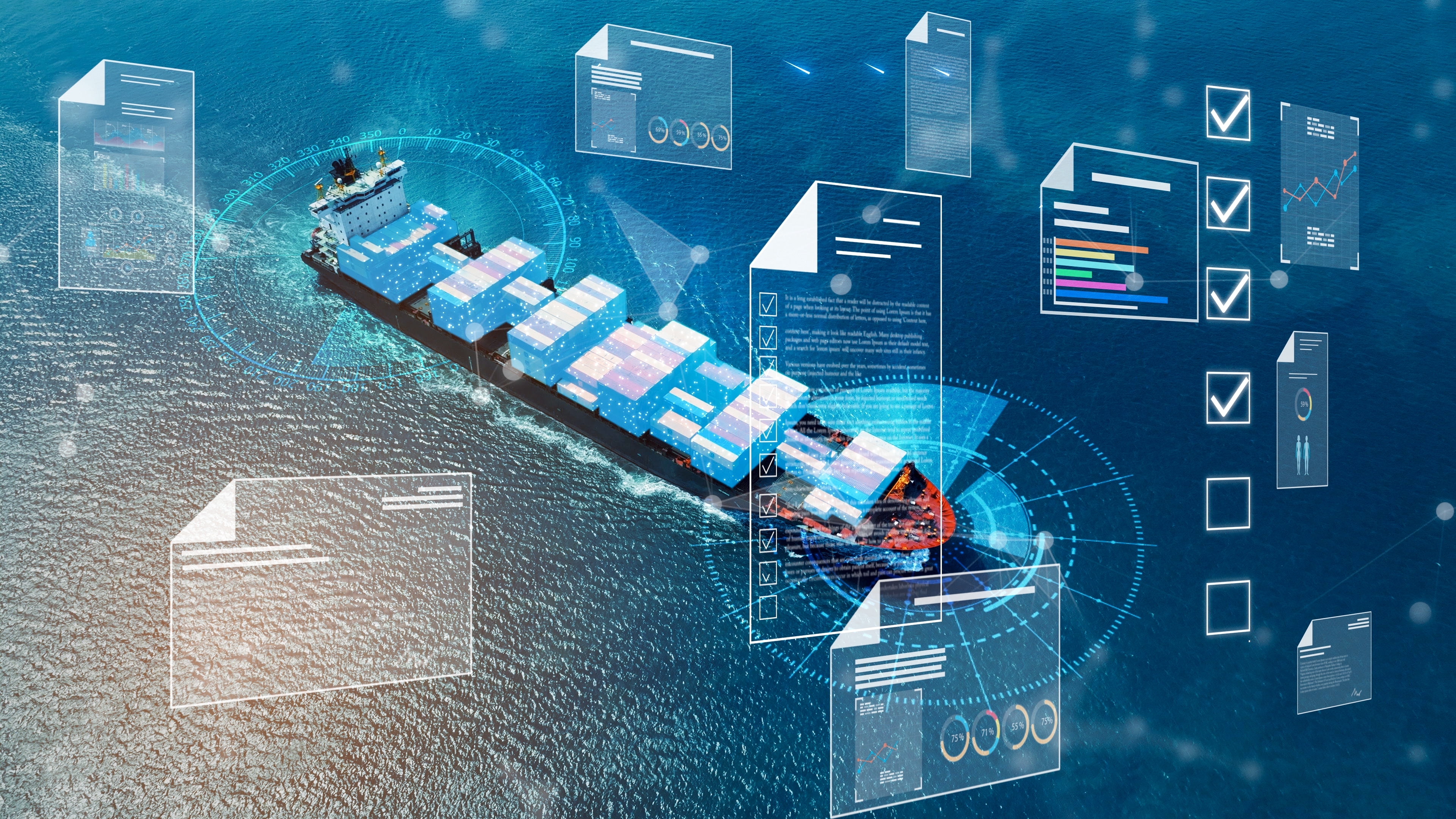
Every shipment generates commercial invoices, packing lists, certificates of origin, transport documents and customs declarations. Behind each document sits a set of compliance determinations: tariff classification, origin, valuation, preference eligibility and, increasingly, exposure to forced labour, sanctions, and environmental regulations.
As it is difficult to review this volume of data manually, the standard approach has been to audit samples. A sampling approach involves periodic review of a subset of declarations, from which broader conclusions are drawn. It is slow, resource-intensive and blind to whatever falls outside the sample, so the greatest risks and opportunities can be missed entirely. Undetected misclassification or incorrect origin exposes companies to penalties, retroactive duty assessments, and reputational damage where exposure of forced labour or sanctions goes unnoticed in upstream supply chains. Importers also fail to claim preferences available under trade agreements because no one has the capacity to check eligibility across every line.
The Solution
Maersk is a global shipping line and logistics integrator spanning maritime, air and inland transport, warehousing, terminals, customs brokerage and supply chain management. Its trade and customs consulting unit advises customers on trade strategy and compliance. Since 2022, the unit has embedded AI into a portfolio of tools and services with customs being one of the first use cases, and it expects AI to be core to their operations in the future.
The portfolio addresses different stages of the compliance workflow. Machine-reading tools extract data from shipping and commercial documents to create customs declarations. Analytical tools scan bulk declaration data at a scale that sampling could not reach, flagging inconsistencies, potential misclassification, incorrect origin and unclaimed preferences. Classification tools generate proposed Harmonized System (HS) codes. Supply chain mapping tools trace goods upstream to identify forced labour, money laundering and sanctions risk; related tools support the calculation of emissions for reporting under the European Union's (EU's) Carbon Border Adjustment Mechanism and the assessment of exposure to the EU Deforestation Regulation (EUDR). Products covered by the EUDR include coffee, cocoa, palm oil, soy, timber, or products derived from them, and importers need to be able to prove that any products it imports to the EU are deforestation-free. The company is also developing tools that allow customers to interrogate their own customs data using natural language.
Human oversight is integrated into these processes. AI outputs follow one of two paths: they are either reviewed and approved by trade experts before delivery to clients (every AI-generated classification, for instance, is verified by a specialist), or they are presented explicitly as risk-prioritization rather than definitive answers, so that client expertise can be directed to the areas identified.
Tools are acquired through a mixed model of specialist third-party providers, in-house development and generic productivity tools, with all processing managed within Maersk's own data security environment. Deployment follows a "super user" model in which some dedicated users, particularly experts in the subject matter, have early access, training and advanced capacity to use the AI tools. Their knowledge and experience then cascade across the organization when more users are onboarded.
Overview
| AI type | Machine learning, document machine reading (NLP), large language model-based natural language tools (in development) |
|---|---|
| Data analysed | Customs declarations, shipping and commercial documents, supply chain and trade data |
| Key customers | Importers and exporters served through Maersk's customs and consulting services across sectors |
| Core functionalities | Document reading and declaration creation; compliance risk and duty optimization analytics; HS classification; supply chain mapping |
| Key markets | Global |
Challenges
Maersk manages these constraints through a governance framework combining security controls, quality assurance of input data, and a human-in-the-loop review policy under which outputs are checked before they reach clients.
Data protection and privacy
Customs and supply chain data constitute commercially sensitive intelligence, and no AI capability is deployed without full assurance on security. All processing, including with third-party tool providers, takes place within a Maersk-controlled environment.
Data quality
AI has made large-scale analytics possible but has not removed the dependency on sound inputs. Significant ongoing effort is required to ensure source data is accurate, structured and accessible before any tool can act on it reliably.
The impact
Efficiency gains
AI-enabled supply chain mapping has substantially reduced the time required to assess forced labour risk. One Maersk customer previously required approximately 100 person-days to map a supply chain and assess its forced labour exposure. The problem with the manual approach is that by the time it is complete, the result may already be obsolete. The AI-enabled service now performs the equivalent analysis near instantaneously and continuous automated mapping keeps the risk picture current. In addition, AI-powered HS classification has not only increased accuracy for customers, but also scalability of major classification projects.
Provision of new services
AI has enabled Maersk to offer new services that it previously could not. The company is now able to perform a full-population analysis of declaration and supply chain data, allowing it to offer proactive advisory rather than reactive, supply chain compliance mapping, support for the EU's Carbon Border Adjustment Mechanism emissions calculations and EUDR risk assessments.
Collecting compliant data from the entire supply chain, origin to destination, using AI-powered compliance screening and controls, makes it possible to provide supply chain visibility for customers and other stakeholders, including border agencies, weeks before goods arrive. This model, the "Passport for Goods", has been pilot tested in multiple markets generating 60 per cent better predictability and resilience, a 40 per cent faster border crossing, reduced carbon emission and food waste – at a 40 per cent lower cost, while at the same time improving government risk management and compliance.
AI enables us to transform the way the border is managed. We can leverage first-hand data from upstream in the supply chain to remove any friction at the border itself.
Glossary
| Large language module | An AI model trained on vast amounts of text data so that it can understand, generate, summarize, translate and answer questions using human language |
|---|---|
| Machine learning | The system learns from past data to make predictions and take decisions. |
| Natural language processing | A branch of AI that enables computers to understand, interpret, generate and respond to human language in text or speech. |
Footnote
This case study is based on Maersk's written interview responses.
← Back to Electronic Commerce and Digital Technologies
Created in September 2026