Directora General Adjunta Jennifer Nordquist
DGA Nordquist: El comercio mundial se está adaptando, no retrocediendo, en medio de una creciente incertidumbre
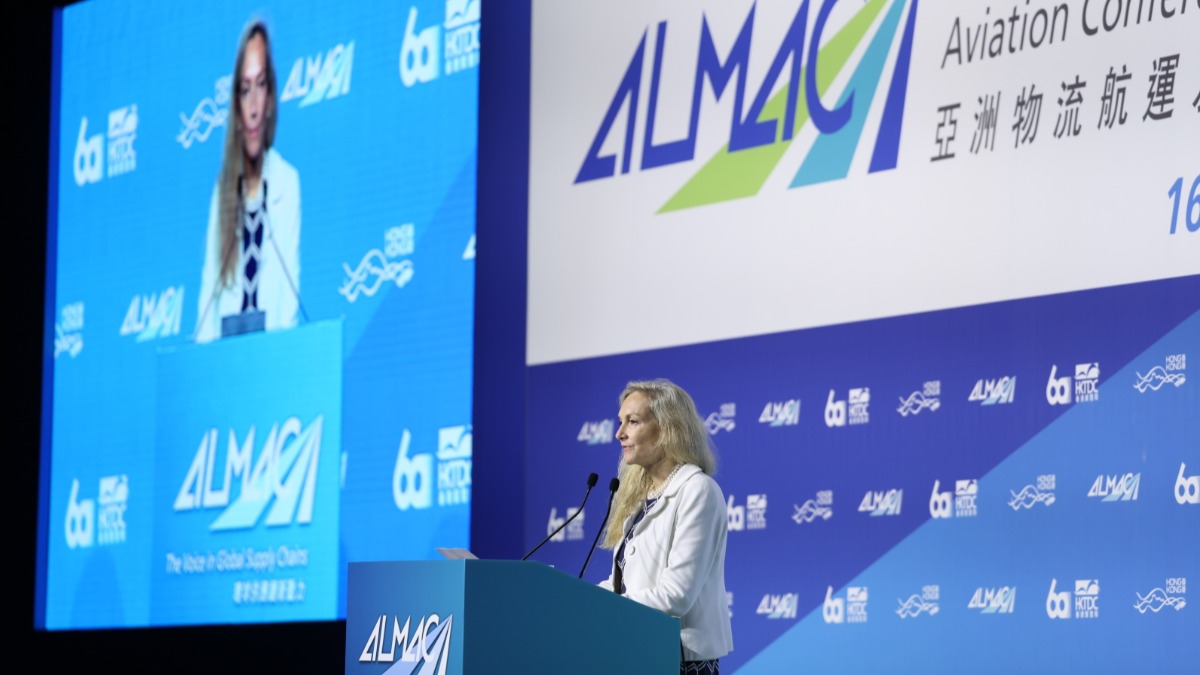
Excellencies, distinguished guests, ladies and gentlemen,
It is a real pleasure to be here in Hong Kong, and I would like to begin by thanking our hosts for their kind invitation and warm welcome.
I looked up a bit of history and was very interested to learn that Hong Kong boasts the most skyscrapers in the world, but you still have set aside 40% of your land area for parks and nature reserves. I also learned that Hong Kong translates to "fragrant harbor," making you one of the only cities named after a smell - which was actually trade in incense! Maybe later today I will even spot some of your famous pink dolphins!
It is actually my first time back in Hong Kong in almost 30 years, which coincidentally is also when WTO came into being. Much has changed over those three decades, both here and in the world around us.
But one thing that has certainly not changed is Hong Kong's remarkable energy, economic dynamism, and its enduring role as a gateway connecting businesses and markets across the world.
I can think of few places more fitting than Hong Kong to discuss the future of global supply chains and international trade. Hong Kong's success as an international trading and logistics hub - your trade to GDP ratio is almost 400 per cent!!! -- is a powerful illustration of how trade can drive growth, create opportunities, and connect economies across borders - objectives that also lie at the very heart of the WTO's mission.
On a side note, I was thinking about the phrase "supply chains" because I feel like it wasn't really a buzzword until fairly recently - it seems to have become popular in the 1990s, just as WTO was being formed. It's actually been around for over a century - it was first used in 1905, and catalogued in the Merriam-Webster dictionary almost a half century later in 1948, just about when the WTO's predecessor, the GATT, as established. So there are some interesting connections in the verbiage and the history of the global trading system under GATT and WTO!
Over the past 3 decades, we have witnessed an extraordinary transformation of global trade: the rise of global value chains, the digital revolution, and changes in economic power. At the same time, we've seen growing geopolitical tensions. Governments are increasingly concerned about economic and national security, and strategic over-dependencies, while businesses are reacting by reassessing their supply chains, which includes by diversifying suppliers and other ways to provide greater certainty in a today's environment.
Yet, despite these pressures, global trade has demonstrated remarkable resilience. I am here to be an optimist!
In 2025, world merchandise trade volumes grew by 4.6 per cent, significantly exceeding earlier expectations -- our economists had initially projected negative growth.
How did it happen? Strong demand for AI-related goods and the ability of businesses to adapt to changing trade conditions.
This resilience has continued this year. According to the WTO's latest Global Trade Outlook, published in October, world merchandise trade volumes are expected to grow by 3.9% in 2026 (more than double the March forecast) and 4.1% in 2027. Meanwhile commercial services trade is expected to grow of 3.3% in 2026 and 6.4% in 2027.
Notably, merchandise trade growth has been outpacing global GDP growth quite significantly for the second year in a row, reversing the trend seen for much of the period since the global financial crisis which was characterized by near parity between trade growth and GDP growth. So we seem to be reverting to the norms of the pre-2008 period, when international trade typically expanded much faster than global economic output.
And this has all happened in spite of the disruptions to energy markets, transport routes, and supply chains. It demonstrates the adaptability of global trade networks and the interconnectedness of the global economy.
So I'd say global trade is not disappearing in the face of uncertainty - it is adapting and evolving.
At the same time, the trade policy environment continues to face challenges.
Our latest WTO Trade Monitoring Report, issued just a few weeks ago, shows that trade policy activity has intensified significantly. I probably don't need to tell you that - you live it every day.
I am going to start with the good news. Our economists found that in the first half of 2026, WTO members introduced 466 trade-facilitating measures, which is more than during all of 2025. Trade facilitation was focused in response to the Hormuz situation -- which is a positive - and different than what we saw in Covid and the Russia/Ukraine war.
On the other hand, in the first six months of 2026 alone, WTO Members and Observers introduced also 333 new restrictive and other non-facilitating trade measures, exceeding the 300 recorded during all of 2025.
The cumulative stock of such import-related measures introduced since 2009 and still in force today is affecting over 21 per cent of world imports, worth some $5.4 trillion.
But if you take a holistic look at the trading system, as our economists have, 72 per cent of global goods trade continues to take place on WTO's most-favoured-nation terms (meaning WTO's standard, non-discriminatory tariff rules, rather than under special preferential trade arrangements).
These findings highlight both the growing pressures on global trade and the enduring importance of WTO rules as an anchor of stability, predictability, and cooperation.
Recent economic shocks have exposed the risks associated with excessive dependence on a limited number of suppliers or markets. Businesses learned that lesson in real time. But resilience should not be confused with isolation or autarky - as my earlier numbers show, trade is alive and well.
The partners may have changed, but the dance continues. I am not sure whether the dance is the Tai Hang Fire dance, a tango, or a ballet. But the music, and movement to it, is still going strong.
WTO research suggests that the most effective response to growing geopolitical tensions and trade changes and disruptions is not to retreat from global markets, but to build more diversified, flexible, and resilient trade networks.
And we are seeing signs of this diversification.
According to our research, the share of global value chain trade accounted for by the 10 most integrated economies declined from 76 per cent in 2010 to 64 per cent in 2024, as emerging economies expanded their participation in international production networks.
Trade facilitation has made a real difference.
The WTO Trade Facilitation Agreement is a powerful example of how multilateral cooperation can deliver practical results. (And I should mention that Hong Kong has been a pioneer in this area. It was the first WTO Member to formally accept the Agreement, which entered into force in 2017, and has been at the forefront of putting its provisions into practice.)
By simplifying and modernizing border procedures, the Agreement helps reduce frictions like trade costs, it improves connectivity, and is facilitating the movement of goods across borders. These benefits are particularly important for developing economies and small businesses seeking to participate in global value chains.
We've seen the results. Thanks this this agreement alone, there has been a 5% increase in global agricultural trade and 1.5% increase in manufacturing trade
The ongoing second review of the Agreement offers an opportunity to build on this progress, address remaining implementation challenges, and explore how digitalization and closer public-private cooperation can further enhance its effectiveness.
And this brings me to the role of policymakers and business leaders.
- For policymakers, the priority must be to maintain fair trade policies, invest in infrastructure, simplify border procedures, and strengthen international cooperation.
- For businesses, it means diversifying suppliers to derisk overdependence on just a few markets, embracing digital technologies, and building partnerships and networks across new markets.
Together, these efforts can help ensure that supply-chain transformation and diversification delivers not only greater resilience, but also more opportunities for broad-based growth.
Bringing more developing economies and small businesses into global value chains can expand economic opportunities while also creating additional sources of supply and greater flexibility, which should also benefit consumers.
The WTO remains an essential platform for this effort, bringing together economies with different interests, priorities, cultures, and levels of development to find common solutions. At the same time, WTO continues to provide major trading economies with an important forum to shape global trade rules, advance their commercial interests, and head off trade tensions.
This is also why reform of the WTO matters. Members - the 166 economies that comprise the WTO -- need to make the organization more effective, responsive, and better equipped to address today's trade challenges and realities of the current system, while ensuring that all Members, big and small, developed and developing, can benefit from the opportunities that global commerce offers.
The task is not to preserve yesterday's trading patterns. It is to ensure that the multilateral trading system evolves to meet the needs of today's fast-moving and ever-changing global economy.
Thank you. I wish you all a successful conference and many engaging and productive discussions.
Compartir
Si tiene problemas para visualizar esta página,
sírvase ponerse en contacto con [email protected], y proporcionar detalles sobre el sistema operativo y el navegador que está utilizando.