

Geneva,
11-13 September 2002
JITAP management meeting
SEE
ALSO:
> press
releases
> news
archives
> Supachai
Panitchpakdi’s speeches
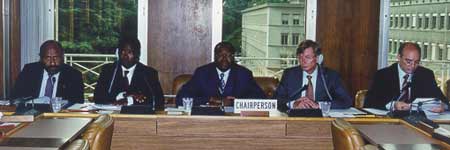
A three day intensive management meeting to discuss the progress of work on the Joint Integrated Technical Assistance Programme (JITAP) was held at the WTO, from 11 to 13 September 2002. This first programme by the three principal trade related Technical Assistance agencies marks a watershed in the area of Trade Related Technical Assistance. Since 1998, JITAP has been, and continues to be, implemented in eight African countries, namely Benin, Burkina Faso, Côte d’Ivoire, Ghana, Kenya, Tunisia, Uganda and the United Republic of Tanzania. Thirteen donor countries are supporting the programme with about 10 million US dollars. Donors are Austria, Belgium, Canada, Denmark, Finland, France, Germany, Ireland, The Netherlands, Norway, Sweden, Switzerland and the United Kingdom.
JITAP was an experiment aimed at reducing marginalization of African countries in the world economy, through capacity building at the three key levels: government, institutions, and enterprise. It laid the foundation for a “bottom-up” approach towards the development of national capacity to participate in the multilateral trading system, and for the formulation of implementable export strategies at sector level by involving all stakeholders.
The programme was evaluated recently and the experiment was confirmed to be an outstanding success. It was described as “probably the most high-profile technical assistance programme in the world”, with significant achievements to its credit. The evaluation recommended the extension and expansion of JITAP. The utility of the programme was confirmed by the eight partner countries at the meeting. The agencies are now working on putting together a programme document for a new phase to commence in January 2003, to cover a larger number of countries in Africa.
Mr. Ablassé Ouedraogo, Deputy Director General of the WTO who chaired the meeting, highlighted that the Doha Declaration places the interest of African and other developing countries at the heart of the WTO work programme.
Mr. Carlos Fortin, Deputy Secretary General of UNCTAD, underscored the importance of JITAP as a unique programme in TRTA. The three Geneva-based trade agencies interact jointly with the beneficiary countries and donors in developing capacities to benefit from the multilateral trading system
Mr. Joseph Smadja, Deputy Executive-Director of ITC, noted that offer and demand for TRTA has increased tremendously and is a built-in component of the Doha work programme.
The meeting was attended by high-level officials from the African partner countries and by representatives of the donors funding the current programme. All participants made constructive contributions for the design of the new JITAP programme.