

TARIFF NEGOTIATIONS IN AGRICULTURE
Reduction methods
Making sense of ‘fixed percentage’ and ‘harmonizing’ cuts, the ‘Uruguay Round’ approach, and Swiss formulas
A variety of methods are possible for negotiated tariff reductions. Some
are more common than others. Some are based on formulas. Even after a
method or combination of methods has been agreed, the final outcome for
each product can depend on bargaining between countries over the tariff
rates for those specific products.
> Back to the agriculture negotiations backgrounder
This briefing document explains current agricultural issues raised before and in the current negotiations. It has been prepared by the Information and Media Relations Division of the WTO Secretariat to help public understanding about the agriculture negotiations. It is not an official record of the negotiations.
Single rate: Tariffs are cut to a single rate for all products. Theoretically, this is the simplest outcome. In practice it is mainly used in regional free trade agreements where the final tariff rate is zero, or a low tariff, for trade within the group.
Flat-rate percentage reductions: the same percentage
reduction for all products, no matter whether the starting tariff is
high or low. For example, all tariffs cut by 25% in equal steps over
five years.
Uruguay Round approach: The 1986-94 Uruguay Round
negotiations in agriculture produced an agreement for developed
countries to cut tariffs on agricultural products by an average of
36% over six years (6% per year) with a minimum of 15% on each
product for the period.
Harmonizing reductions. These are designed principally to make steeper cuts on higher tariffs, bringing the final tariffs closer together (to “harmonize” the rates):
- Different percentages for different tariff bands. For example, no cuts for tariffs between 0 and 10%, 25% cuts for tariffs between 11% and 50%, 50% cuts for tariffs above that, etc. A variation could include scrapping all tariffs below 5% which are sometimes seen as a nuisance with little benefit. These could be simple or average reductions within each band.
- Mathematical formulas designed to make steeper cuts (i.e. higher percentage cuts) on higher tariffs. One example is the so-called Swiss formula (more below).
Other methods. There are a number of possibilities:
- Different rates for different categories of products. For example steeper cuts on processed products than on raw materials. This is an attempt to deal with “tariff escalation”, where countries protect their processing industries by making imported raw materials cheap and imported processed products expensive.
- Combinations of any of these.
THE ‘URUGUAY ROUND APPROACH’
> back to top
Example using 36% average cuts over six years (6% per year)
Negotiate a specified average percentage reduction in tariffs over a specified number of years with the flexibility of a smaller minimum reduction for individual products This was the approach eventually adopted in the 1986–94 Uruguay Round agriculture negotiations.
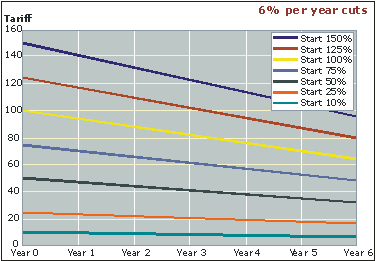
The approach has two features:
- the flat-rate percentage reductions lead to gentler cuts on high tariffs and a broader range of final tariffs than a harmonizing method such as the Swiss formula (see chart);
- the combination of average and minimum reduction figures allows countries the flexibility to vary their actual tariff reductions on individual products (technically described as “tariff lines”) — even if the average cut is 36%, some cuts will be more, some will be less, and it is possible that no single tariff is actually reduced by that amount.
The chart and table below show that where tariffs start high the
final rates are still quite high: a 36% reduction from 150% leaves a
final rate of 96% in year 6. Only when the starting tariffs are low
do the final tariffs have rates close to the Swiss formula (as in
the example): if the tariffs start at 10% and 25%, the rates in year
6 are 6.4% and 16%. The range of final tariffs, from 6.4% to 96%,
remains wide.
The 36% figure is one used in the Uruguay Round, although the
Uruguay Round approach could use different figures. However it was
for average tariff reductions — 36% over six years, for
developed countries, with a separate average target of 24% over 10
years for developing countries.
|
|
Starting tariff 150% |
Starting tariff 125% |
Starting tariff 100% |
Starting tariff 75% |
Starting tariff 50% |
Starting tariff 25% |
Starting tariff 10% |
| % cut | 36 | 36 | 36 | 36 | 36 | 36 | 36 |
| Year 0 | 150.00 | 125.00 | 100.00 | 75.00 | 50.00 | 25.00 | 10.00 |
| Year 1 | 141.00 | 117.50 | 94.00 | 70.50 | 47.00 | 23.50 | 9.40 |
| Year 2 | 132.00 | 110.00 | 88.00 | 66.00 | 44.00 | 22.00 | 8.80 |
| Year 3 | 123.00 | 102.50 | 82.00 | 61.50 | 41.00 | 20.50 | 8.20 |
| Year 4 | 114.00 | 95.00 | 76.00 | 57.00 | 38.00 | 19.00 | 7.60 |
| Year 5 | 105.00 | 87.50 | 70.00 | 52.50 | 35.00 | 17.50 | 7.00 |
| Year 6 | 96.00 | 80.00 | 64.00 | 48.00 | 32.00 | 16.00 | 6.40 |
| Annual steps (%age points) | 10.80 | 9.00 | 7.20 | 5.40 | 3.60 | 1.80 | 0.72 |
| Comparison: Swiss formula, year 6, with coefficient=25 | 21.43 | 20.83 | 20.00 | 18.75 | 16.67 | 12.50 | 7.14 |
THE SWISS FORMULA
A SPECIAL CASE OF A HARMONIZING FORMULA TARIFF CUT
Back to top
Negotiate a much narrower gap between high and low tariffs
with a built-in maximum tariff Greatly
narrowing the gap between high and low tariffs is called harmonizing
the tariffs. The “Swiss formula” is a special kind of harmonizing
method. It uses a single mathematical formula to produce:
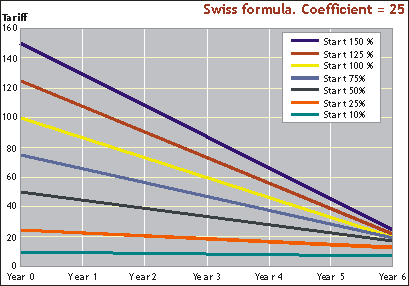
- a narrow range of final tariff rates from a wide set of initial tariffs
- a maximum final rate, no matter how high the original tariff was.
Usually the required cuts are then divided into equal annual steps.
The forumula was proposed by Switzerland in the 1973–79 Tokyo Round
negotiations. But Switzerland opposes using this method in the
current agriculture negotiations; it prefers the Uruguay Round
approach, while Uruguay prefers the Swiss formula!
A key feature is a number, which is negotiated and plugged into the
formula. It is known as a “coefficient” (“A” in the formula
below). This also determines the maximum final tariff rate.
The formula
|
Z = AX/(A+X) |
where
X = initial tariff rate
A = coefficient and maximum tariff rate
Z = resulting lower tariff rate (end of period)
from Walter Goode: “Dictionary of Trade Policy Terms”, Centre for International Economic Studies, University of Adelaide
> See also “Mathematically speaking”
Back to top
Example
How a Swiss formula with a coefficient of 25 works over six years
The coefficient of 25 also defines the maximum tariff at the end of the period.
| Starting tariff 150% |
Starting tariff 125% |
Starting tariff 100% |
Starting tariff 75% |
Starting tariff 50% |
Starting tariff 25% |
Starting tariff 10% |
|
| Coefficient | 25 | 25 | 25 | 25 | 25 | 25 | 25 |
| Year 0 | 150.00 | 125.00 | 100.00 | 75.00 | 50.00 | 25.00 | 10.00 |
| Year 1 | 128.57 | 107.64 | 86.67 | 65.63 | 44.44 | 22.92 | 9.52 |
| Year 2 | 107.14 | 90.28 | 73.33 | 56.25 | 38.89 | 20.83 | 9.05 |
| Year 3 | 85.71 | 72.92 | 60.00 | 46.88 | 33.33 | 18.75 | 8.57 |
| Year 4 | 64.29 | 55.56 | 46.67 | 37.50 | 27.78 | 16.67 | 8.10 |
| Year 5 | 42.86 | 38.19 | 33.33 | 28.13 | 22.22 | 14.58 | 7.62 |
| Year 6 | 21.43 | 20.83 | 20.00 | 18.75 | 16.67 | 12.50 | 7.14 |
| Annual steps (%age points) | 21.43 | 17.36 | 13.33 | 9.38 | 5.56 | 2.08 | 0.48 |
| % cut over 6 years | 85.71 | 83.33 | 80.00 | 75.00 | 66.67 | 50.00 | 28.57 |
| Comparison: Year 6 “Uruguay Round” cut | 96.00 | 80.00 | 64. 00 | 48.00 | 32.00 | 16.00 | 6.40 |
Mathematically speaking …
How the Swiss formula coefficient defines the maximum final tariff:
From the formula, Z=AX/(A+X),
as the initial tariff X rises to infinity, X/(A+X) approaches 1,
resulting in Z=Ax1.
More on tariff cutting formulas:
There are many other approaches to tariff cutting formulas. See WTO document TN/MA/S/3/Rev.2, “Formula Approaches to Tariff Negotiations” (revision), 11 April 2003, prepared by the Secretariat for the non-agricultural market access negotiations.