

2
septembre, 2002, Genève
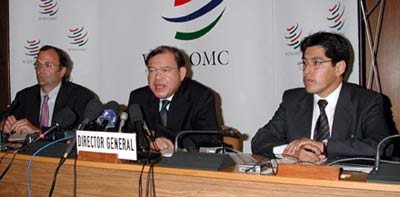
WTO Director-General Supachai Panitchpakdi's first press conference
VOIR
AUSSI:
Communiqués
de presse
Nouvelles
Director-General: First of all, let me say how much honoured I feel to have been given the opportunity to serve this important organization. It is also a source of major pride to be able to participate and be involved with some of the historic events that are taking place within the new work agenda, the Doha Development Agenda. The WTO itself is gaining in importance because of the mandates that have been given to us, because the new mandates that have been given to us from the Doha Ministerial Conference, because of the future challenges that will be confronting us in several aspects not only in terms of breaking into new paths, in gaining more opportunities for all membership to trade more openly and more intensively with one another with less and less impediments in any forms to trade.
Avenues are opening up for us to be working closely with various other organizations so that we can harness the process of globalization that can generate benefits for all concerned, that we can help those who still lag behind to get on board and to be able to partake in the process of globalization so that they will gain in terms of their own benefits, upgrading their quality of life, enhancing the opportunities for gainful employment and having the kind of environment that we would like to see being improved.
This morning, I have had the opportunity to meet with our staff, the incumbent, present Deputies Director-General, who have been very helpful together with the former Director-General, Mr Mike Moore, in giving me all kinds of meticulous assistance to facilitate the transition process since the beginning of this year. It has been seamless, it has been most efficient, and to all of them, the former Director-General and the present Deputies Director-General, I would like to emphasize my sincere appreciation.
One of the most urgent issues that I intend to undertake is to see to it that we move into the phase of substantive negotiation under the Doha Development Agenda as soon as we can, as intensively as we can, as productively as we can. I intend to be actively involved in a way that I can help with the negotiating groups, to monitor the progress and to lend all my assistance to guarantee that progress helps us to meet all the deadlines, and I would like to emphasize again that deadlines are important if we want to make this a successful and efficient round. We have little time to waste, we have actually no time to waste, so every bit and pieces of time that can be spent to advance the cause of the substantive negotiations, to come up as quickly with the substantive proposals, this is really my most immediate task.
Apart from this, I will be tasking my deputies, the four deputies, to have concrete and clear-cut areas of responsibilities. There will be four major areas of responsibility that will reflect my own programme, my own principles in managing this Organization. First is in the area of legal affairs. I hope to assign one of the Deputy Director-Generals to work in the areas of legal affairs, to improve the kind of activities that would be as helpful as possible to the Members to avoid conflicts, to be able to abide by the rules at all times, to be able to have the kind of interpretation of the rules in a way that it would help to resolve any conflicts and to be able to make use as much as we can of the consultation process to prevent the conflicts from becoming too costly and too time-consuming to solve.
The second area of responsibility that I will assign to one of the Deputies is the area of the strengthening of our Organization and our institution, meaning both the Secretariat, the staff and also the trading system. I hope to be holding some sessions with the staff members of the Secretariat so that we can determine the need to strengthen and if needed to restructure the system, to improve as much as we can the work that we can do to serve our membership.
The third area in which one of the Deputy Director-Generals will be tasked to work on is the area of technical assistance, which I see that is needed to be continued beyond the Doha Development Agenda. The Doha Agenda is meant to have the short-term effects in helping countries to be adequately equipped to participate in this new work programme but I perceive that beyond the Doha Agenda, we will be needing to continue with our trade-related development programmes so that countries that still lag behind could be helped to narrow the gap in catching up.
The last area of responsibility will be the area of coherence of policies between our own institution and other organizations because my opinion is that in order to be able to make real use of trade for sustainable development, the WTO would need to be working in tandem with other responsible organisations like the World Bank, the UNCTAD, the IMF, the UNDP, ILO, WHO, and so on and so forth, and not working only from time to time, but to be always in touch with one another, to be jointly developing certain programmes that we could enhance the instruments of trade for sustainable development.
So this will be the work programme, the programme that I have set for myself and that I would ask the responsible Deputy Director-Generals to take care of and the allocation of divisions under the supervision of each Deputy Director-General will be structured according to this allocation of responsibilities.
I will have three years to work, three years is not
a very long period of time because we have so many tasks on our hands
and ahead of us and so I would need to be as clear as possible as to
the directions in which I will be going and certainly many of the
things that I have said, many of the things that I will be proposing,
I will be in close touch with the Membership so that we can do our
best, I can do my best to serve the Membership and that, if permitted,
I would like to take the opportunity to also make some proposals so
that we can improve our own institutions in due time, but certainly I
will build on the achievements that Mr Mike Moore and his team have
been building up for me and I have been very fortunate in that several
things that have been done have helped to reduce the burden for me
that I am sure with my team that we will continue with this good work.
Questions. Mr Fuji, please.
Mr Yasushi Fuji, Kyodo News: Dr Supachai, given that there are wide views on how to conclude the new round, do you think that it is realistic that we can complete the process by the end of the year 2004? Secondly, can you confirm that you have appointed Mr Stuart Harbinson as your chef de cabinet and also he will stay on as Chairman of Agricultural Negotiations?
Director-General: I have said repeatedly that for the Doha Agenda, all of the major issues have already been well-known, that there are only some really new issues, even the new issues are not really new issues, they are issues that have been studied before and considered before, so because of this fact; I hope and I expect that countries which of course are well-acquainted with all these issues will be able to make decisions sooner rather than later, which is a different point from the past. I would also expect that the present pressure for the global community to move forward with our multilateral undertaking will still be with us for the next few years.
We need to be able to make successful use of our multilateral means and the pressure will be on us to make it successful and so I hope again that there will be enough flexibility at the end of the day to move into a successful conclusion by the year 2004, but all this of course depends on the preparations which I hope that we will be able to consult with the Members so that we can devise the best optimum use of the time that we have left which is not very long.
Mr Harbinson's appointment to the director of the office of the
Director-General partly also assuming the role of a chef de cabinet
within his directorship role but as he is also at the same time
conducting the meetings of the Agricultural Committee for the time
being, I see no reason at the moment to do anything to that because it
should be actually up to the Members to decide what Mr Harbinson
should be doing. Actually, Mr Harbinson would have a lot of work to do
within the Secretariat himself, he would have a lot of things to do in
the Secretariat. You can imagine from the things that I have said, the
four pillars that I talked about, Mr Harbinson will have quite a big
role to play there, so we have discussed this and if the Membership
deems that Mr Harbinson should continue in his role as the Chair of
the Agricultural Negotiating Committee, then I see no reason why he
should not continue, but it is up to the Members but in fact, Stuart
himself would have quite some hard time in allocating his time for the
Secretariat and the work for the Committee.
Naomi Koppel from AP: You talk about building on the work of Mr Moore but then you are talking about what sounds like a major reorganization of the WTO Secretariat. Mr Moore has already basically done one of those. Are you actually building on his work or are you starting again from scratch and if so, what is the problem with his reorganization?
Director-General:Well, I don't think I will start with a wholesale reorganization but I have in mind a bit of a restructuring of the Organization. Firstly, whether we can find ways and means to be as responsive as possible to the Members' demands and I am thinking in the areas of, for example, research work. Research work which would help to enhance the understanding of some issues, mainly the controversial ones. So, this is one area that I am thinking of.
Another area that I have been
thinking of is probably the area of having involvement of our staff in
a way that it would make their involvement as efficient, as productive
as possible. For example, you must have heard my proposal in the past
that I have suggested that we should be looking for an opportunity to
have a WTO presence in Africa and this is of course just an idea
because I know that we will be needing to do a lot of work in Africa
and our staff will have to be travelling a lot to Africa and I was
hoping that we could probably more efficiently tackle this issue if we
would have a focal place, a location wherein the host countries would
be able to help support this kind of an office, that we don't have to
put up the budget ourselves and so it could limit the time spent in
going around and concentrate the efforts to channel our information,
documentations, training courses to particular areas like that, so
this is some sort of an idea that I think we may like to do to improve
our own Organization, so it is not really a reorganization as such, as
more really some additional restructuring work that will need to be
done.
Bob Evans, Reuters:Dr Supachai, I understand Mr Moore has recommended to the General Council that they look at the possibility of extending the mandate or the powers of the Director-General, and in that light and given some of your earlier statements this year, I wonder whether you see yourself as being ready to step into major disputes, offering arbitration or for example the FSC, which looks as if it could be a very serious one, or the steel disputes? And one further question, slightly unrelated, I wonder if you have any ideas on how you can calm fears about globalization and how will you handle the anti-globalization movements?
Director-General:Well, I certainly would like to concur with Mr Moore on the need to enhance the authority, the mandate for the Director-General, if only for the fact that the Director-General and his Secretariat will be tasked and have been tasked to do so many things that would need for the Director-General and the staff to take certain actions in time. Of course, expanding the mandate doesn't mean the executive power. It means the role that the Director-General should play in communicating, like I said, in enhancing coherence with other institutions. There should be some kind of authority there to be able to work concretely, constructively, with other Organizations. I would imagine that kind of a enhancement that would be needed.
I also look forward, as you said, that we should be around to help avoid conflicts from coming to a head and to be handled always through the litigation means. I certainly would like to improve on the record that more than half of the cases of complaints that are being submitted to the Secretariat could be resolved by consultations and not by panels. Of course, panels have been doing a marvellous job but I think we need to save the time, we need to save the cost, we need to preserve the amicable relationship, particularly in the next couple of years when we would need a lot of goodwill to be able to achieve the difficult, challenging tasks of the Doha Round, so I would not say that we would step into the role of a mediator right away without preparing ourselves, without consulting with the Members as to how the mediator role would be seen by the Members. I don't think that I would have that kind of an ambition but I think if we can structure the work of the office of the Director-General in a way that there would be enough back up from the Members for us to step in that role, and if we could provide for neutral options then I think I would be willing to do that. I am willing to do that only when the Members would see fit that we can fill that gap but otherwise I would certainly not step in there.
In allaying the fears for globalization and anti-globalizers, you know my past proposals in that I intend to formalize the way we communicate with the outside world. Mr Mike Moore has started the process on the right note. I would continue with that process and I would certainly widen the participation and make it probably a more, let's say a regular sort of event in that we would invite parliamentarians, NGOs, business sector representatives, to have from time to time consultations with us on specific items, specific agendas and of course this will be just an exchange of views and information but I hope to create by doing this on a regular basis, to create more understanding and to shed more light on what we are doing under the roof of the WTO and to eliminate the kind of criticism that we have been a bit secretive in our work here.
I think we will try to do our best to open up. I don't think we can just only explain how good trade could be for each country alone without really showing them the successful cases, so I have already asked our colleagues to look into some of the examples for the successful cases so that we can demonstrate to the representatives of the civil societies that of course we can help solve some of these issues and of course involvement with other institutions, with other organizations will also be a means to allay the fear that we are not really trying to push for the process of globalization at all costs, not at all costs. We will be looking into some of the side effects, we will be trying to take note and to see how we can handle them in a way that trade can help solve all these issues and also that if trade would have some negative impact on some issues, how we can together work to prevent that negative effect.
Esther Lam, Hong Kong Economic Journal:Mr Director-General, I have a question about the World Summit on Sustainable Development in Johannesburg. As we know, whatever declaration or plan of action eventually comes out from the Summit, it will be more a manifestation of political will rather than legally binding as the WTO Agreements and on the issue of environment, we know it can be very difficult among Members as we saw in Doha, so what exactly can you do under your leadership of the WTO on that aspect? And the second question is about the unique situation about China and Chinese Taipei. While they are both full Members of the WTO, recently Mr Long Yongtu Tow, Vice-Minister of Foreign Trade in China said China doesn't plan to do any business or consultation with Chinese Taipei under the WTO framework until the one China issue is resolved. What do you think of this situation, whether it is desirable or we have another option to deal with that? Thank you.
Director-General: Well, the Johannesburg Summit comes at the right time and I don't agree with a lot of people who say that in the past decade the Rio Summit hasn't produced anything concrete. I don't agree. I think the kind of consciousness that Rio 1992 has aroused in the minds of the public around the world has made a crucial difference to the decades before. At least since then we have had tremendous amount of these passions, countries and towns and cities undertaking their own agenda to see to it that economic development, environment and trade go hand in hand.
If you are looking for a successful formula for sustainable development, I don't think there will be any set formula for the successful application, there will be no set of formulas but at least we have talked about global warming, biodiversity, we talk about conservation of energy, food security, food safety, water and all these sorts of things. I mean, I see these as real achievements coming out of Rio but of course if you ask me whether they are really adequate, of course not because we are talking still about a billion people more who will have to be helped and so it is not yet sufficient, that's why we have Johannesburg Summit and I intend that on behalf of the WTO that we will be working hand in hand with those other organizations or countries or institutions to try to streamline, to mainstream trade into the achievement of sustainable development goals and I am fortunate because the Doha Declaration has given us the right kind of framework on which we can construct our edifice of trade development and environment co-existence.
I think the activities to look into the harmonization of rules, the trade rules and the environmental rules, I think that is something that if we can really sit down to discuss that, we would really have some fruitful cooperation because I am sure that several of the agreements on both sides could be reconcilable.
We would certainly like to have more policy coordination with the institutions that are looking after all these environmental agreements, the MEA secretariats and I would do my best, all I can to provide for this kind of assistance so that we can see to it that we have this. The new terminology that I see is that not only win-win situation but win, win and win situation which is something which again a new terminology.
I also certainly hope that the Membership in this new round, this Doha Round, will achieve the goal that has been set under the Doha Programme, to eliminate all trade impediments, all the tariffs on the foods and services related to environmental upgrading so if we can take all these actions in the next couple of years, I would certainly think that we will be doing our bit to provide for the contribution to achieve sustainable development.
Of course, having said that, let me add that I also hope that it is not fully up to the international organizations to be bearing all the burden of achieving sustainable development. As much as we will have to bear the burden, I am sure that individual countries would need to put in their own programmes because I know that trade competition would impact upon people and particularly the small people and small companies, the small enterprises. Now, for them we would have to find some solutions that would help to lessen the impact for their own adjustment.
As for the question of China and Chinese Taipei, I don't think I can offer a ready-made solution. This is the World Trade Organization in which all these countries and economies and spatial territories are represented so within the framework of the World Trade Organization, under the mandate and constitution that I have to work under, of course I would see to it that all arrangements should be made that our Members would be able to make use of our facilities, to be treated equally and particularly on a non-discriminatory basis.
Jan Dirk Hergen Hebermann: Dr Supachai, you have said that you want to introduce a code of conduct for companies here in the WTO in order to prevent them from influencing and interfering in the trade negotiations here in Geneva. Could you be a little bit more precise and tell us what are exactly your plans in this respect?
Director-General:I might have made unclear statements, I don't blame anybody else that this message has come across as I would like to have the WTO determine the code of conduct for the companies. I never had that kind of a wish. What I wish to do is to set up sort of an advisory forum for representatives of the private sector as I do wish also to set up advisory fora for other NGOs in various capacities because I think business corporate society does have something to contribute towards our understanding of the world trading system and particularly they are the ones who will have to live by the rules that we have to produce for them so I think it would be of mutual benefits for us, the Secretariat, and also the Business Advisory Council or forum to have regular meetings.
I have done some of the preliminary preparations for such a advisory council. I have had some meetings with some of the businessmen, mainly CEOs from around the world and they were the ones who advised me that in case they would like to make their own contribution to the world trading system. If they want countries to be more mindful that they will not be exploited by the multinational enterprises or the national enterprises.
They would like to set up to agree upon, to construct their own codes of conduct, particularly for trading activities, and if we at the WTO would care to look into them and endorse the codes of conduct, so that is the proposal that I have made, that in case I can organize this kind of a group, they would see fit to produce their codes of conduct that we can endorse, I would certainly like to ask for support from the Member countries for the Secretariat to endorse them so that at least we will be, we will talk about good governance, we will talk about a set of rules for Members to negotiate or to abide by, then at least we know that the players, the real players will be playing by the rules, and whatever areas that we might be discussing in the future, in the areas of competition or investment, the players are these corporations, are the MNCs, the TNCs and if they have the right kinds of codes of conducts, I hope that the fear of exploitation, the fear of the abuse of the rules would be eliminated, but again this is not for the Members to be negotiating all the codes of conduct, this will be a simple set of codes of conduct that, it's a sort of peer pressure for the corporate Members to be looking after themselves but for us to endorse and to try to convince as many participants, private sector players to abide by as possible, so this is just only that nothing of the sort that has been published before.
Finnish Financial Daily:Dr Supachai, you are going to Johannesburg, do you think that it is the right framework to talk about trade and do you think that the criticism against the sustainable development of WTO is justified?
Director-General:I fully realize that there are some strong criticism and there will probably be more when I arrive in Johannesburg but I think instead of staying away, I think it would be significant, it will be beneficial I hope, at least for myself to be able to be involved in this debate. I am convinced that under this Organization, we have the right kind of mandate to help establish the kind of sustainable development that we have been talking about.
Of course, we do not have the full solution, we do not have the full kits to achieve that single-handedly. I emphasized and I do again emphasize that we need to work together with the rest of the world and I am willing to listen as to what the rest of the world is expecting from us to do. Of course, again, they can expect us to do this and that but I don't know whether we can meet with all these requests, but at least for the things that we set for ourselves to do, that was in the Doha Round, we must and we should achieve that and I am sure that would be part of the building blocks towards the goal of sustainable development.
The criticism on the lack of understanding of WTO, what concerns the issue of sustainable development, I don't think they all hit on the right points. If there would be some criticism from the past, then I would say that is the past, there might have been something lacking in the past activities but I think as we progress, the present WTO, I am sure, is fully aware of the need to be more accountable, to be more accountable for the trade-related agendas and mostly in relation to development, and I hope I would try to convince that I would personally take care of that, that we see a real, concrete combination of the role of trade and the role of factors that would help establish sustainable development. Of course, without losing sight of the progress that we should be making in terms of an overall opening up of our trade regime.
Commercial Daily, Moscow:In which way are you going assist Russia's accession to the WTO? When do you believe it will take place and do you believe that Russia will have enough time and opportunity to actively participate in working on the Doha Agenda?
Director-General:I have had the opportunity to ask my colleagues in the Secretariat to brief me on the status of Russia's accession. I was partly elated to know that some of the crucial points have already been taken up by the Russian Government but herein I think one will have to be a bit cautious in that the road leading to the full accession is still somewhat ahead of us and this I hope to be able to clarify with the Russian Government as soon as I can because this is not for me to decide, I hope you understand, this is not for anybody to decide, this is a question of the Membership, it is a question of the rules and regulations of the commitments that a Member or an aspiring Member will have to abide by, so I hope to be able to determine the kind of programme with the Russian Government that we would have to put for ourselves, to move our negotiations forward.
I certainly am interested to have Russia joining the WTO as soon as possible, I have been emphasized by several countries around the world that Russia will be an important Member of the WTO, I fully subscribe to that will as well, so I hope you would certainly understand that I would do my best, put up my best effort to give our cooperation from this side but let me emphasize again that it is not for the Secretariat alone to be paving the way, we can help facilitate the process, but it is up to the Members and also it is up to Russia to go through the process and for Russia of course I think some essential reforms will still be on the cards, but it is quite evident that accession would provide so much benefit for the Russian economy that it will be worth going through this process and of course, although China may be not always the example for Russia but at least one can see in the huge economy of China that the momentum that China has been gaining from the accession because of the commitments of the WTO has been very helpful to drive forward the domestic policy-making process.
Joaquin Rabago, EFE Spanish News Agency: Dr Supachai, consensus which is what this Organization is based on, is time-consuming. Do you have any proposals to improve and to make any exceptions as far as this is concerned? If you will allow me a second question, some developing countries are complaining that, I mean, they praise Mr Moore for what he has done as far as capacity building is concerned but they think that is about time to go into another phase and not just the theoretical seminar phase etc, to go to the concrete measures, technology transfer, whatever. Thank you.
Director-General:Yes, this is not again shooting from the hip if I would react, respond to your question about consensus. I have written papers, I have put it in one of my books about the need to look into the possibility of enhancing the consensus building process. I don't think we can avoid the consensus building as a process within the WTO, there can be no other way but of course we would have to refine that process a bit and if we look forward to the future enlargement of the Membership of the WTO in the next couple of years, again the question of consensus will always come back in terms of decision-making and that is why we will be holding a retreat, there will be a retreat that the Members will be holding among themselves, among the Ambassadors, in which I hope I would be involved in making some presentations and certainly I would discuss the process of consensus building with the Members and I would try to present my viewpoints which I see fit in trying to enhance this process.
I would have my sessions with the colleagues within the Secretariat but besides this, we may also involve some people from outside, some neutral thinker although I know that the academics would not have the same kind of experiences as the Ambassadors but if we give them something to chew upon, to give them this task of reviewing for us, to give us some ideas some options, and I have looked at options like those we see under organizations like the World Bank or the IMF.
I don't think we would need to have an executive board, I don't think that would be easy to achieve, I don't think we would have that, but at least we may have to work towards a system in which we can see some form of representation, some form of representation that would enhance the green room process, at the same time take care of the wishes of individual countries, that could be represented to their Membership of some groups, so this is just, I would say a very tentative proposal, but I am interested in it and as part of the so-called, the second pillar that I talked about, institutions, this is going to be part of that institution building, institution strengthening, our own institution, the Organization itself and also the system, the trading system that we have to operate.
The second question on the complaint coming from developing countries, I fully realize that in order to transfer technology, to help build up capacity, you have to give training courses, I mean there might be some conferences, there might be some training courses, but of course beyond that and again I have emphasized by saying that one of the Deputy Director-Generals will have to be in charge of this.
In addition to the training courses and regional seminars that we still will have to hold, we may need to have some teams operating side by side with the bureaucracy, the trade bureaucracies of individual countries, so that they would have learning experiences instead of sending them to only short term training courses and I have seen that some Member countries that more advanced countries sometimes embarked upon technical assistance programmes on their own, to some other countries that are less rich, they have their teams that help countries that are acceding to the WTO, they have their teams that would work with those countries that have just acceded to the WTO so that they can give them the kind of understanding and training on the ground for the applications.
So I think that we cannot discard with the seminars and the training courses as Mr Moore has been doing, we need that anyway, but of course we may structure it and we have to listen to the assessment, we may have to look into the assessment of some of the training courses as to how we can go about doing it, how we can improve upon it and how we can make from the training courses some sort of a manual or instructions and how we can invite countries, more advanced countries to match up with some of the developing countries that they can always put up some programmes that can be put in place not only in terms of training courses but in terms of having people, experts on the ground to work with the bureaucrats in the developing countries themselves.
Ravi Kanth, Deccan Herald: Dr Supachi, the historically both GATT and WTO are seen to suffer from what is called some kind of a developing country deficit in its content and work and in it rules and its various programmes that it undertakes including the Doha Agenda. You come from Thailand which is a developing country, what is the kind of developing country orientation that you would like to impart to this organization you being the first developing country Director-General which this organization has seen today? The second question, you know you talked about the global coherence between WTO and organizations like World Bank, UNCTAD and IMF this organization for the last five years has been not able to decide who the observers should be in various negotiating bodies and WTO
Director-General:I think for a start the Doha Agenda is something, if we could achieve the whole thing within the next couple of years, I mean the idea is that of course people can say the Doha Agenda is not mainly the development agenda, it has new issues … but I would say that as compared to other agendas, really one will have to accept that herein we see a lot of ingredients that should be of interest to developing countries, if we would achieve the goals that have been expressed in the declaration.
Now, if we leave something outside, if we are less serious with some of the issues, then of course you can come back and again remind me that we have even become more deeply in deficit for the developing countries but in the meanwhile, while we are working on the Doha Agenda, I certainly would like to work on the, I call it participation, the participatory opportunities for developing countries will have to be increased, will have to be improved.
By this I mean that I would have to afford them the facilities, the means, the resources, whatever it would take that I would be able to mobilize, to have more and more participation from the developing countries. Ambassadors being at meetings, documents getting to the capitals in time, Ministers coming to Geneva, staff, senior people,
A problem with the observership, something like if we want to discuss environment and trade and development and still you don't observership from those responsible institutions. Well, I think you understand that sometimes the question of observership has to do a lot with political attitude.
Nevertheless, I think the Secretariat should keep on making the point clear, what kind of goals observership could serve us, although we might not be able to achieve the full observerships in the way that it would create a kind of coherence.
I would have to try to devise a way to approach coherence even if there cannot be full observerships of the Organization. So I work on two fronts. I would try to convince Members that if we will need to be able to achieve our goals, we would need participation from other institutions and they grant us membership and they expect us to grant them observership as well.
I think we have to make that point time and again and keep repeating that, because, I mean, for development purposes, as you have mentioned from the first point, I think we need more and more integration of our work with other institutions and observership is not just only a case of political attitude, it is really going to make a concrete difference in terms of providing the kind of benefits that can be reaped by having other institutions joining us and helping us with our programme, so again I know this argument has been made, I certainly would like to repeat it, and of course I would like also to work on the other side that if I don't have this kind of arrangement, then I would have to try to go around this to find some ways with our staff so that our staff would be able to embark upon some joint training programmes.
Some months ago, or a year ago, we have organized a joint meeting between government officials responsible for trade and environment, I think somewhere in the northern part of Thailand, for example. Now that was jointly done, successfully done in Chang Mai, in the north of Thailand, and everyone who went to that meeting was elated and they said we should do this more often and I even said something to t he effect that we should try to arrange for the Ministers to meet, if I can be this blunt and I mean if trade Ministers can meet with Development Ministers and Environment Ministers more often, if the politicians can meet and understand each other's problems, then all the better for the global system.
Daniel Pruzin, Bureau of National Affairs: In regard to your ideas about the idea of legal reform and WTO disputes, I'm wondering if you think the idea of applying trade sanctions in order to oblige countries to conform with a WTO ruling, if this idea has now become obsolete in light of recent WTO rulings? Last Friday, we had the ruling on the Foreign Sales Corporation for 4 billion dollars, which some people would say is a ridiculously high sum given the actual trade impact of these tax breaks. We also had a ruling in a dispute between Canada and Brazil on aircraft in the billions of dollars, which Canada never applied because it would simply shut down trade between the two countries, again a ridiculously high sum which has done nothing to resolve dispute. On the other hand, you have the hormones case where you had sanctions applied and one party, namely the EU has refused to go along with it, deliberately continuing to violate the ruling, making a political choice to do so. So do you think the whole concept of applying sanctions is now obsolete and what would you say to the idea of applying sanctions in the case of the FSC ruling, would this be self-defeating to the principles of free and open trade?
Director-General:I hope that you will have a bit of sympathy with me for my first day in office to respond to this question. (laughter)
I will say something. To me, it seems that the WTO is in the business of creating trade, of expanding opportunities for countries to trade and trade more intensively with no impediments with each other, so anything that will have to do with trade expanding, the expanding of trade we should support and anything that has to do with restricting trade, we should try to avoid, so that is the principle on which I would try to operate this Organization.
Now, of course at the moment, sanctioning is still permissible given the right kind of circumstances, the right conditions, but as I have said right from the beginning and you correctly pointed out that one of the efforts would be in the areas, I would be less ambitious, I wouldn't say legal reform, I would say that we would have to address questions of legal activities in a way that we can help prevent the full litigation process for the dispute, that we can resolve the disputes at the consultation level.
The issues that you talked about are the conflicts among the major players. I am sure that as we go on as we need to adjust ourselves, if we are realistic there will be differences in the policies, there will be some disputes, I don't think we can easily avoid that but again I am sure that we are doing some very important tasks at the moment, performing some very important tasks at the moment, which is mainly to see to it that the Doha Round is brought to a finish within the mandated period and so I certainly am quite confident that countries which have been, are involved or will be involved in any form of conflict will certainly do their best to try to find the most amicable manner to reconcile their differences.
Inside, you know I mean for the sake of the big achievement, I am sure that efforts are ongoing in all areas that you just mentioned, efforts are ongoing to try to devise ways and means to achieve final settlement without going into the process of litigation to the fullest extent.