trade monitoring — WTO-wide reports on trade-related developments
New trade-restrictive measures surge but WTO members step up trade facilitation efforts
Stockpile of other trade and trade related import and export measures introduced since 2009 and in force as of the reporting date
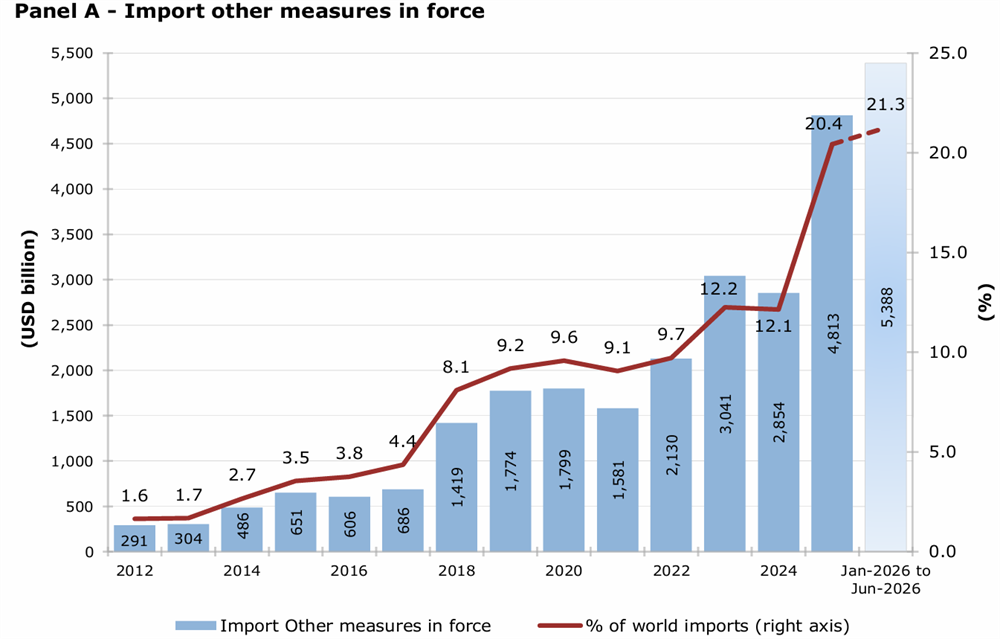
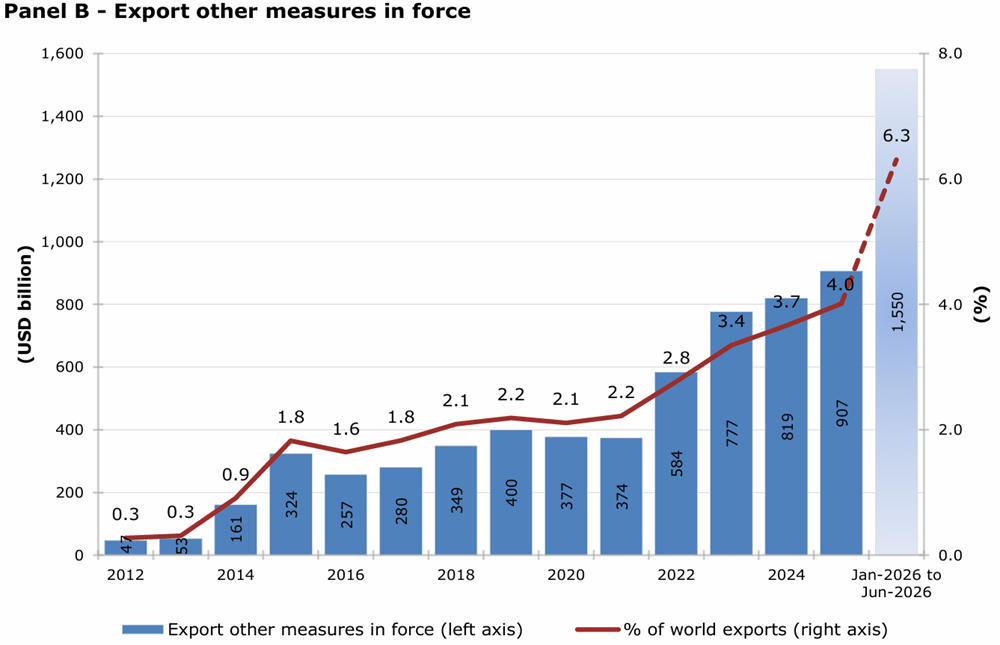
In 2025, WTO members and observers introduced 1,229 new trade and trade-related measures, according to the report. During the first half of 2026 alone, a further 1,048 measures were recorded, reflecting a substantially higher monthly pace of trade policy activity. The increase was broad-based across the membership and not limited to the largest trading economies. These trends were also identified by the Trade Policy Activity (TPA) Index, which WTO and IMF economists updated in July.
New trade-facilitating measures accelerated sharply in the first half of 2026. WTO members and observers introduced 466 such measures, exceeding the 391 recorded during all of 2025. In the first half of 2026, new import-facilitating measures covered an estimated USD 1.3 trillion (5.2 per cent) of world imports, while export-facilitating measures reached a record USD 570 billion (2.3 per cent) of world exports). This is more than five times the level recorded in 2025. Much of this increase reflected temporary actions adopted in response to trade disruptions associated with the Strait of Hormuz situation.
At the same time, members introduced 333 new restrictive and other non-facilitating trade measures in the first half of 2026 alone, exceeding the 300 recorded during all of 2025. Import-related measures covered USD 2.0 trillion (8.0 per cent)) of world imports in the first half of 2026, while export-related measures covered USD 794 billion (3.2 per cent) in world exports.
The report covers trade and trade-related measures up to 30 June 2026, presenting annual data for 2025 and semi-annual data for the period January to June 2026, while also tracking the accumulation of measures introduced since 2009 and still in force.
As of 30 June 2026, the stockpile(1) of import-related restrictive and other non-facilitating measures introduced since 2009 and still in force, covered USD 5.4 trillion of trade, equivalent to 21.3 per cent of world imports. The stockpile of such export-related measures reached USD 1.5 trillion, covering 6.3 per cent of world exports. Both figures represent the highest levels recorded since the WTO trade monitoring began.
Highlighting two contrasting trends, WTO Director-General Ngozi Okonjo-Iweala said: "On the one hand, import tariffs and other non-facilitating measures affect significant shares of global trade, and the stockpile of trade-restrictive measures continues to grow, reaching its highest level since WTO trade monitoring began in 2009 and affecting an increasing share of global trade. On the other hand, WTO members have stepped up their efforts to facilitate trade, introducing measures that have helped businesses navigate recent disruptions and maintain the flow of goods across borders."
"In most sectors examined, new import-facilitating measures covered a larger share of imports than new restrictive and non-facilitating measures. The only exceptions were electric vehicles and photovoltaic cells, where major economies have been heavily competing for market share, which has sparked lots of trade policy debates recently", DG Okonjo-Iweala noted.
She added: "I welcome these trade-facilitating actions and encourage WTO members to build on this positive momentum. At a time of a rapidly changing global trading environment, restraint in the use of new trade restrictions and a continued commitment to open, predictable and transparent trade will be essential for supporting economic growth, strengthening resilience and preserving the benefits of the multilateral trading system."
Her full remarks are available here.
Global trade proved more resilient than expected in the first half of 2026 despite the disruption caused by the Middle East conflict, driven in large part by surging demand for AI-enabling goods, according to the latest "Global Trade Outlook and Statistics" released on 8 October 2026. The WTO has revised its forecast for world merchandise trade volume growth in 2026 upward to 3.9 per cent, from the 1.9 per cent baseline forecast issued in March. In value terms, merchandise trade increased by around 15 per cent year-on-year during the first half of 2026.
Commercial services trade growth is now forecast at 3.3 per cent in 2026, down from the March forecast of 4.8 per cent owing largely to the impact of the Middle East conflict on transport and travel services. Nevertheless, commercial services trade in value terms increased by around 14 per cent year-on-year in the first half of 2026.
Trade remedy actions continued to be widely used, although the trade affected by these measures remained limited. In 2025, WTO members initiated 391 investigations, averaging 32.6 initiations per month. During the first half of 2026, 218 new investigations were initiated, averaging 36.3 per month, while only 31 trade remedy actions were terminated. Anti-dumping measures remained the most frequently used trade remedy instrument.
WTO members and observers introduced 130 new measures affecting trade in services in 2025 and a further 52 measures during the first six months of 2026. Most were aimed at facilitating trade or strengthening regulatory frameworks, while many applied across multiple sectors and modes of supply.
WTO members and observers continued to make extensive use of general economic support measures, with industrial and agricultural support remaining at historically high levels and increasingly focused on competitiveness, resilience, security of supply and climate objectives.
The WTO reports on trade monitoring entitled "Overview of Developments in the International Trading Environment" have been published continuously since 2009, as mandated by WTO rules. Issued under the responsibility of the WTO Director-General, these reports aim to assist the Trade Policy Review Body in analyzing the impact of international trade developments on the multilateral trading system.
Footnotes
- The stockpile refers to the value of trade covered by measures introduced since 2009 that remained in force as of the reporting date. Back to text
Share
Problems viewing this page? If so, please contact [email protected] giving details of the operating system and web browser you are using.