overview
People and culture at the WTO
Merit serves as the foundation for all decisions relating to staffing at the WTO, although efforts are also made to maximize diversification in the workforce. The WTO Secretariat is committed to providing excellent service to its members by having every staff member fully contribute to supporting the organization's mission in an environment grounded in personal value, equal opportunity and non-discrimination.
A diverse and multicultural workforce
Diverse representation is fundamental to an international organization such as the WTO, whose Secretariat should reflect the diversity of its membership and the people it serves. A diverse workforce helps foster stronger collaboration and mutual understanding between members with different systems and cultural styles. Diversity in intellectual thought also generates creativity and innovation, which are critical in addressing the current challenges facing global trade.
As of 30 June 2025, the WTO Secretariat comprised more than 670 staff members representing over 90 nationalities, working in three official languages - English, French and Spanish - to support multilateral trade.
The WTO is committed to providing an inclusive environment in which all individuals feel safe and valued, and where they are treated with dignity, respect and fairness. No abuse of authority, discrimination, harassment, sexual harassment, exploitation and abuse, or retaliation in any form are tolerated.
Gender representation
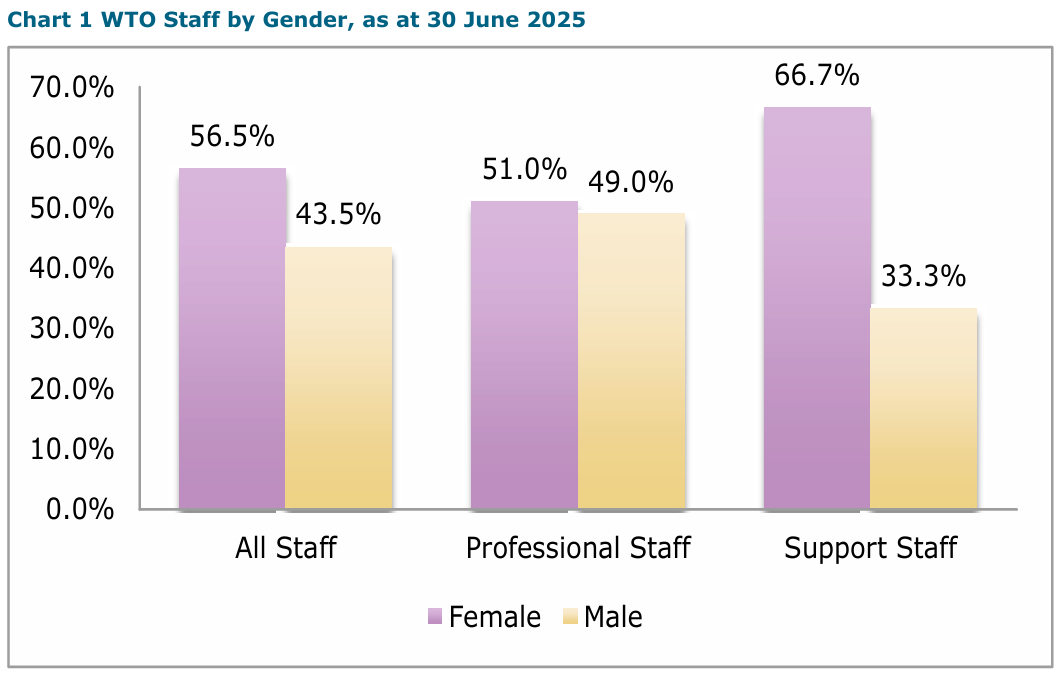
Women now make up 56.5 per cent of WTO staff, outnumbering men 379 to 292. Female representation among professional staff rose from 31 per cent in 1995 to 51 per cent in 2025, while women continue to hold two-thirds of support roles (66.7 per cent).
Geographic representation
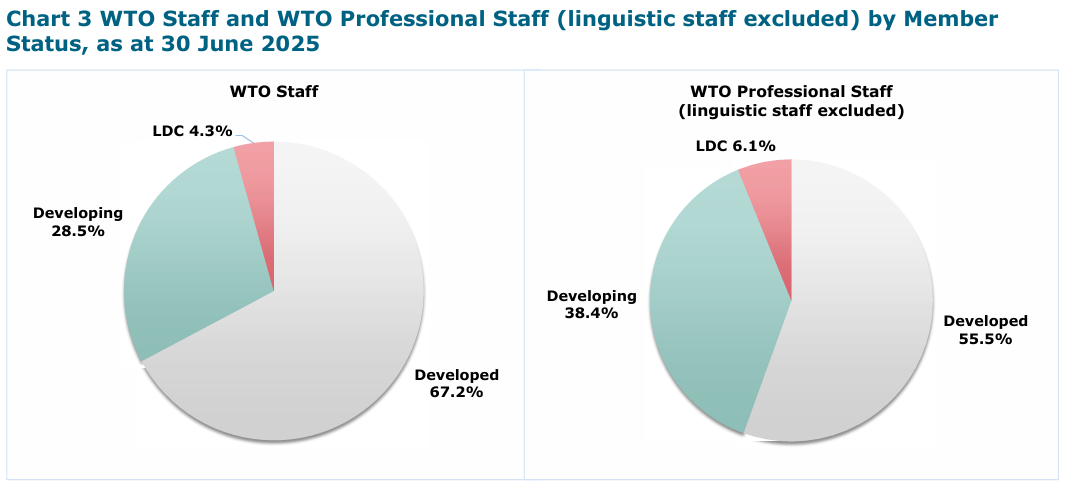
In 2025, 67.2 per cent of WTO staff came from developed members, 28.5 per cent from developing members, and 4.3 per cent from least-developed countries (LDCs). Representation is more balanced among professional staff, with 55.5 per cent from developed members, 38.4 per cent from developing members, and 6.1 per cent from LDCs.
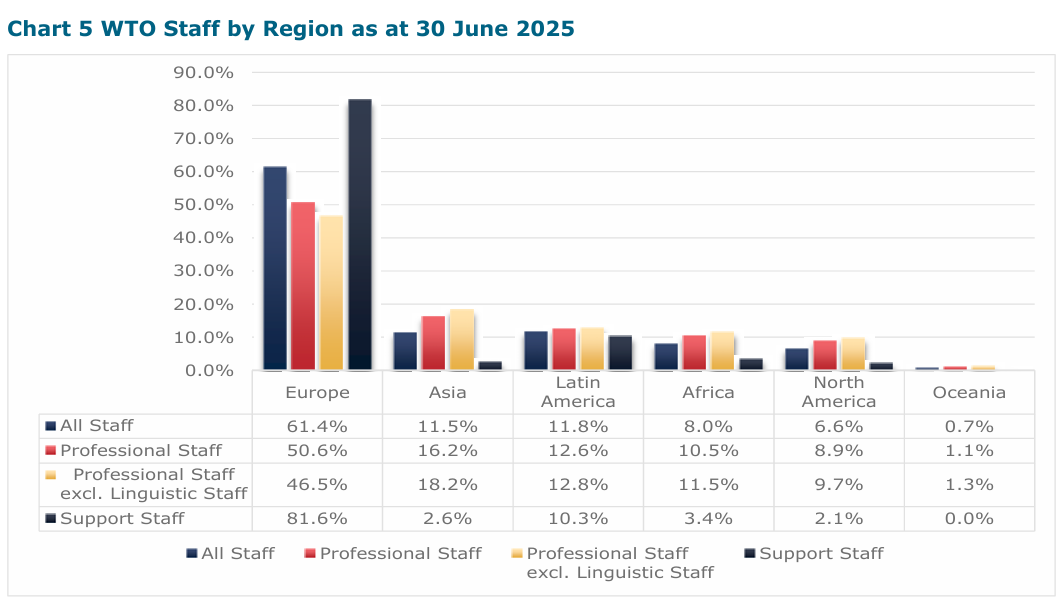
According to the WTO regional grouping system, Europe remains the most represented region, accounting for 61 per cent of staff overall, 51 per cent of professional staff, 47 per cent of professional staff, excluding linguistic staff, and 82 per cent of support staff. Asia represents 12 per cent of staff overall; Latin America 12 per cent; Africa 8 per cent; North America 7 per cent and Oceania 1 per cent.
WTO internship and capacity-building programmes
In addition to regular recruitment for staff positions, the WTO has seven programmes targeting entry-level or mid-level talents and supporting capacity-building among members, many of which contribute to diversity:
- Young Professionals Programme;
- WTO Internship Programme;
- China's LDCs and Accessions and General Internship Programme;
- WTO Support Programme for Doctoral Studies;
- Netherlands Talent Programme;
- French Irish Mission Programme;
- Group Coordinators Support Programme.
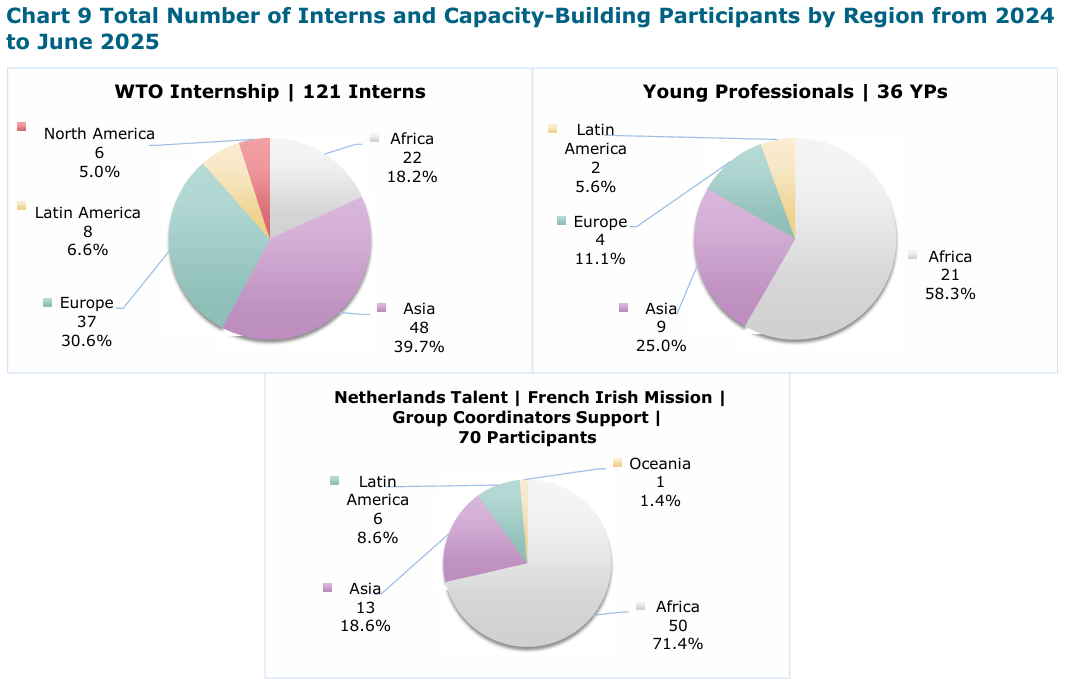
In 2024 and the first half of 2025, WTO internship and capacity-building programmes attracted participants from 98 members and 6 accession candidates, with 83 per cent coming from developing members and LDCs. The WTO Internship Programme hosted 121 interns, while the Young Professionals Programme selected 36 participants from 31 members out of nearly 12,000 applicants. A further 70 participants joined through the Netherlands Talent Programme, the French Irish Mission Programme and the Group Coordinators Support Programme.
An inclusive Secretariat
"Let us recommit to fostering an environment where everyone feels valued, respected, and can be their authentic selves. Let us challenge ourselves to listen, learn and amplify the voices of those who have been marginalized or silenced." Dr. Ngozi Okonjo-Iweala, WTO Director-General
Inclusion refers to creating a work environment in which all individuals feel valued, respected and empowered to contribute their perspectives and talents. It involves fostering a culture of belonging and shared purpose, so that every staff member can perform at their best potential and fully contribute to the WTO's mission.
Fostering a respectful and harmonious working environment free from discrimination and abusive conduct is one of the WTO's four strategic priorities in terms of learning and development. Throughout the year, series of learning sessions are organized to strengthen staff awareness on key inclusion topics, including gender equality, non-discrimination and accessibility. Training courses on fostering a respectful and harmonious workplace, focusing on preventing sexual harassment and racial discrimination, are mandatory.
Share
Problems viewing this page? If so, please contact [email protected] giving details of the operating system and web browser you are using.