STATISTIQUES DE L'OMC
Part du commerce mondial de marchandises en régime NPF
La part du commerce mondial de marchandises effectué conformément au principe non discriminatoire de la nation la plus favorisée (NPF) s'élève à 72% (fin juillet 2026), ce qui démontre que les droits NPF restent importants dans le système commercial multilatéral. Ce chiffre global est en baisse par rapport aux 80% enregistrés au début de 2025 en raison de la hausse considérable du recours aux mesures tarifaires ces dernières années.
See also
The WTO’s non-discrimination principle of MFN treatment remains a cornerstone of the global trading system: under MFN terms, any trade advantage granted by a WTO member to one trading partner must be extended immediately and unconditionally to all other members. Enshrined in Article I of the General Agreement on Tariffs and Trade (GATT 1994) and applicable to all 166 members of the WTO, including separate customs territories, MFN terms promote stability, predictability and fairness in global trade relations.
Analysis conducted by Gonciarz and Verbeet (2025), based on official 2022 imports and tariffs, indicated that the MFN share of global trade stood at just over 80%. An updated analysis, using official 2024 imports and tariff data and taking account of tariff actions recorded up to the end of July 2026, indicates the share is approximately 72%.
Share of trade under MFN terms remains significant
Global merchandise imports can be categorized according to tariff treatment: MFN duty-free trade, MFN dutiable trade, trade eligible for preferential treatment but conducted under MFN terms, trade benefiting from preferential tariffs, trade affected by anti-dumping or countervailing duties, and trade affected by other tariff actions.
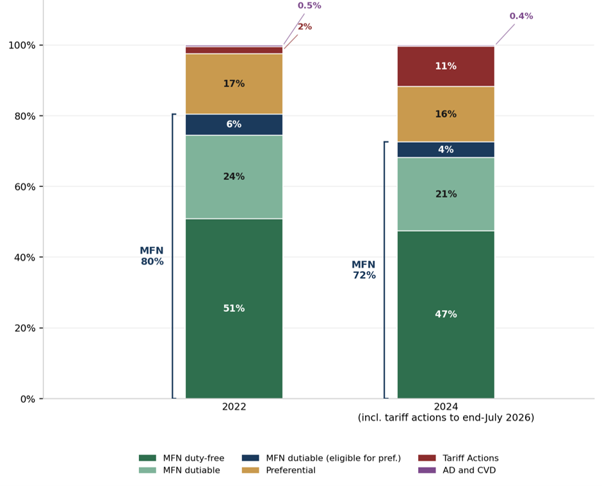
Chart 1 compares the analysis based on 2022 tariff and import data with the updated results based on 2024 tariffs, including tariff actions up to the end of July 2026, weighted by 2024 import flows.
Chart 1: Global merchandise imports by tariff treatment
Percentage shares, 2022 and 2024 (including tariff actions until end-July 2026)*
Source: WTO Integrated Database, WTO Analytical Database, WTO-IMF Tariff Tracker.
* Data for 2024 refer to MFN and preferential tariffs for 2024, and tariff actions until end-July 2026, based on total annual import values of 2024, excluding EU intra trade. Shares are rounded to the nearest percentage point and may not add up to 100.
Based on the latest analysis, taking into account tariff actions up to the end of July 2026, 47% of merchandise trade occurs under MFN duty-free terms and 21% under MFN tariffs. The share eligible for preferential trade but conducted under MFN terms amounts to about 4%. Adding together these three MFN components amounts to 72%. Preferential trade constitutes around 16% of merchandise trade while anti-dumping measures, countervailing duties and other tariff actions total almost 12%.
In contrast, in 2022 about 51% of global trade was conducted under MFN duty-free terms and 24% faced MFN tariffs. Although roughly 23% was eligible for preferential tariffs, only 17% actually benefitted from them, leaving around 6% traded under MFN conditions despite eligibility for preferential treatment. These three MFN components added up to just over 80%. Other trade policy measures affected a comparatively small proportion of trade: those stemming from tariff actions starting in 2018 covered less than 2% of global trade, and anti-dumping and countervailing duties roughly 1%, although these estimates remain approximate.
Data and methodology
The analysis draws primarily on tariff and trade data reported by WTO members to the WTO Integrated Database (IDB). The data include applied MFN tariffs, preferential tariff rates and detailed bilateral import statistics at the national tariff line level. These are complemented by the WTO Analytical Database and by the tariff actions indicated in the WTO-IMF Tariff Tracker, a joint initiative of the WTO and International Monetary Fund, monitoring changes in applied tariffs based on official announcements and regulations.
The resulting dataset covers 187 economies at the six-digit level of the Harmonized System used to measure trade in goods and excludes intra-EU trade.
A key issue in measuring the level of preferential trade is the utilization of tariff preferences: eligible imports are not always claimed as preferential by developing economies as rules of origin and documentation requirements constitute costs that can outweigh the benefit of the preferential treatment where MFN tariffs are already low.
The analysis therefore incorporates detailed merchandise trade statistics under the WTO's transparency mechanisms for preferential trade arrangements. Notified by members accounting for about half of world merchandise trade, these data identify products eligible for preferential treatment and allow statisticians to estimate the preference utilization rate. This is applied in turn to the economies that do not report this level of detail.
For a more detailed explanation of the methodology, see the analytical chapter of the WTO's Global Trade Outlook and Statistics, March 2026.
Conclusion
The increasing number of preferential trade agreements and tariff actions are reshaping the global trade landscape. Trade on MFN terms nevertheless remains central to global trade, with approximately 72% of global merchandise trade continuing to take place under these terms. This underlines the continued importance of the MFN framework as the foundation of global trade governance.
Further information
- WTO Tariff & Trade Data portal – Provides official tariff and trade data from the Integrated Database and Consolidated Tariff Schedules, the WTO's Analytical Database, and also features the WTO–IMF Tariff Tracker, which provides information on latest tariff actions.
- The value of the WTO: An economic viewpoint in six instalments, Part II: Why MFN matters – WTO Blog by Robert W. Staiger. 16 July 2026.
- Global Trade Outlook and Statistics, March 2026 – analytical chapter on the most-favoured-nation share calculation. 19 March 2026.
- How much of world trade is conducted under MFN terms? – WTO Data Blog. 22 January 2025.
- Significance of Most-Favoured-Nation Terms in Global Trade: A Comprehensive Analysis – WTO Staff Working Paper ERSD-2025-02, by Tomasz Gonciarz and Thomas Verbeet. 15 January 2025.
Des problèmes pour visualiser cette page?
Veuillez écrire à [email protected] en indiquant le système d’exploitation et le navigateur que vous utilisez.