Press/354
11 September 2003
ACCESSIONS
Ambition achieved as ministers seal Cambodia membership deal
 WTO ministers approved Cambodia’s membership agreement today (11 September 2003), putting the Southeast Asian country in line to become
the WTO’s 147th member and the first least-developed country to join
the WTO through the full working party negotiation process.
WTO ministers approved Cambodia’s membership agreement today (11 September 2003), putting the Southeast Asian country in line to become
the WTO’s 147th member and the first least-developed country to join
the WTO through the full working party negotiation process.
SEE ALSO:
press
releases
WTO news
archives
Supachai
Panitchpakdi's speeches
> Cambodia’s
accesion
> Cambodia’s
main page
Cambodia still has to ratify the agreed terms and inform the WTO. Thirty days after that it will become a member. Cambodia applied to join the WTO in late 1994.
“The swift conclusion of Cambodia’s membership negotiation shows that the new guidelines to allow least-developed countries to negotiate membership more easily are working,” said WTO Director-General Supachai Panitchpakdi.
“It is also a signal that WTO member governments are serious in their commitment to improving developing countries’ and least-developed countries’ participation in the world trading system,” Dr Supachai said.
Cambodia’s Commerce Minister Cham Prasidh, said: “We managed to secure a package of commitments and concessions we feel was the most affordable and possible deal for Cambodia’s accession, bearing in mind Cambodia’s little political and economic weight and its current reliance on external assistance from the major donor countries who are also WTO members.”
According to the latest WTO data, Cambodia’s merchandise exports were US$1.4 billion in 2002, and its imports were US$2.0 billon.
What Cambodia has promised
Cambodia’s terms of accession are spelt out in the membership agreement which consists of a report from the working party that negotiated the deal, and schedules or lists of commitments on import duties for goods and market access for service providers.
The working party took note of Cambodia’s commitments, for example:
State ownership and privatization: Privatization was carried out during a first phase from 1991 to mid-1993, and a second phase starting in April 1995. Cambodia will ensure transparency, and keep WTO members informed and also provide periodic reports on other issues related to its economic reform as relevant to its obligations under the WTO.
Pricing policies: From accession, in the application of price controls, Cambodia will apply price controls in a way that is consistent with the WTO, and take account of the interests of exporting WTO members. Cambodia has published a list of goods and services subject to state control.
Trading rights (the right to import and export): Responding to a comment that its restrictions on imported pharmaceuticals and veterinary medicines could discriminate in favour of domestic production of similar products, Cambodia said that no later than 1 June 2005, it would amend its legislation, and ensure that its laws and regulations are in full conformity with its WTO obligations.
Other customs duties and charges: Cambodia will ensure these comply with WTO provisions from the date of accession and will be bound at zero.
Tariff rate quotas, tariff exemptions: Cambodia confirmed that it would respect WTO disciplines on tariff rate quotas.
Cambodia said that upon accession to the WTO, any tariff exemptions would only be implemented in conformity with the relevant WTO provisions.
Fees and charges for services rendered: All fees and charges collected for services related to imports and exports will conform with the provisions of WTO agreements, and from the date of accession, Cambodia will not apply, introduce or reintroduce any fees and charges for services rendered that were applied to imports ad valorem (i.e. as a percentage of the prices).
Application of internal taxes: From the date of accession, Cambodia will apply its domestic taxes in strict compliance with Article 3 of GATT and in a non-discriminatory manner to imports regardless of country of origin. GATT Article 3 deals with “national treatment” (or non-discrimination between locals and foreigners) in taxation.
Quantitative import restrictions, including prohibitions, quotas and licensing systems: No later than 1 June 2005, Cambodia will eliminate quantitative restrictions on imports of fertilizers, pesticides and other agricultural inputs and establish a WTO-consistent method of registration and review of imported agricultural chemicals. From 1 January 2007 Cambodia will rely on the provisions of the Technical Barriers to Trade Agreement to regulate domestic and international trade in these items.
From accession, Cambodia will not introduce, re-introduce or apply other non-tariff measures such as licensing, quotas, prohibitions, bans and other restrictions having equivalent effect that could not be justified under the provisions of the WTO Agreements.
Customs valuation: Cambodia will fully implement the Customs Valuation Agreement from 1 January 2009.
Rules of origin: Cambodia will comply fully with the provisions of the WTO Rules of Origin Agreement by 1 January 2005, parts by 1 January 2004.
Other customs formalities: A dispute settlement mechanism within the Cambodian Customs Service to handle complaints about customs practices from traders and governments will be established before 1 January 2005.
Preshipment inspection: From accession the Cambodian government will take full responsibility to ensure that the operations of the preshipment inspection companies retained by Cambodia meet the requirements of the WTO agreements. Cambodia’s preshipment inspection regime will be temporary and will cease when the Customs and Excise Department is able to carry out the functions currently performed by preshipment inspection service providers.
Anti-dumping, countervailing duties, safeguard regimes: Cambodia will not apply any anti-dumping, countervailing or safeguard measure until it has notified and implemented appropriate laws and regulations conforming with the WTO agreements. After that, Cambodia will also only apply any anti-dumping duties, countervailing duties and safeguard measures in full conformity with the relevant WTO provisions.
Export restrictions: Cambodia restricts exports of rice, round logs, unprocessed timber, forestry products, antiques more than 100 years old, narcotic drugs and poisons, weapons, explosives, ammunition, and vehicles and machinery for military purposes. From the date of accession, Cambodia will ensure that restrictions comply with WTO agreements.
Export subsidies: Cambodia will comply with the Subsidies Agreement from accession. It will either eliminate the existing system of remission of import fees and waiver of duty for certain goods used by certain investors, or establish a functioning duty drawback system consistent with WTO provisions, through amendment of the Law on Investment, as necessary, by the end of 2013.
Industrial policy, including subsidies: These subsidies are to be notified from the date of accession.
Standards and certification: Cambodia will gradually implement the Technical Barriers to Trade Agreement. Full implementation will start from 1 January 2007 without recourse to any further transitional period.
Sanitary and phytosanitary measures: Cambodia will gradually implement the SPS Agreement, with full implementation by 1 January 2008. Cambodia will consult with WTO Members upon request if they deem that any measures applied during the transition period affected their trade negatively.
Trade-related investment measures (TRIMs): Cambodia will not maintain any measures inconsistent with the TRIMs Agreement and will apply the TRIMs Agreement from the date of accession without recourse to any transitional period.
State trading entities: Cambodia will apply its laws and regulations governing the trading activities of state-owned enterprises in full conformity with the provisions of the WTO Agreement.
Free zones, special economic areas: Free zones or special economic areas, including special promotion zones established in accordance with the Law on Investment, will be fully subject to the coverage of WTO agreements and its commitments in its Protocol of Accession to the WTO Agreement. Cambodia will ensure enforcement of its WTO obligations in those zones or areas. In addition, from the date of accession goods produced in these zones or areas under tax and tariff provisions that exempt imports and imported inputs from tariffs and certain taxes will be subject to normal customs formalities when entering the rest of Cambodia, including the application of tariffs and taxes.
Transit: Cambodia will apply any laws, regulations and practices governing transit operations and would act in full conformity with the provisions of the WTO agreements.
Agricultural policies: Cambodia binds its agricultural export subsidies at zero, and will not maintain or apply any export subsidies for agricultural products.
Textiles regime: Textiles and clothing import quotas that other members apply to imports from Cambodia will have growth rates applied as provided for in the Agreement on Textiles and Clothing shall be applied, from the date of Cambodia’s accession. These growth rates will end when the Agreement on Textiles and Clothing terminates (in 2005).
Trade-related aspects of intellectual property rights (TRIPS): Cambodia will apply the TRIPS Agreement no later than 1 January 2007, with some protection provided in the interim.
Transparency: From the date of accession, all laws and regulations will be published according to WTO requirements, and on a website from 1 January 2004.
Regional trade agreements: Cambodia’s only regional trade agreement is within ASEAN (the ASEAN Free Trade Area). In this, Cambodia will gradually eliminate tariffs on essentially all ASEAN products by 2015. Details will be notified to the WTO.
The countries that negotiated with Cambodia
Working party members: Australia, Canada, China, EU, India , Japan, Rep. Korea, Malaysia, New Zealand, Panama, Singapore, Chinese Taipei, Thailand, United States, Venezuela
Chairperson: A. Meloni (Italy)
Cambodia’s Working Party was established on 21 December 1994. Cambodia submitted a Memorandum on its Foreign Trade Regime in June 1999. Replies to questions concerning the Memorandum were circulated in January 2001, the latest revisions and updates arriving in March 2003.
The 14 November 2002 meeting was the working party’s third. It marked an advancement of the accession process because for the first time members focused on ideas for a draft Working Party Report and, thereby, concentrated on agreeing Cambodia’s terms of entry.
The 16 April 2003 meeting was the first to consider the report. The final revision was approved at the last working party meeting on 22 July 2003.
Next
After the Cancún Ministerial Conference has approved the package, Cambodia will then have to ratify the agreement and inform the WTO. It will become a full member 30 days later.
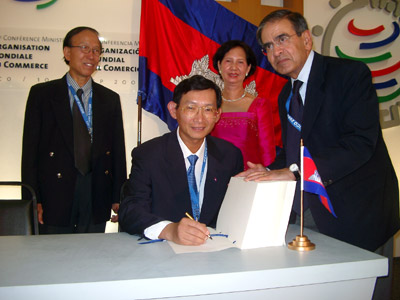
H.E. Mr. Cham Prasidh, Minister of Commerce of Cambodia, signing the protocol of accession of Cambodia to the WTO
> Click to see a larger image (38KB)