

WTO: 2007 PRESS RELEASES
Press/472
WORLD TRADE 2006, PROSPECTS FOR 2007
Risks lie ahead following stronger trade in 2006, WTO reports
Risks in financial and property markets and large trade imbalances in goods and services mean increased uncertainty in 2007 and raise the prospect of weaker economic and trade expansion in the coming year, according to WTO economists. “A successful conclusion to the Doha Round holds great potential for boosting growth and alleviating poverty,” Director-General Pascal Lamy said. “An agreement would also deliver more relevant trade rules, helping to establish a more stable and certain foundation for today’s dynamic global marketplace.”
> Download this press release (pdf
format, 21 pages, 183KB)
> Download all tables and charts (zip
format, 157KB)
> Guide to downloading files.
Tables and charts:
Chart 1: Real GDP and trade growth of United
States, 2005-06
Chart 2: Growth in the volume of world merchandise
trade and GDP, 1996-06
Table 1: GDP and merchandise trade by region, 2004-06
Chart 3: Real merchandise trade growth by region, 2006
Chart 4: Export prices of selected primary products,
2005 and 2006
Chart 5: Dollar changes vis-à-vis selected major
currencies, 2001-2006
Table 2: World exports of merchandise and commercial
services, 2006
Table 3: World exports of commercial services trade by
major category, 2006
Appendix Table 1:
World merchandise trade by region and selected
country, 2006
Appendix Table 2:
World exports of commercial services by region, 2006
Appendix Table 3:
Leading exporters and importers in world merchandise
trade, 2006
Appendix Table 4:
Leading exporters and importers in world merchandise
trade (excluding intra-EU(25) trade), 2006
Appendix Table 5:
Leading exporters and importers in world commercial
services trade, 2006
> Problems viewing this page?
Please contact [email protected] giving details of the operating system and web browser you are using.


SEE ALSO:
> Press releases
> WTO news archives
> Pascal
Lamy’s speeches
Last year’s press release (11 April 2006)
> Trade picks up in mid-2005, but 2006
picture is uncertain
In their preliminary assessment of trade in 2006 and prospects for the coming year, they said the consensus among forecasters of around 3% global economic growth in 2007 could slow merchandise trade growth to about 6% compared with 8% in 2006.
By contrast, the world economy and trade grew vigorously in 2006, the 8% expansion in merchandise trade being the second highest since 2000. Growth in gross domestic product (GDP) — a measure of the size of the economy — was stronger than expected in Europe and Japan. The Chinese and Indian economies continued to record high growth.
Least-developed countries’ trade grew by about 30%, fuelled by higher prices for petroleum and other primary commodities. They and developing countries as a whole saw their shares of world merchandise trade reach record proportions. And for some of the smaller suppliers, fear of a setback in textiles and clothing in the face of competition from China proved unfounded in 2006.
“The strong performance of 2006 is welcome, particularly the gains made by developing and least-developed countries,” WTO Director-General Pascal Lamy said. “But this has to be consolidated. The uncertainties that lie ahead are a warning for us not to lose sight of the need to continue to reform the world economy.”
“The best contribution the WTO can make is to keep strengthening the multilateral trading system. One of the unsung achievements of the system is its stabilizing effect on world trade and the global economy. A successful conclusion to the Doha Round holds great potential for boosting growth and alleviating poverty. An agreement would also deliver more relevant trade rules, helping to establish a more stable and certain foundation for today’s dynamic global marketplace.”
Overview of major trade developments in 2006
The overall picture in 2006 was of trade expanding in real terms (i.e. ignoring price changes), faster than output by a large margin. The dollar value of world merchandise exports increased by 15% to $11.76 trillion in 2006. Commercial services exports were up by an estimated 11% and reached $2.71 trillion in 2006.
Price changes affected the nominal merchandise trade growth rates of countries and whole regions. The annual average prices for fuels and metals rose sharply, benefiting the export earnings of fuels and metal exporters.
The four regions with the highest share of fuels and other mining products in their merchandise exports (the Middle East, Africa, the Commonwealth of Independent States — CIS — and South and Central America) again recorded the strongest annual export rise in 2006.
The United States recorded its best annual merchandise export growth in more than a decade but its trade deficit continued to grow. However, when adjusted for price changes, US merchandise exports expanded faster than world trade and faster than US imports.
China’s trade growth continued to outstrip other major traders. China’s merchandise exports grew by 27%. In the second half of 2006, its merchandise exports started to exceed those of the United States, but for the whole year US exports still exceeded those of China.
Least-developed countries’ exports rose sharply in 2006 due to much larger values of fuels exports and stronger exports of other primary products and manufactured goods.
Developing countries’ share of world merchandise exports reached an all time record of 36%. The 0.9%,share for least-developed countries was also a record, the highest level since 1980, the earliest data kept by the WTO.
The picture for textiles and clothing is better for small suppliers with preferences in developed country markets than many had feared following the 2005 elimination of quotas and of the WTO’s Agreement on Textiles and Clothing.
As expected, China has enhanced its role as the leading supplier. Low and lower-middle income countries have seen their share of world exports of textiles and clothing increase markedly. The richer developing countries, including the newly-industrializing Asian economies (NICs) and Mexico, lost market share. Some small suppliers also lost shares, but others gained. Overall, in 2006, the least-developed countries increased their shares of developed countries’ textiles imports. The fact that China, India and Bangladesh performed well also means that millions of low-income workers benefited.
Details: the state of the world economy and trade in 2006
The year 2006 witnessed robust growth in the world economy and vigorous trade expansion. Global gross domestic production (GDP) growth accelerated to 3.7%, the second best performance since 2000. All major regions recorded GDP growth in excess of population growth.
Economic growth in the least-developed countries continued to exceed 6% for the third year in a row. A large part of the stronger global economy is attributable to the recovery in Europe, which turned out to be stronger than expected in early 2006. The United States economy maintained its overall expansion as weaker domestic demand was balanced by a reduction in the external deficit, mainly due to a faster export growth. In Japan somewhat faster economic growth was achieved despite weaker domestic demand reflected in a widening of its external surplus. China and India continued to report outstandingly high economic and trade growth.
Strong economic fundamentals in many key economies contributed to stronger investor confidence worldwide. General government deficits decreased in the United States, the European Union and in Japan and inflationary pressures were contained. A high level of global monetary liquidity combined with a low level of real interest rates contributed to a rally on global stock markets. Stock markets in emerging economies again recorded much faster growth than those in developed economies. Increased investor confidence in emerging markets is also reflected in the sharply reduced spread in interest margins between emerging market bonds and those of US government bonds.
The more favourable investment climate is also reflected in a sharp rise in global foreign direct investment (FDI) flows in 2006, which approached the record levels of the past. UNCTAD (1) reports that global FDI inflows surged by one-third to $1.23 trillion, the second highest level ever. The high growth of global FDI flows can be attributed partly to increased mergers and acquisitions activity and higher share prices. A high level of total net private capital flows to emerging markets was reported by the Institute of International Finance. (2)
A further sign of high global liquidity is the rise in global foreign exchange reserves and the advanced re-payment of external public debt by a number of developing countries. Debt levels, measured by the outstanding debt to GDP ratios, decreased in all developing regions partly due to debt forgiveness. For the heavily indebted poor countries the debt levels in 2006 are estimated to have come down to half the level reported five years ago. (3)
The real effective exchange rate of the US dollar continued to depreciate moderately, contributing to the readjustment of the US current account deficit (the trade deficit in goods and services)(4). The exchange rates of the Asian economies with large current account surpluses fared differently in 2006. On an annual average basis, real effective exchange rates appreciated significantly in the case of the Republic of Korea and Singapore and moderately in the case of China. The Japanese Yen, however, continued to depreciate in 2006.(5)
High global liquidity and a further steep rise in the price of fuels and nominal interest rates has not so far translated into higher domestic inflation rates. In developed markets consumer price increases averaged between 2% and 3%, and in the developing economies the rate was about 5%. In both developed and developing regions no acceleration in consumer price inflation was observed between 2005 and 2006 (6). However, inflationary pressures can be detected in sectors for which supply is less elastic, such as real estate markets and auction prices for works of art.
The strong global macro-economic situation in 2006 provided a favourable framework for the expansion of international trade. In 2006, world merchandise exports grew in real terms (i.e. at constant prices) by 8.0%, compared to 6.5% in the preceding year. A large part of this trade acceleration can be attributed to the marked recovery in Europe’s export and import growth. Higher prices of fuels and metals led to a stagnation in the quantity of mining products traded internationally but the higher export earnings of oil exporters resulted in import growth in excess of the world average. High energy prices also invigorated demand for mining equipment and investment in machinery with high energy efficiency.
China’s merchandise trade expansion remained outstandingly strong in 2006. Office and telecom equipment continued to be the mainstay of Chinese export growth but significant gains in world market shares in 2006 could be observed in “traditional” exports such as clothing and “new” products such as iron and steel. Chinese imports again rose faster than global trade but continued to lag behind export growth.
Trade prospects for 2007
The marked correction in share prices observed on global stock markets at the end of February 2007 highlighted the increased uncertainty of investors with respect to the short-term prospects of the world economy. The consensus among forecasters favours a moderate deceleration in world economic growth in 2007 (7). The economic fundamentals in the major economies are strong enough to keep global economic growth close to 3% (GDP measured at market exchange rates).
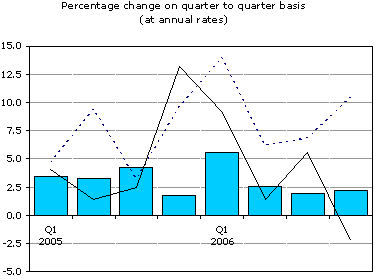
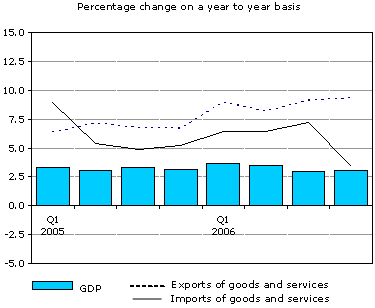
US domestic demand slowed markedly in the second half of 2006 and is expected to weaken further in the first half of 2007. Imports of goods and services contracted between the third and fourth quarter (on a seasonally adjusted basis) and should remain subdued in the first half of 2007 (see Chart 1). The slowdown in GDP growth in Europe is expected to be less pronounced than in the United States (and could be avoided in Japan), maintaining developed countries economic growth close to 2.5% in 2007. Demand in the oil importing countries is expected to benefit from on average lower import prices of fuels in 2007. Although endogenous factors have played an increasing role in developing country economic performance over the last decade, the slowdown in industrial markets is likely to contribute to less dynamic growth in the developing world, which is still expected to grow at least twice as fast as the developed markets. The most likely scenario is that GDP growth in 2007 will slow down in all regions, with relatively even growth among the regions in the developed and developing areas.
Chart 1: Real GDP and trade growth of United States, 2005-06 back to top
Source: OECD, Olisnet.
The major risks to this scenario are found in financial market developments, a dramatic downturn in the property markets, and the continued existence of large current account imbalances. The search for high yield investments has led to a rapid expansion of financial instruments (hedge funds, carry trade).
Assuming the basic scenario of global economic GDP growth of nearly 3%, global merchandise trade could slow down to about 6% in 2007, or 2 percentage points less than in 2006. This estimate is supported by the results of the Secretariat’s time series forecasting model which predicts a slowdown in the OECD area’s imports of goods and services to 4.5%, a 2.5 percentage point decrease from the rate observed in 2006.
The downside risks associated with this trade projection include a stronger than expected correction in highly priced property markets, a pickup in inflation, and risk perceptions that could lead to a further rise of interest rates. Interest rate rises could trigger a correction of stock and bond markets and lower then predicted levels of investment and private consumption.
Real merchandise trade developments and output in 2006
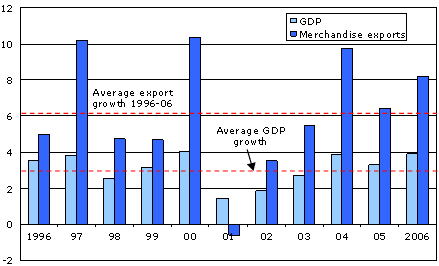
The pick up in global economic activity was the major factor in the vigorous expansion of global trade in 2006. Real merchandise export growth is provisionally estimated to have grown by 8.0% in 2006, almost two percentage points faster than in 2005, and well above the average expansion of the last decade (1996-2006). The expansion of real trade exceeded global output growth by more than 4 percentage points (see Chart 2).
Chart 2: Growth in the volume of world merchandise trade and GDP, 1996-06 back to top
(Annual percentage change)
Source: WTO.
In 2006, the variation in regional real trade growth increased even though
economic growth by region differed less than in the preceding year. These
divergent developments can be attributed largely to the terms of trade changes
in favour of fuel-exporting countries and regions. The North American region
comprises two net exporters of fuels and the United States, which is a major net
importer of fuels. The real merchandise exports of the United States rose by
10.5% in 2006, which was the highest growth rate since 1997 and almost two times
faster than its import growth. Energy related petroleum products decreased by
2.5% in volume terms. Weaker domestic demand in the United States, a lower real
effective (i.e. trade weighted) dollar exchange rate, and stronger global demand
growth contributed to this favourable development. Canada’s merchandise exports
slowed down markedly due to the combination of lower US demand and a marked
appreciation of the Canadian dollar since 2002. Mexican merchandise trade
expanded vigorously with both imports and exports up by double digit rates as
its economy recorded its best growth since 2000.
At 13.5%, Asia’s real merchandise exports remained the most buoyant of all
regions. Asia’s imports rose faster than in the preceding year and faster than
world trade but continued to lag behind its export growth. Most of the excess of
Asia’s export over import growth can be attributed to the region’s major
traders, China and Japan. The expansion of China’s exports was somewhat less
dynamic in 2006 than in 2005, while Japan, the Republic of Korea and Chinese
Taipei recorded a faster growth (between 10% and 15%). Imports into Japan and
Chinese Taipei, however, advanced by only 2% to 3% in 2006.
Table 1: GDP and merchandise trade by region, 2004-06
(Annual percentage change at constant prices)
|
GDP |
Exports |
Imports |
||||||
|
2004 |
2005 |
2006 |
2004 |
2005 |
2006 |
2004 |
2005 |
2006 |
North America |
3.9 |
3.2 |
3.4 |
8.0 |
6.0 |
8.5 |
10.5 |
6.5 |
6.5 |
United States |
3.9 |
3.2 |
3.4 |
8.5 |
8.0 |
10.5 |
11.0 |
6.0 |
5.5 |
South and Central America a |
6.9 |
5.2 |
5.2 |
13.0 |
8.0 |
2.0 |
18.5 |
14.0 |
10.5 |
Europe |
2.4 |
1.8 |
2.8 |
7.0 |
4.0 |
7.5 |
7.0 |
4.0 |
7.0 |
European Union (25) |
2.3 |
1.6 |
2.8 |
7.0 |
4.0 |
7.5 |
6.5 |
3.5 |
6.5 |
Commonwealth of Independent States (CIS) |
8.0 |
6.7 |
7.5 |
12.0 |
3.5 |
3.0 |
16.0 |
18.0 |
20.0 |
Africa and Middle East |
6.0 |
5.5 |
5.4 |
8.0 |
5.0 |
1.0 |
14.0 |
13.0 |
8.5 |
Asia |
4.8 |
4.1 |
4.4 |
15.5 |
11.5 |
13.5 |
14.5 |
8.0 |
8.5 |
China |
10.1 |
9.9 |
10.7 |
24.0 |
25.0 |
22.0 |
21.5 |
11.5 |
16.5 |
Japan b |
2.7 |
1.9 |
2.2 |
13.5 |
5.0 |
10.0 |
6.5 |
2.0 |
2.0 |
India |
8.0 |
8.5 |
8.3 |
15.5 |
20.5 |
11.5 |
16.0 |
20.5 |
12.0 |
World |
3.9 |
3.2 |
3.7 |
10.0 |
6.5 |
8.0 |
... |
... |
... |
a Includes the Caribbean.
b Trade volume data are derived from customs values deflated by
standard unit values and an adjusted price index for electronic goods.
Source: WTO.
Europe’s real merchandise exports recorded their strongest annual growth since
2000, exceeding import growth (estimated at 7%) but continued to lag behind the
global rate of trade expansion. European countries recorded considerable
variation in their trade performance. Double-digit export growth can be observed
for the countries at its eastern border, ranging from Finland and the Baltic
states in the North to Turkey in the South. All these countries benefited from
further integration with the EU and the strength of import demand from the
Commonwealth of Independent States (CIS) region. Both Germany and the United
Kingdom recorded export and import growth well above the European average, while
real trade growth was sluggish in Italy and Spain and stagnated in France and
Ireland.
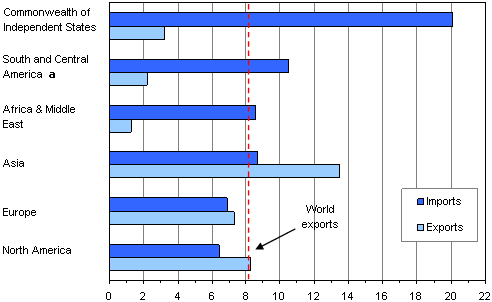
The four net fuel exporting regions (CIS, Middle East, Africa and South/Central
America and the Caribbean) only recorded a small increase in their export volume
(of about 2 percentage points), while their imports rose faster than global
trade in 2006 (Chart 3). The most buoyant imports of all regions were observed
for Commonwealth of Independent States, which are estimated to have expanded by
20%, while the region’s real exports remained sluggish in 2006. In contrast to
these global trade developments, South and Central America’s expansion rate of
both exports and imports decelerated in 2006. Venezuela recorded a marked
contraction of her exports and those of Brazil rose by less than 4%. The
combined exports of Africa and the Middle East are estimated to have almost
stagnated, while imports, despite their deceleration, continued to expand
somewhat faster than the global average. While the slowdown in the exports of
these regions can be linked to reduced demand for the more expensive categories
of fuels and metals, the increase in imports might be considered modest given
the outstanding income growth of these regions over the last three years. (8)
Chart 3: Real merchandise trade growth by region, 2006 back to top
(Annual percentage change)
a Includes the Caribbean.
Source: WTO.
Nominal merchandise and commercial services trade developments in 2006 (9)
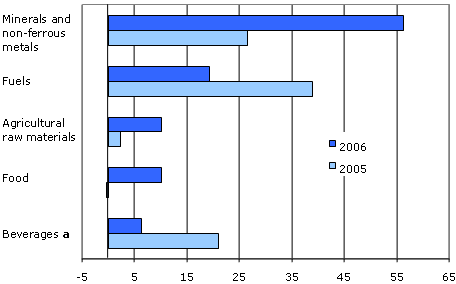
World merchandise exports in dollar value terms were strongly affected by price developments in 2006. Price developments differed widely by sector in the course of the year. According to the IMF commodity price indices, the world export prices of minerals and non-ferrous metals increased by 56%, those of fuels by 20% and those of food and agricultural raw materials by 10%. Export prices of manufactured goods are estimated to have increased by not more than 3% (10).
Chart 4: Export prices of selected primary products, 2005 and 2006 back to top
(Annual percentage change)
a Comprising coffee, cocoa beans and tea.
Source: IMF, International Financial
Statistics.
Price changes for manufactured goods remained less strong than those for
primary products for the third consecutive year. An important element in
the moderate price trends for manufactured goods was the continued
decline in prices for electronic goods, which accounted for more than
one in six dollars of world exports of manufactured goods in 2005. These
shifts in relative prices are explained largely by the different
regional export unit values (prices) which ranged from 4% to 5% for Asia
and Europe to about 18% to 20% for exports of South and Central America,
Africa, the Middle East and the CIS. Information on price trends for
world commercial services trade are not available. However, the price
deflators for US services exports and imports increased between 3% and
4% in 2006, somewhat less rapidly than in the preceding year.
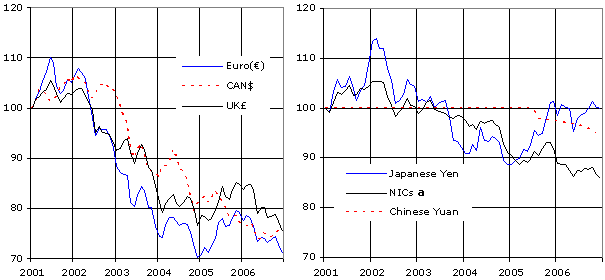
Overall exchange rate developments in 2006 only had a moderate impact on
the dollar price level of internationally traded goods. Contrary to
developments between 2002 and 2004, the average annual exchange rate
change between the US dollar and the euro and the British pound had been
rather moderate as divergent developments in the course of 2005 and 2006
balanced each other. While a weaker yen might have contributed to weaker
dollar export prices of Japan, the appreciation of the Canadian dollar
and the currencies of several Asian traders had the opposite effect (see
Chart 5).
Chart 5: Dollar changes vis-à-vis selected major currencies, 2001-2006 back to top
(Indices, January 2001=100)
a Trade weighted currency basket of the Korean won, the Singapore
dollar and Chinese Taipei dollar.
Source: IMF, International Financial Statistics.
World merchandise exports in dollar terms rose by 15.4% to $11.76 trillion. About 40% of this value change can be attributed to inflation. Commercial services exports rose by 11% to $2.71 trillion. The increase in commercial services exports in 2006 was about the same as in the preceding year and for the fourth consecutive year less pronounced than that of merchandise trade. It is uncertain to what extent divergent relative price developments have contributed to the differences in the growth of merchandise and commercial services trade values.
Table 2: World exports of merchandise and commercial services, 2006 back to top
(Billion dollars and percentage)
|
Value |
Annual percentage change |
|||
|
2006 |
2000-06 |
2004 |
2005 |
2006 |
Merchandise |
11762 |
11 |
22 |
14 |
15 |
Commercial services |
2710 |
10 |
20 |
11 |
11 |
Source: WTO.
Merchandise exports by region in dollar terms have been strongly
affected again by price developments. The four regions with the highest
share of fuels and other mining products in their merchandise exports —
the Middle East (70% in 2005), Africa (65%), the Commonwealth of
Independent States (60%) and South/Central America (37%) again recorded
the strongest annual export increases in 2006. However, as prices of
fuels increased in 2006 less rapidly than in 2005, the sharp rise in the
export values of these regions were in effect smaller than in the
preceding year. The opposite development can be observed for the net
importers of fuels — North America, Europe and Asia reported a faster
export growth in 2006 than in 2005, although the growth in their
shipments remained less strong than that of the fuel exporting regions.
Although Europe’s merchandise exports recorded the weakest regional
growth rate (13%), its share in world merchandise exports, at 42%,
remained the largest of all regions. Europe’s imports rose by 14% to
$5.22 trillion. Intra-EU (25) trade rose by 13%, which was somewhat
stronger than export growth to third countries (11%) but slower than
imports from third countries (15%). The Baltics and the Balkan states
continued to record export and import growth in excess of 20%. The
combined exports/imports of the Balkan states exceed those of Turkey,
whose exports and imports also expanded faster than those of total
Europe.
In North America, Mexico reported stronger export and import growth than
its NAFTA partners. The United States reported its best annual export
growth performance (14%) in more than a decade, and although US export
growth exceeded its import growth (11%), the merchandise trade deficit
had grown already so large that it continued to grow in 2006. Only in
the fourth quarter, supported by the decline in import volumes and
falling import prices for crude oil, did the US merchandise trade
deficit started to decrease.
Asia’s merchandise exports and imports continued to expand faster than
world trade in 2006. Among the six major Asian traders China continued
to record the highest export and import growth, and as its export growth
continued to exceed its import growth, the merchandise trade surplus
rose sharply. In the course of 2006, China’s trade surplus widened
further as the momentum in the export expansion was maintained while
nominal import growth slackened, partly due to weaker oil prices. The
dollar value of Japan’s merchandise exports grew by nearly 9% but
continued to lag behind the expansion of world trade and its own import
growth. The fast growing economies of India and Viet Nam reported a
vigorous expansion of exports and imports, in the range of 20% to 35% in
2006. Since 1995, the exports and imports of these two countries have
expanded faster than Asia’s trade and their share in world merchandise
exports increased markedly. Among the smaller Asian traders, Bangladesh,
Cambodia and Mongolia continued their double-digit export expansion, a
feature since 2003, with exports up between 20% and 44% in 2006. The
merchandise trade of New Zealand virtually stagnated while that of
Chinese Taipei and the Philippines was less dynamic than world trade in
2006.
Africa’s merchandise exports rose by 21%, again faster than imports,
which are estimated to have increased by nearly 16%. The share of Africa
in world merchandise exports reached its highest level since 1990.
Although most of Africa’s export growth can be attributed to the rise in
oil exports, it is a noticeable development that non-oil exporting
African countries increased their exports by about 16%. It is estimated
that about one in 10 African countries experienced a decline in their
exports, while half of them recorded an export expansion which exceeded
the global average. South Africa, the region’s largest merchandise
trader, reported a rise in its imports of 24% while exports advanced by
13%.
Middle Eastern trade has been strongly affected by political and oil
market developments. The region’s merchandise exports are estimated to
have grown by 19%, roughly in line with crude oil prices. Merchandise
imports increased by 14% which must be considered a rather moderate
increase given the surge in the region’s export earnings and foreign
exchange reserves in the past years.
Among the seven geographic regions distinguished in this report, the
Commonwealth of Independent States (CIS) recorded the most dynamic
export and import growth in 2006. Benefiting from strong fuel and metal
prices on world markets, the region’s exports increased by one-quarter
last year to $422 billion, more than twice the level recorded only three
years ago. Imports rose by nearly one-third to $278 billion, but the
region’s merchandise trade surplus continued to expand by about $20
billion in 2006.
South/Central America’s merchandise exports and imports continued to
expand faster than world trade in 2006 even though their growth was less
pronounced than in the preceding year. The deceleration in the region’s
export growth is attributable largely to the performance of the region’s
oil exporters and Brazil. Sharply higher prices for metals benefited
exports from Chile, Jamaica, Peru and Suriname. The exports of Chile and
Peru surged by more than 40%, the highest export growth rates reported
in the region in 2006.
Box: Textiles and clothing trade developments in 2006 In the second year after the phasing out of the
Agreement on Textiles and Clothing, the structural changes in world trade
of textiles and clothing continued unabatedly. Exporters from developed
countries and those from advanced developing economies in East Asia are
losing market share, together with major developing suppliers in Central
America and the Mediterranean region, which process textiles originating
from developed countries. China’s exports continued to gain market share in
all major developed import markets despite restrictions introduced in 2005.
Some smaller suppliers expanded their textiles and clothing exports even
faster than China and the share of least-developed countries in imports of
the United States and the European Union increased sharply in 2006. Imports of textiles and clothing into major markets by origin, 2006
Note: East Asia(4) comprises Chinese Taipei, Hong Kong China,
Macao China and the Republic of Korea. EU(25) imports include
intra-trade. |
||||||||||||||||||||||||||||||||||||||||||||||||||||||||||||||||||||||||||||||||||||||||||||||||||||||||||||||||||||||||||||||||||||||||||||||||||||||||||||||||||||||||||||||||||||
It is clear from the discussion above that trade expansion in 2006 was
very favourable for the developing countries as a group. Their combined
merchandise exports rose by 20%, to $4.27 trillion, and imports rose by
17%. The share of developing countries in world merchandise exports
reached with 36%, an all-time record level. The share of developing
countries in world merchandise imports was 31%, the largest share in
more than a quarter of a century. For the least-developed countries, the
expansion of merchandise exports has been even stronger than for the
developing countries over the last six years, including 2006.
Least-developed countries’ exports are estimated to have increased by
about 30%, to $108 billion in 2006. Their share in world merchandise
exports reached 0.9%, the highest level since 1980 (the first year for
which records are kept). Merchandise imports rose by 17%, which was far
less rapid than merchandise exports, leading the least-developed
countries as a group to record a trade surplus for the first time.
Because of differences in commodity composition, individual country
performance, and relative country size, aggregations such as developing
countries and least-developed countries are increasingly less meaningful
for trade analysis (see Appendix Table 1)
The review of world merchandise trade by leading exporters and importers
reconfirms the importance of price developments and the outstanding
trade performance of China and India. Among the thirty leading
merchandise exporters, the eight most dynamic (with export values up by
more than 20% in 2006) comprise five oil exporters, one metal exporter
(Chile) and China and India (11). Moderate and sluggish export value growth
of less than 10% was reported by Japan (9%), France (6%), Spain (7%) and
Ireland (3%). The merchandise imports of these latter countries also
expanded far less rapidly than the world average. The ten leading
exporters comprise the same countries as the group of the top ten
leading importers, and although the annual variation of trade differed
markedly between the leading traders, the ranking did not change from
the preceding year, with the single exception of the merchandise imports
of the United Kingdom, which again surpassed those of Japan (see Appendix Table 3 and 4).
Since 2000, China has more than doubled its share in world merchandise
exports and ranks as the third largest exporter and importer in
merchandise trade. Despite its strong export expansion, China remained
the third largest merchandise exporter in 2006. However, in the second
half of 2006, China’s merchandise exports exceeded those of the United
States for the first time.
World commercial services exports rose by 11% to $2.7 trillion in 2006 (12).
The expansion rate of global services trade was basically unchanged from
the preceding year and that of the last six years. Since 2003,
commercial services exports expanded less rapidly each year than
merchandise trade.
Among the three broad commercial services categories, transportation,
travel and “other commercial services”, the latter is by far the largest
and also the fastest growing category. In 2006, other commercial
services categories expanded by 13% while transportation and travel
services were up by 9% and 7% respectively. In the 1990s, transportation
services expanded less rapidly than travel, but since 2000 the situation
has been reversed. The relatively sluggish growth of travel services can
be observed in all major exporting regions but is most pronounced in
North America’s services trade.
Table 3: World exports of commercial services trade by major category,
2006 back to top
(Billion dollars and percentage
change)
|
Value |
Annual percentage change |
|||
|
2006 |
2000-06 |
2004 |
2005 |
2006 |
Commercial services |
2710 |
10 |
20 |
11 |
11 |
Transport |
626 |
10 |
25 |
12 |
9 |
Travel |
737 |
7 |
18 |
8 |
7 |
Other commercial services |
1347 |
12 |
19 |
12 |
13 |
Source: WTO.
Commercial services trade by region is presented in Appendix Table 2.
Europe and North America, recorded — as in the preceding year — export
and import growth below the world average. Within the European Union
services trade developments by member differed widely: services exports
of France and Finland are reported to have declined, while those of
Luxembourg and Poland expanded by one-quarter or more (13). The CIS region
reports export and import growth rates of commercial services of about
20%, the fastest growth of all regions.
Asia’s commercial services exports continued for the third consecutive
year to expand faster than the global average and faster than the
region’s services imports, thereby reducing the region’s deficit in
services trade. Japan, the region’s largest commercial services trader,
increased its commercial services exports by 12% and its imports by 8%.
Among the major Asian traders India continues to excel in terms of its
services trade expansion. While the dynamic growth of India’s commercial
— and in particular software services (14) — exports are widely reported, the
dynamic expansion of its services imports attracts less attention even
though the growth rate in 2006 exceeded that of exports. According to
the most recent numbers, India’s commercial services imports are only
about 5% short of its commercial services exports.
The commercial services trade of Africa and the Middle East are
provisionally estimated to have expanded close to the world average in
2006. But limitations in data availability could make these estimates
subject to larger revisions than for the estimates provided for other
regions.
The trade performance of the leading commercial services exporter and
importer differed widely in 2006. The shifts in ranking should be
interpreted with caution as they might be due to changes in methodology,
and given the incomplete data of major traders, will be subject to
revisions.
On the basis of the preliminary data, it appears that the three top
leading traders, namely the United states, the United Kingdom and
Germany, maintained their rank for both exports and imports. If the
export contraction of France’s commercial services is confirmed, Japan
would replace it as the world’s fourth largest services exporter. Italy
moved ahead of Spain to rank as the sixth largest exporter. China’s
commercial services exports are estimated to have surpassed those of the
Netherlands and India, entering the group of the top ten exporters by
moving ahead of Hong Kong, China (15).
On the import side, no change occurred among the top ten positions in
2006. According to the provisional data, India’s imports are estimated
to have exceeded slightly those of the Republic of Korea, even though
the latter imports also increased strongly in 2006. (16)
Appendix Table 1
World merchandise trade by region and selected country, 2006 back to top
(Billion dollars and percentage)
|
Exports |
Imports |
||||||||
|
Value |
Annual percentage change |
Value |
Annual percentage change |
||||||
|
2006 |
2000-06 |
2004 |
2005 |
2006 |
2006 |
2000-06 |
2004 |
2005 |
2006 |
World |
11762 |
11 |
22 |
14 |
15 |
12080 |
11 |
22 |
13 |
14 |
North America |
1675 |
5 |
14 |
12 |
13 |
2546 |
7 |
17 |
14 |
11 |
United States |
1037 |
5 |
13 |
11 |
14 |
1920 |
7 |
17 |
14 |
11 |
Canada |
388 |
6 |
16 |
14 |
8 |
357 |
7 |
14 |
15 |
11 |
Mexico |
250 |
7 |
14 |
13 |
17 |
268 |
7 |
16 |
13 |
15 |
South and Central America a |
426 |
14 |
30 |
24 |
20 |
351 |
9 |
28 |
23 |
18 |
Brazil |
137 |
16 |
32 |
23 |
16 |
88 |
7 |
31 |
17 |
14 |
Other South and Central America a |
289 |
13 |
29 |
25 |
22 |
262 |
10 |
27 |
25 |
19 |
Europe |
4957 |
11 |
20 |
9 |
13 |
5218 |
11 |
20 |
10 |
14 |
European Union (25) |
4527 |
11 |
19 |
8 |
12 |
4743 |
11 |
20 |
9 |
14 |
Germany |
1112 |
12 |
21 |
7 |
15 |
910 |
11 |
18 |
9 |
17 |
United Kingdom |
443 |
8 |
14 |
11 |
15 |
601 |
10 |
20 |
9 |
17 |
France |
490 |
7 |
15 |
3 |
6 |
533 |
8 |
18 |
7 |
6 |
Italy |
410 |
9 |
18 |
5 |
10 |
436 |
11 |
19 |
8 |
13 |
Commonwealth of Independent States (CIS) |
422 |
19 |
36 |
28 |
24 |
278 |
23 |
31 |
25 |
29 |
Russian Federation |
305 |
19 |
35 |
33 |
25 |
164 |
24 |
28 |
29 |
31 |
Africa |
361 |
16 |
31 |
30 |
21 |
290 |
14 |
28 |
20 |
16 |
South Africa |
58 |
12 |
26 |
12 |
13 |
77 |
17 |
35 |
17 |
24 |
Africa less South Africa |
303 |
17 |
32 |
34 |
23 |
213 |
13 |
26 |
22 |
13 |
Oil exporters b |
212 |
19 |
40 |
46 |
25 |
81 |
18 |
33 |
25 |
18 |
Non oil exporters |
90 |
13 |
20 |
14 |
17 |
131 |
11 |
23 |
20 |
10 |
Middle East |
644 |
16 |
33 |
35 |
19 |
373 |
14 |
31 |
19 |
14 |
Asia |
3276 |
12 |
25 |
16 |
18 |
3023 |
12 |
27 |
17 |
16 |
China |
969 |
25 |
35 |
28 |
27 |
792 |
23 |
36 |
18 |
20 |
Japan |
647 |
5 |
20 |
5 |
9 |
577 |
7 |
19 |
13 |
12 |
India |
120 |
19 |
30 |
30 |
21 |
174 |
23 |
37 |
41 |
25 |
Four East Asian traders c |
844 |
9 |
25 |
12 |
15 |
787 |
9 |
27 |
13 |
17 |
Memorandum items: |
|
|
|
|
|
|
|
|
|
|
MERCOSUR |
190 |
14 |
28 |
21 |
16 |
134 |
7 |
38 |
20 |
17 |
ASEAN |
771 |
10 |
20 |
15 |
18 |
683 |
10 |
25 |
17 |
14 |
EU (25) extra-trade |
1480 |
11 |
21 |
11 |
11 |
1697 |
11 |
21 |
15 |
15 |
Developing economies |
4274 |
14 |
27 |
22 |
20 |
3749 |
13 |
29 |
18 |
17 |
Least Developed Countries |
108 |
20 |
32 |
36 |
30 |
101 |
15 |
18 |
21 |
17 |
a Includes the Caribbean. For composition of groups see the
Technical Notes of WTO, International Trade Statistics, 2006.
b Algeria, Angola, Cameroon, Chad, Congo, Equatorial Guinea,
Gabon, Libya, Nigeria, Sudan.
c Chinese Taipei; Hong Kong, China; Republic of Korea and
Singapore.
Source: WTO.
Appendix Table 2
World exports of commercial services by region, 2006 back to top
(Billion dollars and percentage)
|
Exports |
Imports |
||||||||
|
Value |
Annual percentage change |
Value |
Annual percentage change |
||||||
|
2006 |
2000-06 |
2004 |
2005 |
2006 |
2006 |
2000-06 |
2004 |
2005 |
2006 |
World |
2710 |
10 |
20 |
11 |
11 |
2620 |
10 |
19 |
11 |
10 |
North America |
460 |
6 |
13 |
10 |
9 |
401 |
7 |
15 |
9 |
9 |
United States |
387 |
6 |
14 |
10 |
9 |
307 |
7 |
16 |
9 |
9 |
South and Central America a |
77 |
9 |
16 |
18 |
14 |
80 |
7 |
14 |
21 |
14 |
Brazil |
18 |
12 |
21 |
28 |
21 |
27 |
9 |
12 |
38 |
20 |
Europe |
1382 |
11 |
20 |
9 |
9 |
1223 |
10 |
17 |
8 |
8 |
European Union (25) |
1247 |
12 |
19 |
9 |
9 |
1132 |
10 |
16 |
8 |
8 |
United Kingdom |
223 |
11 |
25 |
5 |
9 |
169 |
10 |
18 |
10 |
6 |
Germany |
164 |
13 |
17 |
10 |
11 |
214 |
8 |
13 |
4 |
7 |
France |
112 |
6 |
11 |
6 |
-2 |
108 |
10 |
19 |
8 |
3 |
Italy |
100 |
10 |
18 |
7 |
13 |
101 |
11 |
12 |
9 |
14 |
Spain |
100 |
12 |
16 |
9 |
8 |
77 |
15 |
24 |
11 |
18 |
Commonwealth of Independent States (CIS) |
51 |
20 |
29 |
20 |
21 |
74 |
21 |
28 |
19 |
19 |
Russian Federation |
30 |
21 |
26 |
21 |
22 |
45 |
18 |
23 |
18 |
17 |
Africa |
64 |
13 |
21 |
12 |
12 |
80 |
13 |
23 |
21 |
12 |
Egypt |
16 |
9 |
30 |
3 |
10 |
10 |
6 |
24 |
27 |
9 |
South Africa |
12 |
16 |
16 |
15 |
8 |
14 |
16 |
28 |
18 |
17 |
Middle East |
63 |
11 |
16 |
14 |
9 |
96 |
12 |
23 |
19 |
10 |
Israel |
19 |
4 |
21 |
10 |
9 |
15 |
4 |
15 |
7 |
8 |
Asia |
614 |
12 |
27 |
14 |
15 |
666 |
10 |
24 |
12 |
14 |
Japan |
121 |
9 |
25 |
14 |
12 |
143 |
4 |
21 |
2 |
8 |
China |
87 |
... |
34 |
19 |
... |
100 |
... |
31 |
16 |
... |
India |
73 |
... |
... |
... |
34 |
70 |
... |
... |
... |
40 |
Four East Asian traders b |
208 |
10 |
22 |
9 |
14 |
197 |
10 |
23 |
10 |
12 |
a Includes the Caribbean. For composition of groups see the Technical
Notes of WTO, International Trade Statistics, 2006.
b Chinese Taipei; Hong Kong, China; Republic of Korea and Singapore.
Note: While provisional full year data were available in early March for
33 countries accounting for more than 60% of world commercial services trade,
estimates for most other countries are based on data for the first three
quarters (the first six months in the case of China).
Source: WTO.
Appendix Table 3
Leading exporters and importers in world merchandise trade, 2006 back to top
(Billion dollars and percentage)
Rank |
Exporters |
Value |
Share |
Annual % change |
Rank |
Importers |
Value |
Share |
Annual % change |
1 |
Germany |
1112 |
9.2 |
15 |
1 |
United States |
1920 |
15.5 |
11 |
2 |
United States |
1037 |
8.6 |
14 |
2 |
Germany |
910 |
7.4 |
17 |
3 |
China |
969 |
8.0 |
27 |
3 |
China |
792 |
6.4 |
20 |
4 |
Japan |
647 |
5.4 |
9 |
4 |
United Kingdom |
601 |
4.9 |
17 |
5 |
France |
490 |
4.1 |
6 |
5 |
Japan |
577 |
4.7 |
12 |
6 |
Netherlands |
462 |
3.8 |
14 |
6 |
France |
533 |
4.3 |
6 |
7 |
United Kingdom |
443 |
3.7 |
15 |
7 |
Italy |
436 |
3.5 |
13 |
8 |
Italy |
410 |
3.4 |
10 |
8 |
Netherlands |
416 |
3.4 |
14 |
9 |
Canada |
388 |
3.2 |
8 |
9 |
Canada |
357 |
2.9 |
11 |
10 |
Belgium |
372 |
3.1 |
11 |
10 |
Belgium |
356 |
2.9 |
12 |
|
|
|
|
|
|
|
|
|
|
11 |
Korea, Republic of |
326 |
2.7 |
15 |
11 |
Hong Kong, China |
336 |
2.7 |
12 |
|
|
|
|
|
|
retained imports a, b |
36 |
0.3 |
... |
12 |
Hong Kong, China |
323 |
2.7 |
10 |
12 |
Spain |
319 |
2.6 |
10 |
|
domestic exports b |
23 |
0.2 |
... |
|
|
|
|
|
|
re-exports b |
300 |
2.5 |
... |
|
|
|
|
|
13 |
Russian Federation |
305 |
2.5 |
25 |
13 |
Korea, Republic of |
309 |
2.5 |
18 |
14 |
Singapore |
272 |
2.3 |
18 |
14 |
Mexico b |
268 |
2.2 |
15 |
|
domestic exports |
143 |
1.2 |
15 |
|
|
|
|
|
|
re-exports |
129 |
1.1 |
22 |
|
|
|
|
|
15 |
Mexico |
250 |
2.1 |
17 |
15 |
Singapore |
239 |
1.9 |
19 |
|
|
|
|
|
|
retained imports a |
110 |
0.9 |
16 |
16 |
Taipei, Chinese |
224 |
1.9 |
13 |
16 |
Taipei, Chinese |
203 |
1.6 |
11 |
17 |
Saudi Arabia b |
209 |
1.7 |
16 |
17 |
India |
174 |
1.4 |
25 |
18 |
Spain |
206 |
1.7 |
7 |
18 |
Russian Federation c |
164 |
1.3 |
31 |
19 |
Malaysia |
161 |
1.3 |
14 |
19 |
Switzerland |
141 |
1.1 |
12 |
20 |
Switzerland |
147 |
1.2 |
13 |
20 |
Australia b |
140 |
1.1 |
11 |
|
|
|
|
|
|
|
|
|
|
21 |
Sweden |
147 |
1.2 |
13 |
21 |
Austria |
139 |
1.1 |
9 |
22 |
United Arab Emirates |
139 |
1.2 |
21 |
22 |
Turkey |
137 |
1.1 |
17 |
23 |
Austria |
138 |
1.1 |
11 |
23 |
Malaysia |
131 |
1.1 |
14 |
24 |
Brazil |
137 |
1.1 |
16 |
24 |
Thailand |
129 |
1.0 |
9 |
25 |
Thailand |
131 |
1.1 |
19 |
25 |
Sweden |
126 |
1.0 |
13 |
26 |
Australia |
123 |
1.0 |
16 |
26 |
Poland |
124 |
1.0 |
22 |
27 |
Norway |
122 |
1.0 |
17 |
27 |
United Arab Emirates b |
95 |
0.8 |
17 |
28 |
India |
120 |
1.0 |
21 |
28 |
Czech Republic |
93 |
0.8 |
22 |
29 |
Ireland |
113 |
0.9 |
3 |
29 |
Brazil |
88 |
0.7 |
14 |
30 |
Poland |
110 |
0.9 |
23 |
30 |
Denmark |
86 |
0.7 |
14 |
|
Total of above d |
10033 |
83.2 |
- |
|
Total of above d |
10340 |
83.5 |
- |
|
World d |
12062 |
100.0 |
15 |
|
World d |
12380 |
100.0 |
14 |
a Retained imports are defined as imports less
re-exports.
b Secretariat estimates.
c Imports are valued f.o.b.
d Includes significant re-exports or imports for re-export.
Source: WTO.
Appendix Table 4
Leading exporters and importers in world merchandise trade (excluding
intra-EU(25) trade), 2006 back to top
(Billion dollars and percentage)
Rank |
Exporters |
Value |
Share |
Annual % change |
Rank |
Importers |
Value |
Share |
Annual % change |
1 |
Extra-EU (25) exports |
1480 |
16.4 |
11 |
1 |
United States |
1920 |
20.6 |
11 |
2 |
United States |
1037 |
11.5 |
14 |
2 |
Extra-EU (25) imports |
1697 |
18.2 |
15 |
3 |
China |
969 |
10.7 |
27 |
3 |
China |
792 |
8.5 |
20 |
4 |
Japan |
647 |
7.2 |
9 |
4 |
Japan |
577 |
6.2 |
12 |
5 |
Canada |
388 |
4.3 |
8 |
5 |
Canada |
357 |
3.8 |
11 |
6 |
Korea, Republic of |
326 |
3.6 |
15 |
6 |
Hong Kong, China |
336 |
3.6 |
12 |
|
|
|
|
|
|
retained imports a, b |
36 |
0.4 |
... |
7 |
Hong Kong, China |
323 |
3.6 |
10 |
7 |
Korea, Republic of |
309 |
3.3 |
18 |
|
domestic exports b |
23 |
0.3 |
... |
|
|
|
|
|
|
re-exports b |
300 |
3.3 |
... |
|
|
|
|
|
8 |
Russian Federation |
305 |
3.4 |
25 |
8 |
Mexico b |
268 |
2.9 |
15 |
9 |
Singapore |
272 |
3.0 |
18 |
9 |
Singapore |
239 |
2.6 |
19 |
|
domestic exports |
143 |
1.6 |
15 |
|
retained imports a |
110 |
1.2 |
16 |
|
re-exports |
129 |
1.4 |
22 |
|
|
|
|
|
10 |
Mexico |
250 |
2.8 |
17 |
10 |
Taipei, Chinese |
203 |
2.2 |
11 |
|
|
|
|
|
|
|
|
|
|
11 |
Taipei, Chinese |
224 |
2.5 |
13 |
11 |
India |
174 |
1.9 |
25 |
12 |
Saudi Arabia b |
209 |
2.3 |
16 |
12 |
Russian Federation c |
164 |
1.8 |
31 |
13 |
Malaysia |
161 |
1.8 |
14 |
13 |
Switzerland |
141 |
1.5 |
12 |
14 |
Switzerland |
147 |
1.6 |
13 |
14 |
Australia b |
140 |
1.5 |
11 |
15 |
United Arab Emirates |
139 |
1.5 |
21 |
15 |
Turkey |
137 |
1.5 |
17 |
16 |
Brazil |
137 |
1.5 |
16 |
16 |
Malaysia |
131 |
1.4 |
14 |
17 |
Thailand |
131 |
1.4 |
19 |
17 |
Thailand |
129 |
1.4 |
9 |
18 |
Australia |
123 |
1.4 |
16 |
18 |
United Arab Emirates b |
95 |
1.0 |
17 |
19 |
Norway |
122 |
1.3 |
17 |
19 |
Brazil |
88 |
0.9 |
14 |
20 |
India |
120 |
1.3 |
21 |
20 |
Indonesia |
78 |
0.8 |
5 |
|
|
|
|
|
|
|
|
|
|
21 |
Indonesia |
104 |
1.2 |
21 |
21 |
South Africa b |
77 |
0.8 |
24 |
22 |
Turkey |
85 |
0.9 |
16 |
22 |
Saudi Arabia b |
65 |
0.7 |
9 |
23 |
Iran, Islamic Rep. of b |
75 |
0.8 |
34 |
23 |
Norway |
64 |
0.7 |
15 |
24 |
Bolivarian Rep. of Venezuela b |
63 |
0.7 |
14 |
24 |
Philippines b, c |
52 |
0.6 |
10 |
25 |
Chile |
59 |
0.7 |
45 |
25 |
Romania |
51 |
0.5 |
26 |
26 |
South Africa |
58 |
0.6 |
13 |
26 |
Iran , Islamic Rep. of b |
51 |
0.5 |
34 |
27 |
Kuwait b |
54 |
0.6 |
21 |
27 |
Israel b |
50 |
0.5 |
6 |
28 |
Algeria |
53 |
0.6 |
15 |
28 |
Ukraine |
45 |
0.5 |
25 |
29 |
Nigeria b |
52 |
0.6 |
23 |
29 |
Viet Nam |
44 |
0.5 |
20 |
30 |
Philippines |
47 |
0.5 |
14 |
30 |
Chile |
38 |
0.4 |
18 |
|
Total of above d |
8160 |
90.5 |
- |
|
Total of above d |
8513 |
91.2 |
- |
|
World (excl. intra-EU (25)) d |
9015 |
100.0 |
16 |
|
World (excl. intra-EU (25)) d |
9333 |
100.0 |
15 |
a Retained imports are
defined as imports less re-exports
b Secretariat estimates.
c Imports are valued f.o.b.
d Includes significant re-exports or imports for re-export.
Source: WTO.
Appendix Table 5
Leading exporters and importers in world commercial services trade, 2006 back to top
(Billion dollars and percentage)
|
|
|
|
Annual |
|
|
|
|
Annual |
Rank |
Exporters |
Value |
Share |
% |
Rank |
Importers |
Value |
Share |
% |
|
|
|
|
change |
|
|
|
|
change |
1 |
United States |
387 |
14.3 |
9 |
1 |
United States |
307 |
11.7 |
9 |
2 |
United Kingdom |
223 |
8.2 |
9 |
2 |
Germany |
215 |
8.2 |
7 |
3 |
Germany |
164 |
6.1 |
11 |
3 |
United Kingdom |
169 |
6.5 |
6 |
4 |
Japan |
121 |
4.5 |
12 |
4 |
Japan |
143 |
5.5 |
8 |
5 |
France |
112 |
4.1 |
-2 |
5 |
France |
108 |
4.1 |
3 |
6 |
Italy |
101 |
3.7 |
13 |
6 |
Italy |
101 |
3.9 |
14 |
7 |
Spain |
100 |
3.7 |
8 |
7 |
China |
100 |
3.8 |
... |
8 |
China |
87 |
3.2 |
... |
8 |
Netherlands |
78 |
3.0 |
7 |
9 |
Netherlands |
82 |
3.0 |
4 |
9 |
Ireland |
77 |
3.0 |
11 |
10 |
India |
73 |
2.7 |
34 |
10 |
Spain |
77 |
2.9 |
18 |
11 |
Hong Kong, China |
71 |
2.6 |
15 |
11 |
Canada |
72 |
2.7 |
12 |
12 |
Ireland |
67 |
2.5 |
17 |
12 |
India |
70 |
2.7 |
40 |
13 |
Singapore |
57 |
2.1 |
12 |
13 |
Korea, Republic of |
69 |
2.7 |
20 |
14 |
Belgium |
57 |
2.1 |
7 |
14 |
Singapore |
61 |
2.3 |
12 |
15 |
Canada |
56 |
2.1 |
7 |
15 |
Belgium |
54 |
2.0 |
6 |
16 |
Korea, Republic of |
51 |
1.9 |
16 |
16 |
Russian Federation |
45 |
1.7 |
17 |
17 |
Denmark |
50 |
1.9 |
19 |
17 |
Denmark |
44 |
1.7 |
17 |
18 |
Luxembourg |
50 |
1.9 |
25 |
18 |
Austria |
40 |
1.5 |
... |
19 |
Austria |
50 |
1.8 |
... |
19 |
Sweden |
39 |
1.5 |
12 |
20 |
Sweden |
50 |
1.8 |
17 |
20 |
Hong Kong, China |
35 |
1.3 |
7 |
21 |
Switzerland |
50 |
1.8 |
8 |
21 |
Taipei, Chinese |
33 |
1.2 |
3 |
22 |
Greece |
36 |
1.3 |
5 |
22 |
Thailand |
32 |
1.2 |
18 |
23 |
Australia |
32 |
1.2 |
6 |
23 |
Australia |
32 |
1.2 |
6 |
24 |
Norway |
32 |
1.2 |
10 |
24 |
Norway |
31 |
1.2 |
7 |
25 |
Russian Federation |
30 |
1.1 |
22 |
25 |
Luxembourg |
31 |
1.2 |
23 |
26 |
Taipei , Chinese |
29 |
1.1 |
13 |
26 |
Switzerland |
27 |
1.0 |
5 |
27 |
Thailand |
24 |
0.9 |
18 |
27 |
Brazil |
27 |
1.0 |
20 |
28 |
Turkey |
24 |
0.9 |
-8 |
28 |
Indonesia |
27 |
1.0 |
... |
29 |
Poland |
21 |
0.8 |
28 |
29 |
Malaysia |
23 |
0.9 |
6 |
30 |
Malaysia |
21 |
0.8 |
5 |
30 |
Mexico |
23 |
0.9 |
8 |
|
Total of above |
2305 |
85.1 |
- |
|
Total of above |
2185 |
83.5 |
- |
|
World |
2710 |
100.0 |
11 |
|
World |
2620 |
100.0 |
10 |
Note: While provisional full
year data were available in early March for 33 countries accounting for more
than 60% of world commercial services trade, estimates for most other countries
are based on data for the first three quarters (the first six months in the case
of China).
Source: WTO
Footnotes
1. UNCTAD, UNCTAD Investment
Brief, No.1, 2007. back to text
2. Institute for International Finance, Capital Flows
to Emerging Market Economies, January 18, 2007. back to text
3. IMF, World Economic Outlook, April 2007, Table 40. back to text
4. The ratio of the US current account deficit to US
GDP is estimated to have remained unchanged in 2006 and the deficit started to
decline in current dollar terms in the fourth quarter of 2006 . back to text
5. JPMorgan, Real broad effective exchange rate
indices. Direct communication to the WTO Secretariat. back to text
6. IMF, World Economic Outlook, April 2007. back to text
7. OECD, OECD Economic Outlook December 2006, UN,
World Economic Situation and Prospects 2007, January 2007 and IMF, World
Economic Outlook, April 2007. back to text
8. There are indications that some imports are not
fully covered in the regular trade returns which could lead not only to an
underreporting of the level of imports but also to an underestimation of their
import growth. back to text
9. Merchandise trade values for 2006 were estimated on
the basis of monthly customs data while commercial services data are derived
from Balance of Payments statistics. The latter are typically available later
than merchandise trade data, contributing to a greater uncertainty in the
estimates for services than for merchandise trade in 2006. back to text
10. Dollar export prices of manufactured goods
increased in the United States and Germany by 2.5% and 1.7% respectively while
those of Japan decreased by 2.5% in 2006. China’s export unit value index for
manufactured goods rose by 3.6% in 2006. back to text
11. Although India is a net-fuel importer it exports
large volumes of oil production processed from imported crude oil. back to text
12. Commercial services data are derived from Balance
of Payments statistics which do not include the sales of majority-owned foreign
affiliates abroad (commercial presence). back to text
13. The decline in services exports of France and
Finland are concentrated in the group “other commercial services”. Economic
explanations for this decrease have yet to be identified. In the case of
Luxembourg the marked rise in services exports can be attributed to the strength
in financial services. back to text
14. Comprising computer services, IT enabled services
and business process outsourcing. back to text
15. At the time of writing (early March 2007)
published information on China's services trade is limited to the first half of
2006. back to text
16. India's services imports are adjusted to include
all freight transportation services to conform to the standard definitions of
the IMF, Balance of Payments Manual (5th edition). back to text
