GOODS SCHEDULES
Schedules of concessions
WTO schedules of concessions, often referred to as “goods schedules”, are legal instruments that form an integral part of the General Agreement on Tariffs and Trade (GATT) and the WTO Agreement. These schedules describe the treatment a WTO member must provide to traded goods of other WTO members. This includes so-called “bound” or maximum duties. Goods schedules are one of the main WTO tools to ensure transparency, security and predictability for world trade.
The contents of most goods schedules has changed considerably since the Uruguay Round of Multilateral Trade Negotiations was concluded in 1994. This is as a result of rectifications, modifications (e.g. renegotiations under Article XXVIII of the GATT), changes in the Harmonized System for classifying traded goods and plurilateral negotiations, such as the Information Technology Agreement (ITA) and the ITA expansion. Most of these changes take place under the 1980 Procedures for Modification and Rectification of Schedules. The Committee on Market Access is the body responsible for supervising all tariff concessions and all changes to the schedules.
See also
News
Goods schedules: Rules and procedures
1980 Procedures for Modification and Rectification of Tariff Schedules
Committee on Market Access
The Committee on Market Access (CMA) is responsible for any issues related to market access that are not covered by another WTO body (see WT/L/47).
In particular, the CMA has a mandate to supervise the implementation of all tariff and non-tariff concessions, including procedures for modification or withdrawal of tariff concessions, and to ensure that WTO schedules are up to date. Members have frequently discussed these issues at the CMA.
The CMA also oversees the content and operation of, and access to, two of the main WTO databases on tariffs and trade: the Integrated Database and the Consolidated Tariff Schedules Database. The CMA reports periodically to the Council on Trade in Goods.
The current chair of the CMA is .
Find out more:
Why do goods schedules change?
How are goods schedules identified?
How do the 1980 procedures work?
What is market access in the WTO?
Other resources
Goods Schedules e-Library: Search and download all the legal instruments that form the schedules of concessions.
Consolidated Tariff Schedules (CTS) Database: This database consolidates, in a single file and in a standardized format, all the most recent legal instruments that comprise the good schedules of each member. Although the CTS files do not have legal value, they are a useful resource to determine specific concessions for specific members.
Tariff Analysis Online facility (TAO): Obtain information about specific bound duties and download members’ consolidated tariff schedules (CTS) files (free registration required).
Stats.wto.org: Download summary statistics for different data elements, including on applied and bound tariffs.
WTO Analytical Index, practice:
World Customs Organization, Harmonized System Convention
Disputes
WTO disputes citing:
WTO Analytical Index, jurisprudence
WTO Appellate Body Repertory of Reports and Awards (5th edition: 1995—2013)
WTO Dispute Settlement: One-Page Case Summaries (1995—2018)
Share
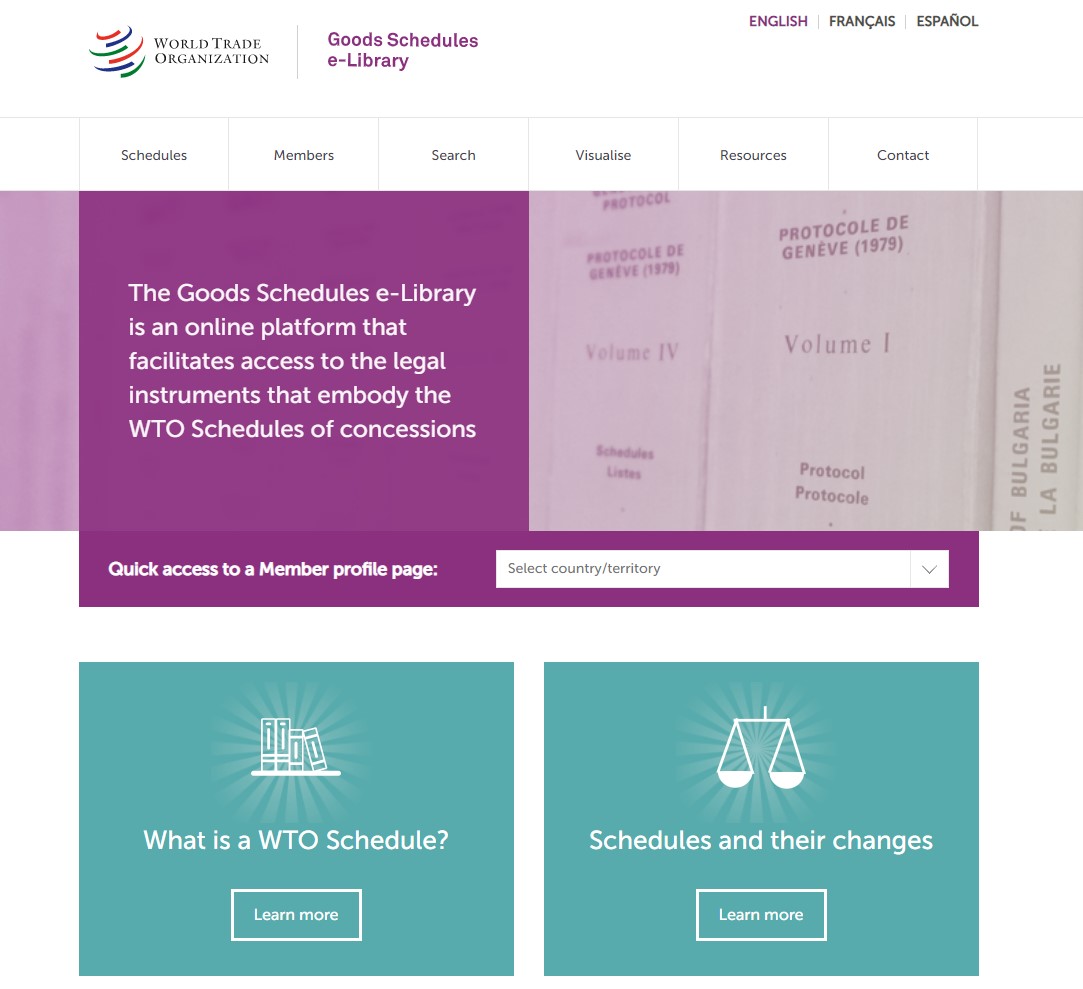
The Goods Schedules e-Library is an online platform that facilitates access to the legal instruments that embody the WTO schedules of concessions.
Download full publication
Order printed copy
OrderDownload:
- Summary tariff tables (MS excel format)
- Summary trade tables (MS excel format)
- All individual country/territory tariff profiles (MS excel format)
- Individual profiles (pdf format)

Problems viewing this page? If so, please contact [email protected] giving details of the operating system and web browser you are using.