Publications
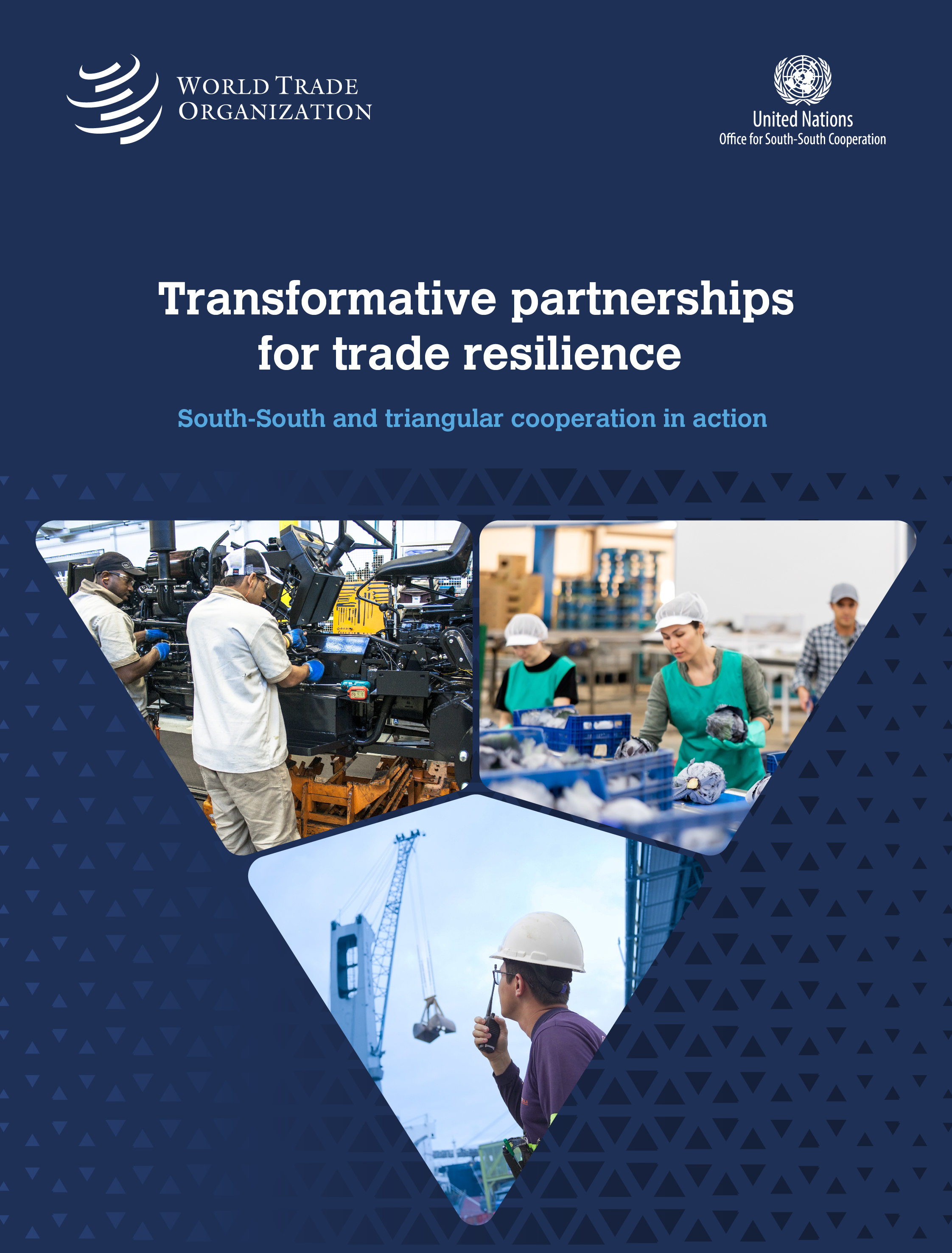
Transformative Partnerships for Trade Resilience - Executive summary
Executive summary
Trade between developing economies – South-South trade – has become a major force in the world economy, representing more than a quarter of world merchandise exports in 2025. South-South cooperation and triangular cooperation (South-South partnerships supported by a developed economy) are helping an increasing number of developing economies share in its benefits.
South-South trade has grown fast, but its gains are uneven
Trade between developing economies accounted for 27.8 per cent of world merchandise exports in 2025, worth around US$ 7.2 trillion. Its share of world exports has nearly doubled since 2005, while its value has increased 4.8-fold. This trade has expanded nearly twice as rapidly as trade between developing and developed economies and has remained resilient through successive crises.
Its benefits, however, remain unevenly shared. Most South-South trade takes place within developing Asia. Outside Asia, developing regions trade more with Asia than with each other. Regional integration in Africa and in Latin America and the Caribbean is the largest untapped source of growth.
Broadening participation in trade depends on lowering the policy and institutional barriers that raise the costs of trade. These costs in developing economies remain almost 30 per cent higher than in high-income economies, with non-tariff measures, limited access to trade finance and weak quality infrastructure weighing heavily on exporters in developing economies. South-South and triangular cooperation can help address these barriers by providing complementary channels for mobilizing knowledge, expertise and resources and by enabling developing economies to share relevant experience and solutions.
A long-standing form of cooperation
South-South cooperation is a long-standing partnership among peers whose scope has steadily widened. Rooted in the 1955 Bandung Conference, a historic meeting of 29 Asian and African developing economies in Indonesia, and further consolidated in the 1978 Buenos Aires Plan of Action (BAPA), which established a framework for technical and economic cooperation among developing economies, it has grown from technical exchanges into economic, financial and multi-actor partnerships.
BAPA+40, the Second High-level UN Conference on South-South Cooperation, in 2019, explicitly recognized its contribution to trade. South-South cooperation is founded on sovereignty, national ownership, non-conditionality and mutual benefit, and complements rather than replaces North-South cooperation.
Over time, an increasingly diverse ecosystem has emerged around South-South cooperation, encompassing regional integration arrangements, development finance institutions in developing economies, national cooperation agencies, trust funds and other platforms for knowledge and resource exchange.
Triangular cooperation extends the impact of South-South cooperation by bringing developed economy and multilateral partners into partnerships led by developing economies. These partners add finance, technical expertise and scale, while leadership stays with the developing economies involved.
New industries open further opportunities for cooperation. Developing economies are already among the leading exporters of green industrial goods, a market worth around US$ 1.76 trillion in 2024, yet production remains concentrated in only a few of these economies. Cooperation on technology, skills, regulatory standards and regional value chains can help many more developing economies take part.
Partnerships with the EIF and STDF have delivered results
Partnerships supported by the multi-agency Enhanced Integrated Framework (EIF) and the Standards and Trade Development Facility (STDF) have illustrated how South-South and triangular cooperation can deliver tangible trade-related results. In each successful partnership, a developing economy has adapted a solution developed by another developing economy, with support provided from international organizations and development partners.
The results are concrete and have lasted beyond the specific projects. The partnerships have ranged from shortening laboratory testing times for export products and securing internationally recognized pest-free areas to opening new export markets and raising incomes for thousands of smallholder farmers.
What the successful partnerships have in common is that they have built lasting institutions. The partnerships adapted solutions proven to work in comparable settings, embedded the results in national institutions and combined external financing with national ownership and leadership.
Measurement of South-South cooperation is improving, but coverage remains incomplete
Better measurement of South-South cooperation is needed to build a more complete picture of its importance. Much of this cooperation takes the form of technical assistance, training, expert exchanges and knowledge sharing, which is difficult to capture by conventional financial statistics. As a result, its scale and results are often underestimated, both in national policy-making and in the monitoring of support for trade.
Two complementary frameworks are now helping to improve measurement. The United Nations (UN) Framework to Measure South-South Cooperation, established by developing economies engaged in South-South Cooperation and welcomed by UN member states at the UN Statistical Commission in 2022, underpins reporting under UN Sustainable Development Goal (SDG) 17.3.1, with UN Trade and Development as its custodian. Ten economies reported under SDG 17.3.1 for the first time in 2026.
Secondly, Total Official Support for Sustainable Development (TOSSD) records official support regardless of its form, including South-South and triangular cooperation. More than 130 economies and organizations now report to the TOSSD, among them 19 developing economies.
Data coverage needs to be broadened to give a full picture of South-South cooperation. Many developing economies face practical difficulties in collecting information across ministries and agencies. Stronger national data systems, peer learning and coherent reporting across the UN Framework to Measure South-South Cooperation and TOSSD would allow more developing economies to report on their own priorities and would make trade-related cooperation more visible.
Priorities for action
Three priorities emerge for maximizing the impact of South-South and triangular cooperation in trade. They build on the BAPA+40 of 2019, the Sevilla Commitment on financing for development adopted by the United Nations in 2025, the Awaza Programme of Action for landlocked developing countries adopted by the UN in 2024 and the Antigua and Barbuda Agenda for small island developing states (SIDS) adopted by world leaders in 2024.
- Targeted action is needed on key trade-related constraints, including resilience in sectors and supply chains exposed to crises, financing for trade-related capacity, regional integration and cross-border cooperation, sustained trade capacity, and broader participation by least-developed countries, landlocked developing countries and SIDS.
- Inter- and intraregional cooperation needs to be strengthened with financial institutions and development partners, including on regional value chains and through co-financing mechanisms such as the UN Office for South-South Cooperation’s (UNOSSC’s) Triangular Cooperation Window.
- Coordination, partnership brokering and measurement need to be improved, including by strengthening connections between trade-related facilities and existing South-South and triangular cooperation mechanisms and platforms.
Partnership is the thread that runs through the three priorities. It is also the theme of the 2026 Global Review of Aid for Trade. As the initiative marks its twentieth anniversary, this co-publication of the WTO and UNOSSC contributes to the discussion on building partnerships for trade that effectively leverages South-South and triangular cooperation for resilient, inclusive and sustainable trade.
Share
Problems viewing this page? If so, please contact [email protected] giving details of the operating system and web browser you are using.