Trade in Services for Development initiative
Trade in Services for Development initiative
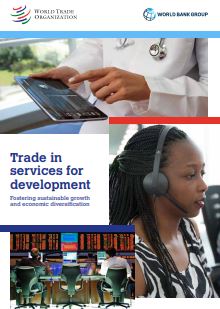
In 2023, the WTO and the World Bank co-published "Trade in Services for Development". The publication was launched by WTO Director-General, Dr Ngozi Okonjo-Iweala and the President of the World Bank, Ajay Banga, at an event attended by ministers from Jamaica, Rwanda and the United Kingdom.
See also
The co-publication revealed that the role of services trade and investment in services in supporting economic growth and development warrants greater policy attention and international cooperation.
The co-publication led to the development of the Trade in Services for Development (TS4D) initiative.
A global economy shifting towards services
In recent decades, services have emerged as the driving force for the economic growth of countries at all levels of development. They account for the largest share of global economic activity, generating more than two-thirds of GDP. They also employ the most workers, and are the source of most new jobs, especially for female and young workers.
The shift towards services has been pronounced in developing economies, where growth in services output has mostly outpaced growth in industry and agriculture. The shift towards services since the 1970s has been most prominent for upper middle-income and high-income economies. The GDP share of services in low-income economies has also increased since then, but it is less pronounced than in other developing economies.
The services sector today generates more jobs than any other sector. Services also play an important role in women’s empowerment, as most women employed globally now work in the services sector. The share of women employed in the services sector has increased in all economies since 2000.
Services are the future of trade
Services trade has been the most dynamic component of world trade for the last 15 years, providing developing and least-developed economies with significant opportunities for export-led growth, economic diversification, inflows of foreign direct investment (FDI) and integration into global value chains.
Fuelled by advances in information and communications technologies (ICT), global commercial services exports have almost tripled since 2005. The composition of services trade has changed markedly, with exports of digitally delivered services increasing almost four-fold.
Services also play a critical trade-facilitating role in the functioning of regional and global value chains, with trade in intermediate services (i.e. inputs in the production of other goods and services) valued at more than double the value of final services exports.
Underlining the "servicification" of the world economy, services account today for 50 per cent of global trade in value-added terms, compared to 16 per cent for agriculture and 34 per cent for industry.
The importance of services trade in the global economy is further amplified when services supplied through a commercial presence (mode 3 – a foreign company provides services through establishment in another member's territory) are taken into account. This represents more than half of global trade in services. Services trade has also led to an increasing number of jobs linked to services exports, and plays the main role in MSME's participation in international trade.
Dynamic sector but opportunities remain to be seized
The fast growth of services trade has been even stronger in developing economies. Between 2005 and 2023, the growth of commercial services exports of LDCs and other developing economies exceeded the world average by a wide margin (over 300% for LDCs and over 250% for other developing economies).
The expansion of developing economies’ exports is increasingly due to services supplied across borders via digital means. Developing economies also account for an increasing share of non-traditional service exports, such as "other commercial services" (including computer, financial and business services).
The share of developing economies in world services exports has increased markedly (from 23.5% in 2005 to around 35% in 2022).
However, this growth is starting from a low base, and there are important differences across economies and regions. LDCs still account for less than 1% of world services exports, with important opportunities remaining to be seized.
Services trade policies are key to growth
Trade policy in services has an important role to play in fostering growth and in helping to respond to key challenges. It should form an integral part of development strategies because openness to services trade has a positive impact on economy-wide productivity and on the performance of key services sectors.
For example, services such as transport and logistics provide the basic infrastructure that underpins trade in goods. Without efficient services, goods cannot be successfully traded. Indeed, services trade restriction in logistics, maritime services and road transport has been found to lead to higher trade costs, negatively impacting goods exports.
Facilitating services policies reduce trade costs, help attract foreign direct investment (FDI), boost supply-chain resilience and increase manufacturing productivity and exports. For instance, openness in services trade can lead to greater productivity in manufacturing industries and an increase in manufacturing exports due to the key role of services inputs. Facilitating trade in services therefore benefits the local manufacturing sector while trade or investment restrictions raise costs and reduce export competitiveness.
Moreover, there is growing acceptance that services trade will prove central to global economic growth, with clear benefits provided by a rapidly digitalizing global economy. Services also play a key role in facilitating timely access to critical goods in response to pandemics and natural disasters, in addressing food security through modern agricultural practices, in facilitating the transition to a decarbonized global economy, and in designing and deploying green technologies.
Services trade policies are also instrumental in attaining a range of other policy objectives, such as ensuring greater economic and export diversification, or increasing opportunities for female workers, young people and MSMEs, as they all have the potential to benefit from an expansion of services trade.
The manner in which governments design and implement services trade policies is central to their development and to prospects for deeper integration into world trade. However, barriers to trade in various service sectors and modes of supply remain significant around the world.
Support can help developing economies reap benefits of services trade
Governments are confronted with a number of challenges as they enact policies aimed at harnessing the potential of services trade to support inclusive economic growth and development. Many of these challenges stem from the sheer diversity of the services economy. A deepened commitment to supportive business environments and to trade openness in services are essential for a comprehensive growth agenda.
Deepened international cooperation aimed at increasing the predictability of policy regimes and commitments in trade agreements, lowering barriers to trade in services and promoting the adoption of trade-facilitating regulatory practices are all key to realizing the development potential of services trade. While a significant share of the gains from services reforms are secured through the unilateral actions of governments, trade agreements can play a complementary role.
The Aid for Trade initiative, which aims to help developing economies strengthen their capacity to trade, could help to address the challenges many developing and least-developed economies face in participating in services trade negotiations, implementing negotiated outcomes and exporting services.
A Trade in Services for Development initiative could help to mobilize more technical assistance and capacity building with the aim of: (i) improving data and information sources on services trade; (ii) facilitating the participation of developing economies in services negotiations and discussions on trade in services; (iii) strengthening services-related regulatory frameworks and institutions; (iv) helping developing economies seize the opportunities offered by digitalization; (v) boosting supply capacities and skill sets in developing economies to increase and diversify their services exports.
Technical assistance and capacity building for trade in services
Following discussions with WTO members and exchanges between the World Bank and the WTO, the Trade in Services for Development (TS4D) initiative was launched.