obstáculos técnicos al comercio
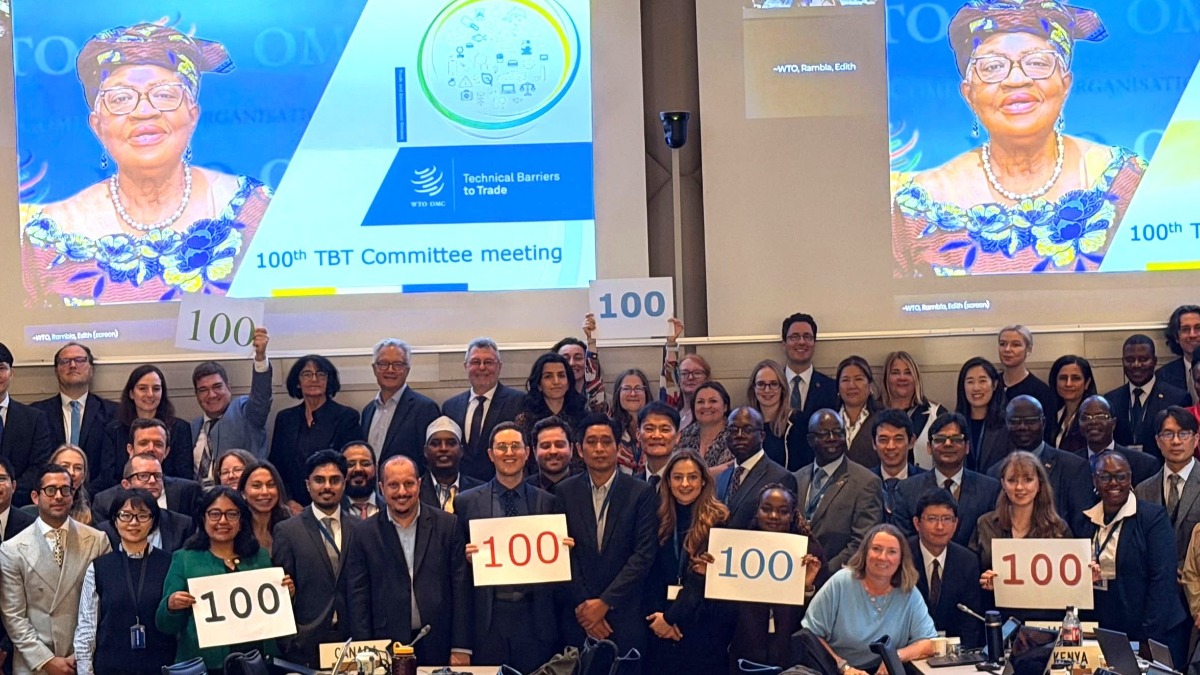
La Directora General elogia la labor del Comité de Obstáculos Técnicos al Comercio en su 100ª reunión
Más información

Nota
La presente nota ha sido preparada por la Secretaría de la OMC para ayudar al público a comprender la labor de los consejos, comités y otros órganos de la OMC. El objetivo no es presentar un informe completo sobre todas las cuestiones planteadas en la reunión. Estas se abordan en el acta de la reunión formal.
DG Okonjo-Iweala congratulated WTO members for their constructive and pragmatic engagement in the Committee's work over the past years, including in tackling emerging regulatory challenges. "At a time of profound pressure on all multilateral institutions, the TBT Committee is a tangible demonstration of the WTO's value in practice. It shows that members still use WTO rules agreed over 30 years ago, and just as importantly, that they can find pragmatic solutions to keep those rules effective."
The recording is available here.
Standards development process
A session on the process for developing standards held on 10 November explored common challenges and practical approaches to implementing the TBT Agreement's disciplines on standards, including the "Code of Good Practice for the Preparation, Adoption and Application of Standards". It discussed challenges faced by developing economies and least-developed country members in setting and implementing international standards, such as limited resources, technical expertise and stakeholder awareness, as well as the importance of training and capacity-building.
Speakers also highlighted the importance of the TBT Committee's "Six Principles", which guide the development of international standards to ensure they are fair, inclusive and transparent, and do not create unnecessary barriers to trade, and the importance of using relevant international standards in regulatory processes. The importance of transparent and inclusive processes for developing standards was also highlighted.
Interoperable data standards
A session on interoperable data standards held the same day explored how interoperable digital standards - meaning standards that allow different products, technologies and systems to work together across markets - and trusted digital data can reduce technical barriers to trade, including conformity assessment costs.
Speakers highlighted the importance of metrology, accreditation and conformity assessment in ensuring the reliability of digital information. The discussion also addressed the risks of regulatory fragmentation on driving up costs for exporters, especially small businesses in developing economies. In addition to the "Six Principles", the importance of international standardization efforts in promoting interoperability were underscored.
Additive manufacturing
A session on additive manufacturing also held on 10 November examined the current landscape of international standards, regulations and conformity assessment procedures for additive manufacturing technologies, such as 3D printing. Speakers said international standards help to promote regulatory coherence and reduce compliance costs, while noting the rapid evolution of technology.
They also discussed how additive manufacturing challenges conventional conformity assessment, as product quality depends on multiple production factors. Also highlighted was the role of advanced inspection technologies and accreditation in strengthening confidence in additively manufactured products and facilitating international trade.
The recordings of each session can be watched here.
Linkages with WTO Trade Facilitation Agreement
A cross-cutting information session held on 11 November highlighted a practical link between the TBT Agreement and the Trade Facilitation Agreement for traders who need to meet technical requirements and complete border procedures as part of the same transaction. Members explored the complementarity of each Committee's work on transparency and enquiry points, conformity assessment, risk management, cooperation among authorities, national coordination and technical assistance, among other aspects. The session was led by the respective chairs of each Committee, namely Maryam A. Aldoseri (Bahrain, Kingdom of) and Alix Rancurel (France).
Specific trade concerns
On 11 November, the Committee heard positive developments in three previously raised concerns. The United Kingdom, Australia and Canada reported on progress with regards to Indonesia's Halal Product Assurance Law and Mexico reported on progress with regards to South Africa's amendments to the Regulations of Liquor Products Act. It was also noted that Türkiye's concerns with respect to Saudi Arabia's conformity assessment practices affecting its products were resolved.
The Committee considered a total of 79 new and previously raised trade concerns regarding proposed and final TBT measures, which are listed here.
The 15 new trade concerns addressed regulations related to batteries, chemicals, food and beverages, fertilizers, halal products, motor compressors, textiles sold in e-commerce (known as the "ultra-fast fashion"), vehicles, among other issues.
Transparency
The Committee adopted further improvements to notifications and related processes following work carried out in the Transparency Working Group. The scope of the notification format has been broadened to facilitate members' voluntary information sharing.
Pakistan, Nigeria and Tanzania presented their updated notifications of the legal and institutional arrangements for implementing the TBT Agreement. These notifications are available here.
ePing updates
In an update on the ePing project funded by the Standards and Trade Development Facility (STDF), the WTO Secretariat reported on the results of national consultations held in Kenya, Namibia, South Africa, Tanzania and Uganda to identify possible improvements to ePing. The ePing platform helps businesses and governments keep track of new product regulations and standards in export markets, enabling them to anticipate changing requirements and avoid unnecessary trade disruptions. All WTO members will now receive a survey to guide the evolution of ePing.
11th Triennial Review
In line with the timeline adopted in July 2026, WTO members started submitting proposals under the 11th Triennial Review of the TBT Agreement, with the aim of defining the Committee's work during the upcoming 2028-2030 cycle. The Triennial Review covers key areas of the Committee's work, including regulatory cooperation between members, transparency, standards, conformity assessment and matters related to the Committee's operation. The proposals submitted by WTO members are available here.
Side events
Two side events were organized on the margins of the meetings, one by the European Union on the "Digital Product Passport" and another by Switzerland and the United Nations' Food and Agriculture Organization (FAO) on "nutrition labelling in practice".
Next TBT week
The next regular meeting of the Committee is scheduled for 17-19 March 2027 and will be preceded by informal meetings.
Compartir
Si tiene problemas para visualizar esta página,
sírvase ponerse en contacto con [email protected], y proporcionar detalles sobre el sistema operativo y el navegador que está utilizando.