

WTO ANALYTICAL INDEX: MARRAKESH AGREEMENT
Marrakesh Agreement Establishing the World Trade Organization
The texts reproduced here do not have the legal standing of the original documents which are entrusted and kept at the WTO Secretariat in Geneva.
- Preamble
- Article I
- Article II
- Article III
- Article IV
- Article V
- Article VI
- Article VII
- Article VIII
- Article IX
- Article X
- Article XI
- Article XII
- Article XIII
- Article XIV
- Article XV
- Article XVI
- Explanatory Notes
- Ministerial Decisions and Declarations Regarding the WTO as an International Organization
- Tables
V. Article IV
Article IV: Structure of the WTO
1. There shall be a Ministerial Conference composed of representatives of all the Members, which shall meet at least once every two years. The Ministerial Conference shall carry out the functions of the WTO and take actions necessary to this effect. The Ministerial Conference shall have the authority to take decisions on all matters under any of the Multilateral Trade Agreements, if so requested by a Member, in accordance with the specific requirements for decision making in this Agreement and in the relevant Multilateral Trade Agreement.
2. There shall be a General Council composed of representatives of all the Members, which shall meet as appropriate. In the intervals between meetings of the Ministerial Conference, its functions shall be conducted by the General Council. The General Council shall also carry out the functions assigned to it by this Agreement. The General Council shall establish its rules of procedure and approve the rules of procedure for the Committees provided for in paragraph 7.
3. The General Council shall convene as appropriate to discharge the responsibilities of the Dispute Settlement Body provided for in the Dispute Settlement Understanding. The Dispute Settlement Body may have its own chairman and shall establish such rules of procedure as it deems necessary for the fulfilment of those responsibilities.
4. The General Council shall convene as appropriate to discharge the responsibilities of the Trade Policy Review Body provided for in the TPRM. The Trade Policy Review Body may have its own chairman and shall establish such rules of procedure as it deems necessary for the fulfilment of those responsibilities.
5. There shall be a Council for Trade in Goods, a Council for Trade in Services and a Council for Trade-Related Aspects of Intellectual Property Rights (hereinafter referred to as the “Council for TRIPS”), which shall operate under the general guidance of the General Council. The Council for Trade in Goods shall oversee the functioning of the Multilateral Trade Agreements in Annex 1A. The Council for Trade in Services shall oversee the functioning of the General Agreement on Trade in Services (hereinafter referred to as “GATS”). The Council for TRIPS shall oversee the functioning of the Agreement on Trade-Related Aspects of Intellectual Property Rights (hereinafter referred to as the “Agreement on TRIPS”). These Councils shall carry out the functions assigned to them by their respective agreements and by the General Council. They shall establish their respective rules of procedure subject to the approval of the General Council. Membership in these Councils shall be open to representatives of all Members. These Councils shall meet as necessary to carry out their functions.
6. The Council for Trade in Goods, the Council for Trade in Services and the Council for TRIPS shall establish subsidiary bodies as required. These subsidiary bodies shall establish their respective rules of procedure subject to the approval of their respective Councils.
7. The Ministerial Conference shall establish a Committee on Trade and Development, a Committee on Balance-of-Payments Restrictions and a Committee on Budget, Finance and Administration, which shall carry out the functions assigned to them by this Agreement and by the Multilateral Trade Agreements, and any additional functions assigned to them by the General Council, and may establish such additional Committees with such functions as it may deem appropriate. As part of its functions, the Committee on Trade and Development shall periodically review the special provisions in the Multilateral Trade Agreements in favour of the least-developed country Members and report to the General Council for appropriate action. Membership in these Committees shall be open to representatives of all Members.
8. The bodies provided for under the Plurilateral Trade Agreements shall carry out the functions assigned to them under those Agreements and shall operate within the institutional framework of the WTO. These bodies shall keep the General Council informed of their activities on a regular basis.
B. Interpretation and Application of Article IV
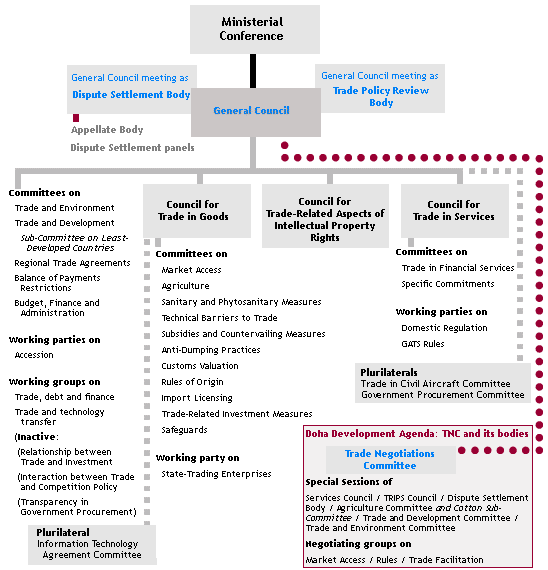
52. The following chart provides an overview of the structure of the WTO:
Key
 |
Reporting to General Council (or a subsidiary body) |
 |
Reporting to Dispute Settlement Body |
 |
Plurilateral committees inform the General Council or Goods Council of their activities, although these agreements are not signed by all WTO members |
 |
Trade Negotiations Committee reports to General Council |
The General Council also meets as the Trade Policy Review Body and Dispute Settlement Body.
(a) “there shall be a Ministerial Conference … which shall meet at least once every two years”
(i) 1996 Singapore Ministerial Conference
53. The First WTO Ministerial Conference was held in Singapore from 9 to 13 December 1996. The Ministerial Declaration(65) was adopted on 13 December 1996. In addition, a number of Members agreed on the Ministerial Declaration on Trade in Information Technology Products.(66) The Conference also agreed to establish working groups to examine the relationship between trade and investment, to study issues raised by Members relating to the interaction between trade and competition policy, and to conduct a study on transparency in government procurement; also, to direct the Council for Trade in Goods to undertake exploratory and analytical work on trade facilitation and the simplification of trade procedures. These subjects are often referred to as the “Singapore issues”.
(ii) 1998 Geneva Ministerial Conference
54. The Second Ministerial Conference was held in Geneva, Switzerland, from 18 to 20 May 1998. The Ministerial Declaration(67) was adopted on 20 May 1998. Ministers also adopted a Declaration on Global Electronic Commerce.(68)
(iii) 1999 Seattle Ministerial Conference
55. The Third Ministerial Conference was held in Seattle, United States, from 30 November to 3 December 1999. Despite intense negotiations with a view to launching a new Millennium Round, consensus was not achieved. Members did not adopt any Ministerial Declaration.(69)
(iv) 2001 Doha Ministerial Conference
56. The Fourth Ministerial Conference was held in Doha, Qatar, from 9 to 14 November 2001. Members launched a new round of negotiations (commonly known as the Doha Round). In addition to the Ministerial Declaration (also known as the Doha Declaration)(70), Ministers adopted the declarations and decisions listed below:
- Declaration on the TRIPS Agreement and Public
Health;(71)
-
Decision on “Implementation-Related Issues and
Concerns”;(72)
-
Decision on “Procedures for Extensions under Article 27.4 of
the SCM Agreement for Certain Developing Country Members”;(73)
- Decision on the “ACP–EC Partnership Agreement”(74) and Decision on the “Transitional Regime for the EC Autonomous Tariff Rate Quota Regime on Imports of Bananas”.(75)
57. The text of the Doha Declaration and related decisions is in Section XIX.D below. The text of the Declaration on the TRIPS Agreement and Public Health is in the Chapter on the TRIPS Agreement.
(v) 2003 Cancún Ministerial Conference
58. The Fifth Ministerial Conference was held in Cancún, Mexico, from 10 to 14 September 2003. The main task was to take stock of progress in negotiations and other work under the Doha Development Agenda. The Members approved a Ministerial statement on 14 September 2003 instructing Member government officials to continue working on outstanding issues.(76) On 1 August 2004, as a follow-up to the Cancún Ministerial Conference, the General Council adopted a decision (also known as the “July Package”), which, inter alia, amended the scope of the Doha negotiations.(77)
(vi) 2005 Hong Kong Ministerial Conference
59. The Sixth Ministerial Conference was held in Hong Kong, China, from 13 to 18 December 2005. Members adopted a Ministerial Declaration providing further guidance regarding the Doha negotiations.(78)
(vii) 2009 Geneva Ministerial Conference
60. The Seventh Ministerial Conference was held in Geneva from 30 November to 2 December 2009. Ministers made statements and exchanged views on the activities of the WTO including the Doha Work Programme, and the WTO’s contribution to recovery, growth and development.(79) They also adopted a Decision on the Work Programme on E-commerce and a Decision on TRIPS Non-Violation and Situation Complaints.(80)
(viii) 2011 Geneva Ministerial Conference
61. The Eighth Ministerial Conference will take place in Geneva, Switzerland, from 15 to 17 December 2011.
(b) “The Ministerial Conference shall carry out the functions of the WTO”
(i) Powers of the Ministerial Conference
62. In addition to general powers under Article IV:1, the Ministerial Conference has specific powers under other Articles of the WTO Agreement, including: the power to appoint a Director-General(81), to adopt an authoritative interpretation of the Multilateral Trade Agreements(82), to grant a waiver(83), to adopt amendments(84), and to decide on accessions.(85)
(ii) Powers under other Agreements
63. Paragraph 2(b) of the GATT 1994 incorporation text provides that the references to the CONTRACTING PARTIES acting jointly in Articles XV:1, XV:2, XV:8, XXXVIII and the Notes Ad Articles XII and XVIII of the GATT 1994, and in the provisions on special exchange agreements in Articles XV:2, XV:3, XV:6, XV:7 and XV:9 of the GATT 1994, shall be deemed to be references to the WTO; the powers of the CONTRACTING PARTIES are therefore exercised by the Ministerial Conference. The other functions that the provisions of GATT 1994 assign to the CONTRACTING PARTIES acting jointly may be allocated to the various WTO organs by decision of the Ministerial Conference; as of 30 September 2011, such a decision had not taken place.
64. Articles XII:5(b) and XII:6 give the Ministerial Conference power to establish certain procedures in connection with balance-of-payments restrictions.(86)
65. Article 64.3 gives the Ministerial Conference power to extend the non-applicability of non-violation complaints to the TRIPS Agreement on recommendation of the TRIPS Council.(87)
66. The Ministerial Conference and General Council have established the following working parties to carry out various functions:
Working Group on the Relationship between Trade and Investment(88);
Working Group on the Interaction between Trade and Competition Policy(89);
Working Group on Transparency in Government Procurement(90);
Working Parties on Accession(91);
Working Party on Preshipment Inspection(92);
Working Group on Trade, Debt and Finance(93); and
Working Group on Trade and the Transfer of Technology.(94)
(c) “Ministerial Conference shall … take decisions on all matters under any of the Multilateral Trade Agreements”
67. As of 31 December 2004, the Ministerial Conference had adopted the following decisions (also see Section V.B.2 above):
Ministerial Declaration adopted in Singapore(95);
Ministerial Declaration on Trade in Information Technology Products adopted in Singapore(96);
Ministerial Declaration adopted in Geneva(97);
Ministerial Declaration on electronic commerce adopted in Geneva(98);
Ministerial Declarations adopted in Doha(99);
Ministerial Declaration on the TRIPS Agreement and Public Health, adopted in Doha(100);
Decision on Implementation-Related Issues and Concerns, adopted in Doha(101);
Decision on Procedures for Extensions under Article 27.4 of the SCM Agreement for Certain Developing Country Members, adopted in Doha(102);
Two decisions on waivers adopted at Doha (Decision on the ACP–EC Partnership Agreement(103) and Decision on Transitional Regime for the EC Autonomous Tariff Rate Quotas on Imports of Bananas(104));
Decision on the Work Programme on E-commerce, adopted in Geneva(105); and
Decision on TRIPS Non-Violation and Situation Complaints, adopted in Geneva.(106)
(d) “in accordance with the specific requirements for decision-making in this Agreement and in the relevant Multilateral Trade Agreements”
68. As regards the specific requirements for decision making, see Section X.B below. Also see the relevant sections of the various Multilateral Trade Agreements.
69. The General Council adopted the rules of procedure for the Ministerial Conference at its meeting of 31 January 1995.(107) The General Council amended these rules on 25 July 1996.
(a) “there shall be a General Council”
70. The General Council is the WTO’s highest-level decision-making body. It meets regularly to carry out the functions of the WTO. It has representatives (usually ambassadors or equivalent) from all Member governments and has the authority to act on behalf of the Ministerial Conference.
(b) “The General Council shall also carry out the functions assigned to it by this Agreement”
71. The General Council is mandated to make appropriate arrangements for effective cooperation with intergovernmental organizations under Article V:1 for consultation and cooperation with non-governmental organizations under Article V:2.(108) Article VII:3 mandates the General Council to adopt financial regulations(109) and the budget.(110)
(c) “the General Council shall establish its rules of procedure”
72. The General Council adopted its rules of procedure on 31 January 1995 (see paragraph 69 above).(111)
73. The General Council approved the first set of guidelines for appointment of officers to WTO bodies on 31 January 1995. These guidelines were proposed by the Chairman of the GATT 1947 CONTRACTING PARTIES and approved by the Preparatory Committee for the World Trade Organization.(112) These guidelines were reviewed on 11 December 2002.(113)
(d) “the General Council shall … approve the rules of procedure for the committees … ”
74. The General Council adopted the rules of procedure for the following Committees at its meetings on the dates set forth below:
Committee on Trade and Development — 15 November 1995(114);
Committee on Balance-of-Payments Restrictions — 13 and 15 December 1995(115); and
Committee on Regional Trade Agreements(116) — 2 October 1996.(117)
(e) Procedures for reporting to and by the General Council
75. On 15 November 1995, the General Council adopted procedures for an annual overview of WTO activities and for reporting under the WTO:
“1. Reporting procedures for sectoral Councils and their subsidiary bodies
All bodies constituted under Annex 1A Agreements shall be required to submit a factual report to the Council for Trade in Goods. The same shall apply to the subsidiary bodies established by the Council for Trade in Services and the Council for Trade-Related Intellectual Property Rights. The reports of the sectoral councils would be factual in nature, containing an indication of actions and decisions taken, with cross references to reports of subordinate bodies and could follow the model of the GATT 1947 Council reports to the CONTRACTING PARTIES. The respective sectoral councils should report in November each year to the General Council on the activities in the Council as well as in the subsidiary bodies.
2. Reporting procedures for the Committees on Trade and Development, on Budget, Finance and Administration and on Balance-of-Payments Restrictions
The Committee on Trade and Development shall submit a report to the General Council at the end of each year. The Committees on Budget, Finance and Administration and on Balance-of-Payments will also submit, in addition to reports submitted during the course of the year on specific issues, a short factual report at the end of the year.
3. Reporting procedures for the Committees on Plurilateral Trade Agreements
The Committees on the Plurilateral Trade Agreements referred to in Article IV:8 of the WTO Agreement shall be invited to report annually to the General Council.
4. Action by the General Council and the sectoral councils
The sectoral councils will take note of reports of their subsidiary bodies.
The General Council will take note of the reports by the sectoral councils, which would serve as a basis for an overview of the activities of the WTO in the course of the year. The report of the Committee on Trade and Development will be adopted by the General Council. The reports of the other subsidiary bodies mentioned in item 2 above would be duly noted.
The General Council would also take note of the reports by the Committees on Plurilateral Trade Agreements referred to in Article IV:8 of the WTO Agreement.
5. Overview by the Ministerial Conference
The General Council will prepare a report on its activities every year which would contain a first section of a factual nature, summarizing actions and decisions taken by the General Council during the year; a section on dispute settlement; a section on trade policy reviews; and a cross reference to the reports of sectoral councils and the Committees mentioned in item 2 above.
The Ministerial Conference would carry out an overview of the activities of the WTO over the previous two years on the basis of the annual reports of the General Council. In years when the Ministerial Conference does not meet, the General Council would carry out an annual overview of the WTO activities as mentioned in item 4 above.
The overview of activities of the WTO based on these reports could be part of an Agenda item for general statements at the Ministerial Conference …”(118)
4. Article IV:3: “the General Council shall convene … to discharge the responsibilities of the Dispute Settlement Body (DSB)”
76. The General Council, acting as the DSB, discharges the responsibilities enumerated inArticle 2.1 of the DSU(119), including: the authority to establish panels, to adopt Panel and Appellate Body reports, to maintain surveillance of implementation of rulings and recommendations and authorize suspension of concessions and other obligations under the covered agreements. (120) For the activities of the DSB generally, see the Chapter on the DSU.
(b) “The DSB … shall establish such rules of procedure”
77. The DSB adopted its own rules of procedure(121) on 10 February 1995. The DSB follows, mutatis mutandis, the rules of procedure for the General Council(122) with certain exceptions. The DSB adopted Chapter V of the rules of procedure concerning officers on 25 April 1995.(123) For the text of the Rules of Procedure, see the Chapter on the DSU.
(c) Special Session of the Dispute Settlement Body
78. The Trade Negotiations Committee created a Special Session of the Dispute Settlement Body for the negotiations on improvements and clarifications of the Dispute Settlement Understanding launched by paragraph 30 of the Doha Declaration. However, paragraph 47 of the Doha Declaration provided that the single undertaking of the Doha Round does not include “improvements and clarifications of the Dispute Settlement Understanding”.(124)
5. Article IV:4: “the General Council shall … discharge the responsibilities of the Trade Policy Review Body”
79. Country reviews are conducted on a rotational basis, with the frequency of review being determined by reference to each Member’s share of world trade in a recent representative period. See the Chapter on the TPRM.
(b) “the Trade Policy Review Body shall …establish such rules of procedure”
80. At its meeting of 6 June 1995, the TPRB adopted its rules of procedure(125) following, mutatis mutandis, the rules of procedures for the General Council(126) with certain exceptions. See the Chapter on the TPRM.
(a) “Council for Trade in Goods”
81. The Council for Trade in Goods oversees the functioning of the Multilateral Trade Agreements in Annex IA. The bodies that administer these Agreements report annually to the Council for Trade in Goods as provided by the Procedures noted above in paragraph 75. The Agreements also specify the following functions for the Council for Trade in Goods(127)
Understanding on the Interpretation of Article XVII of the GATT 1994:
To receive notifications of state trading enterprises — paragraph 1;
To receive counter-notifications of state trading enterprises — paragraph 4; and
To make recommendations with regard to the adequacy of notifications and the need for further information — paragraph 5.
Understanding on the Interpretation of Article XXIV of the GATT 1994:
To receive a full explanation from Members party to an interim agreement leading to the formation of a customs union or a free-trade area, if they believe that 10 years is insufficient for the period in Article XXIV:5(c) of the GATT 1994 — paragraph 3;
To receive the reports of working parties that examine notifications made under Article XXIV:7(a) of the GATT 1994 — paragraph 7;
To receive notifications of substantial changes to the plan and schedule in any interim agreement — paragraph 9; and
To receive periodic reports from customs unions and constituents of free-trade areas — paragraph 11.
Agreement on Textiles and Clothing
The Council for Trade in Goods designated the members of the Textiles Monitoring Body — Article 8.1. It also conducted a review of the Agreement before the end of each stage of the integration process — Article 8.11. The Agreement and all restrictions there under were terminated on 1 January 2005.
Agreement on Trade-Related Investment Measures
To receive notifications of all applied TRIMs that are not in conformity with the TRIMs
Agreement — Article 5.1 — and of TRIMs applied to certain new investments — Article 5.5;
To extend the transition period for the elimination of TRIMs of a developing country Member — Article 5.3;
To assign responsibilities to the Committee on TRIMs — Article 7.2; and
To review operation of the TRIMs Agreement and as appropriate propose amendments to the text to the Ministerial Conference — Article 9.
Anti-Dumping Agreement
To approve anti-dumping action on behalf of a third country — Article 14.4.
Agreement on Safeguards
To review proposals to suspend substantially equivalent concessions — Article 8.2;
To receive notifications on results of consultations, on mid-term reviews (Article 7.4), on compensation (Article 8.1), or on proposed suspension of concessions (Article 8.2) — Article 12.2;
To request additional information from a Member notifying a safeguard measure — Article 12.2; and
To receive reports from the Committee on Safeguards and assign functions to that Committee — Article 13.1.
Agreement on Notification Procedures
To receive recommendations from the Working Group on Notification Obligations and Procedures.
82. In addition, under paragraph 2(b) of the GATT 1994 incorporation text, the Ministerial Conference may allocate certain functions of the CONTRACTING PARTIES to the GATT to organs of the WTO.(128)
83. The Council for Trade in Goods reports to the General Council on an annual basis under the procedures referred to in paragraph 75 above.(129)
84. At its meeting of 31 July 1995, the General Council approved rules of procedure for meetings of the Council for Trade in Goods, consisting of the General Council’s rules of procedure applied mutatis mutandis with agreed modifications.(130)
(b) “Council for Trade in Services”
85. The Council for Trade in Services oversees the functioning of the General Agreement on Trade in Services (GATS), and has the following specific functions provided in the GATS(131)
To receive notifications of laws, regulations or administrative guidelines that significantly affect trade in services covered by specific commitments, and counter-notifications of measures affecting the operation of the GATS — Article III;
To receive and review notifications of economic integration agreements in services, and periodic reports by parties to such agreements, and to make recommendations to the parties — Article V:7;
To receive notifications of labour market integration agreements in services — Article Vbis;
To develop necessary disciplines on measures relating to qualification requirements and procedures, technical regulations and licensing requirements, through bodies it may establish — Article VI:4;
To receive notifications concerning recognition agreements — Article VII:4;
To request information from a Member concerning operations of a monopoly supplier — Article VIII:3;
To receive notifications of a grant of monopoly rights regarding supply of a service covered by a specific commitment, or of a proposed modification of specific commitments — Article VIII:4 or XXI:1; to establish procedures for rectification or modification of schedules — Article XXI:5; to establish procedures for changes to Article II exemptions and scheduled commitments on financial services — Second Annex on Financial Services;
To receive notifications of balance-of-payments measures — Article XII:4;
To be informed of security measures — Article XIVbis;
To carry out an assessment of trade in services, in order to establish guidelines and procedures for negotiations on progressive liberalization — Article XIX;
To consult with a Member or Members upon request, or to refer to arbitration a dispute regarding whether a measure falls within the scope of a double taxation agreement — Article XXII:2;
To carry out functions assigned to it to facilitate the operation of the GATS and further its objectives; to create subsidiary bodies — Article XXIV;
To review Article II exemptions granted for more than five years — Annex on Article II Exemptions; and
To review periodically developments in the air transport sector — Annex on Air Transport Services.
86. The Council for Trade in Services reports to the General Council on an annual basis under the procedures referred to in paragraph 75 above.(132)
87. At its meeting of 15 November 1995, the General Council approved rules of procedure for meetings of the Council for Trade in Services, consisting of the General Council’s rules of procedure applied mutatis mutandis with agreed modifications.(133)
(c) “The Council for Trade-Related Aspects of Intellectual Property Rights (TRIPS)”
88. The Council for Trade-Related Aspects of Intellectual Property Rights (TRIPS Council) oversees the functioning of the Agreement on Trade-Related Aspects of Intellectual Property Rights. It has the following specific functions provided in the TRIPS Agreement, as discussed further in the Chapter on the TRIPS Agreement:
To receive notifications regarding application of the Rome Convention or the Berne Convention — Articles 1.3 and 3.1;
To receive notifications of international intellectual property agreements pre-existing the WTO Agreement — Article 4(d);
To conduct negotiations concerning a multilateral system for notifying and registering geographical indications for certain wines, to keep under review the application of the provisions of Section 3 (Geographical Indications), to consult with Members and to take action as agreed to facilitate the objectives of Section 3 — Articles 23.4 and 24.2;
To receive notifications of laws and regulations pertaining to the TRIPS Agreement made effective by a Member — Article 63.2;
To examine the scope and modalities for non-violation and situation complaints made pursuant to the TRIPS Agreement and submit its recommendations to the Ministerial Conference — Article 64.3;
To grant extensions of the implementation period to least-developed countries — Article 66.1;
To monitor the operation of the Agreement and Members’ compliance there under, and to establish appropriate arrangements for cooperation with WIPO — Article 68; and
To review the implementation of the Agreement periodically and refer to the Ministerial Conference certain amendments — Article 71.
89. The TRIPS Council reports to the General Council on an annual basis under the procedures referred to in paragraph 75 above.(134)
90. At its meeting of 15 November 1995, the General Council approved rules of procedure for meetings of the TRIPS Council, consisting of the General Council’s rules of procedure applied mutatis mutandis with agreed modifications.(135)
(d) The Councils “shall operate under the general guidance of the General Council”
91. The Council for Trade in Goods, see paragraph 82 above, Council for Trade in Services, see paragraph 86 above, and Council for Trade-Related Aspects of Intellectual Property Rights, see paragraph 89 above, all report to the General Council.
(a) “the [Council for Trade in Goods] … shall establish subsidiary bodies”
92. The Council for Trade in Goods has established the following working parties as of 30 September 2011:
Working Party on State Trading Enterprises(136);
Working Group on Notification Obligations and Procedures(137); and
working parties on various regional trade agreements.(138)
93. The Council for Trade in Goods has also established the following committees (all, except (a), under specified provisions):
Committee on Market Access;
Committee on Agriculture(139);
Committee on Sanitary and Phytosanitary Measures(140);
Committee on Technical Barriers to Trade(141);
Committee on Subsidies and Countervailing Measures(142);
Committee on Anti-Dumping Practices(143);
Committee on Customs Valuation(144);
Committee on Rules of Origin(145);
Committee on Import Licensing(146);
Committee on Trade-Related Investment Measures(147);
Committee on Safeguards(148); and
Committee of Participants on the Expansion of Trade in Information Technology Products.
(b) “These subsidiary bodies shall establish … rules of procedure subject to approval of their respective Councils”
94. The Council for Trade in Goods approved the rules of procedure for the following subsidiary bodies on the dates set forth below:
Committee on Market Access — 1 December 1995(149);
Committee on Agriculture — 22 May 1996(150);
Committee on Sanitary and Phytosanitary Measures — 11 June 1997(151);
Committee on Technical Barriers to Trade — 1 December 1995(152);
Committee on Subsidies and Countervailing Measures — 22 May 1996(153);
Committee on Anti-Dumping Practices — 22 May 1996(154);
Committee on Customs Valuation — 1 December 1995(155);
Committee on Rules of Origin — 1 December 1995(156);
Committee on Import Licensing — 1 December 1995(157);
Committee on Trade-Related Investment Measures — 1 December 1995(158);
Committee on Safeguards — 22 May 1996.(159)
95. The Rules of Procedure for the Independent Entity are included in Annex III to the decision by the General Council establishing the Independent Entity.(160)
96. No rules of procedure have been adopted for the Working Party on State Trading Enterprises.
(c) “the [Council for Trade in Services] … shall establish subsidiary bodies as required”
97. As at 31 December 2004, the Council for Trade in Services has established the following subsidiary bodies:
Committee on Trade in Financial Services;
Committee on Specific Commitments;
Working Party on Domestic Regulation;
Working Party on GATS Rules; and
Working Party on Professional Services.
(d) “the [TRIPS Council] shall establish subsidiary bodies as required”
98. The Council for Trade-Related Aspects of Intellectual Property Rights has not established any subsidiary bodies to date.
8. Article IV:7: Committees established by the Ministerial Conference or General Council
99. The Ministerial Conference and General Council have established the following Committees to date:
Committee on Trade and Development(161);
Committee on Balance-of-Payments Restrictions(162);
Committee on Budget, Finance and Administration(163);
Committee on Market Access(164);
Committee on Trade and Environment(165); and
Committee on Regional Trade Agreements.(166)
(a) Committee on Trade and Development
(i) Establishment and terms of reference
100. The General Council established the Committee on Trade and Development on 31 January 1995, with the following terms of reference:
“1. To serve as a focal point for consideration and coordination of work on development in the World Trade Organization (WTO) and its relationship to development related activities in other multilateral agencies.(167)
2. To keep under continuous review the participation of developing country Members in the multilateral trading system and to consider measures and initiatives to assist developing country Members, and in particular the least-developed country Members, in the expansion of their trade and investment opportunities, including support for their measures of trade liberalization.(168)
3. To review periodically, in consultation as appropriate with the relevant bodies of the WTO, the application of special provisions in the Multilateral Trade Agreements and related Ministerial Decisions in favour of developing country Members, and in particular least-developed country Members, and report to the General Council for appropriate action.
4. To consider any questions which may arise with regard to either the application or the use of special provisions in the Multilateral Trade Agreements and related Ministerial Decisions in favour of developing country Members and report to the General Council for appropriate action.
5. To provide guidelines for, and to review periodically, the technical cooperation activities of the WTO(169) as they relate to developing country Members.
6. The Committee will establish a programme of work which may be reviewed as necessary each year.”(170)
101. At the Doha Ministerial Conference, Members decided that the Committee on Trade and Development should act as a forum to identify and debate developmental aspects of the new negotiations.(171)
(ii) Rules of procedure and observer status
102. On 15 November 1995, the General Council approved rules of procedure for meetings of the Committee on Trade and Development(172), consisting of the General Council’s rules of procedure applied mutatis mutandis with agreed modifications.
103. Several intergovernmental organizations have been given observer status in the Committee on Trade and Development and the Sub-Committee on Least Developed Countries.(173)
104. The Committee on Trade and Development reports to the General Council on an annual basis.(174)
Establishment of the Sub-Committee on Least-Developed Countries
105. The Committee on Trade and Development adopted the decision establishing the Sub-Committee on Least-Developed Countries(175) on 5 July 1995 with the following terms of reference:
“(a) to give particular attention to the special and specific problems of least-developed countries;
(b) to review periodically the operation of the special provisions in the Multilateral Trade Agreements and related Ministerial Decisions in favour of the least developed country Members;
(c) to consider specific measures to assist and facilitate the expansion of the least-developed countries’ trade and investment opportunities, with a view to enabling them to achieve their development objectives; (176) and
(d) to report to the Committee on Trade and Development for consideration and appropriate action.”(177)
106. The Sub-Committee on Least-Developed Countries adopted its rules of procedure on 17 October 1995.(178)
Work Programme for Least-Developed Countries
107. Pursuant to paragraph 42 of the Doha Declaration the Sub-Committee on Least-Developed Countries was mandated to report to the General Council on an agreed work programme for least-developed countries.(179) With respect to the mandate of the Doha Declaration and the negotiations on least-developed countries, see paragraphs 42–43 of the Doha Declaration. Since the adoption of the Work Programme for the Least-Developed Countries on 12 February 2002, the Sub-Committee has focused on implementation of that programme(180), as well as monitoring the work of the Integrated Framework discussed immediately following.
108. The Committee on Trade and Development adopted the Guidelines for WTO Technical Cooperation on 15 October 1996.(181) On 13 December 1996, the Singapore Ministerial Conference adopted the Comprehensive and Integrated WTO Plan of Action for the Least-Developed Countries(182), prepared by the Committee on Trade and Development. The Plan of Action “offers a comprehensive approach and includes measures relating to the implementation of the Decision in Favour of Least-Developed Countries(183), as well as in the areas of capacity-building and market access from a WTO perspective.”(184)
109. Also, on the basis of a recommendation by the Committee on Trade and Development(185), the Singapore Ministerial Conference agreed to “organize a meeting with UNCTAD and the International Trade Centre in 1997, with the participation of aid agencies, multilateral financial institutions and least-developed countries to foster an integrated approach to assist these countries enhance their trading opportunities.”(186) On 27–28 October 1997, the High-Level Meeting on Integrated Initiatives for Least-Developed Countries’ Trade Development was organized jointly by the WTO, UNCTAD and ITC, with the participation of the IMF, UNDP and World Bank.(187) At this High-Level Meeting, Members (i) “endorsed the Integrated Framework for Trade-Related Technical Assistance, including for Human and Institutional Capacity Building, to support Least-Developed Countries in Their Trade and Trade- Related Activities”(188), (ii) recommended “all WTO Members to keep under active review all options for improving market access for least-developed countries presented in the Comprehensive and Integrated WTO Plan of Action for the Least-Developed Countries and to monitor the implementation of the commitments made in this regard”(189), and (iii) “took note of the two reports and the recommendations” produced in the two roundtable discussions.(190)
110. In 2000, pursuant to the mandate in paragraph 109 above(191), the Sub-Committee on Least-Developed Countries conducted the review of all options for improving market access for least-developed countries presented in the Comprehensive and Integrated WTO Plan of Action for the Least-Developed Countries, and reported it to the Committee on Trade and Development.(192) In addition, pursuant to that mandate, the six core international agencies of the Integrated Framework, i.e. IMF, ITC, UNCTAD, UNDP, World Bank and WTO, conducted the review of the Integrated Framework.(193) In order to implement the decision by the heads of the six core agencies for the Integrated Framework to revamp the Integrated Framework, the Sub-Committee on Least-Developed Countries adopted the Integrated Framework Pilot Scheme.(194) The Pilot scheme included (i) the recommendation on the establishment of a trust fund(195), and, (ii) the proposal on the establishment of the Integrated Framework Steering Committee and the Inter-Agency Working Group.(196)
111. The Doha Declaration instructed the Director-General to consult with the relevant agencies, bilateral donors and beneficiaries, to identify ways of enhancing and rationalizing the Integrated Framework for Trade-Related Technical Assistance to Least-Developed Countries and the Joint Integrated Technical Assistance Programme (JITAP). The Committee on Budget, Finance and Administration was instructed to develop a plan for adoption by the General Council in December 2001 to ensure long term funding for WTO technical assistance.(197)
112. On 13 July 2003, the six core agencies issued a joint communiqué that reaffirmed their commitment to providing assistance that would enable the effective integration of least-developed countries into the multilateral trading system.(198)
113. At its meeting of 9–10 February 2004, the Integrated Framework Working Group adopted its work programme in the wake of the second evaluation of the Integrated Framework.(199) The work programme was subsequently approved by the IF Steering Committee at its 11th Session on 13 February 2004.(200) The Integrated Framework Working Group aims to achieve, inter alia, the following by 31 December 2005:
(a) “Encourage effective follow-up to the Diagnostic Trade Integration Study (DTIS) in those countries where the studies have been completed(201), as outlined in document WT/LDC/SWG/IF/13. Bilateral and multilateral development partners are urged to work with committed IF partner governments to respond to the trade-related technical assistance priorities identified in the DTIS and its Action Matrix;
(b) undertake new DTIS in countries that have demonstrated clear and strong commitment to mainstream trade into national development plans …”
Favourable and more preferential treatment for developing countries
114. The Comprehensive and Integrated WTO Plan of Action for the Least-Developed Countries (see paragraph 108 above) also includes “provision for taking positive measures, for example duty-free access, on an autonomous basis, aimed at improving their overall capacity to respond to the opportunities offered by the trading system.”(202) At the High-Level Meeting referenced in paragraph 109 above, as well as shortly thereafter, 28 Members announced steps taken, or to be taken to enhance market access for imports from LDCs.(203)
115. Paragraph 42 of the Doha Ministerial Declaration commits WTO Members “to the objective of duty-free, quota-free market access for products originating from LDCs” and “to consider additional measures for progressive improvements in market access for LDCs.”(204)
116. The Decision on Implementation-Related Issues and Concerns combined with paragraph 12 of the Doha Declaration aimed to provide a two-track solution to developing countries’ issues concerning implementing the WTO agreements.(205)
117. As part of the Work Programme adopted by the Sub-Committee on Least-Developed Countries on 28 February 2002(206), it was agreed that the focus would be on: (i) the identification and examination of market access barriers to products of least developed countries in desired markets; (ii) annual reviews in the Sub-Committee on Least-Developed Countries of market access improvements, market access measures taken by Members; and (iii) examination of possible additional measures for improvement of market access, including elimination of barriers to exports and further improvement of preferential access schemes such the GSP.(207)
118. As of 30 September 2011, the WTO maintains, beyond the specific provisions contained in the WTO Agreement, two additional legal instruments concerning favourable and more preferential treatment for developing countries: (i) the Enabling Clause(208) and (ii) the Waiver on Preferential Tariff Treatment for Least-Developed Countries.(209) With respect to the activities of the Committee on Trade and Development and the Sub-Committee on Least-Developed Countries concerning the Waiver on Preferential Tariff Treatment for Least-Developed Countries respectively, see the Chapter on the GATT 1994 under Article I.
119. The Committee on Trade and Development receives notifications of regional trade agreements among developing countries, pursuant to the Enabling Clause. Before December 2006, the Committee reviewed regional trade agreements on the basis of procedures it adopted on 2 November 1998.(210) When an agreement was notified under the Enabling Clause, it was inscribed on the agenda of the Committee on Trade and Development. Subsequent actions of the Committee might have included “noting” the agreement, requesting additional information, transferring it to the Committee on RTAs for examination, and reviewing reports made by members on changes to their agreements.
120. The Decision on a Transparency Mechanism for Regional Trade Agreements(211), adopted by the General Council on 14 December 2006, applies to RTAs notified under paragraph 2(c) of the Enabling Clause, as well as under Article XXIV of the GATT and Article V of the GATS. For additional information on the Transparency Mechanism, see the section on the Committee on Regional Trade Agreements below and the Chapter on the GATT 1994 (under Article I and XXIV).
121. On 14 December 2010, the General Council adopted a Transparency Mechanism for Preferential Trade Arrangements (PTAs), applying to almost all differential and more favourable treatment under the Enabling Clause; “preferential treatment accorded by any Member to products of least-developed countries”; and “any other non-reciprocal preferential treatment authorized under the WTO Agreement”.(212) This Transparency Mechanism calls for early notification of such non-reciprocal preferences. Each preferential arrangement is to be considered by the Committee on Trade and Development on the basis of a factual presentation prepared by the Secretariat, in a single formal meeting of the Committee. All information notified is to be made available on the WTO website, and the Secretariat is to maintain an electronic database accessible to the public. This Transparency Mechanism is to apply on a provisional basis until Members approve its permanent application.(213)
(v) Reference to GATT practice
122. Regarding GATT practice and the terms of reference and activities of the Committee on Trade and Development under GATT 1947.
(b) Committee on Balance-of-Payments Restrictions
(i) Establishment and terms of reference
123. The General Council established the BOPs Committee(214) on 31 January 1995, with the following terms of reference:
“(a) to conduct consultations, pursuant to Article XII:4, Article XVIII:12 and the Understanding on the Balance-of-Payments Provisions of the General Agreement on Tariffs and Trade 1994, on all restrictive import measures taken or maintained for balance-of-payments purposes and, pursuant to Article XII:5 of the General Agreement on Trade in Services, on all restrictions adopted or maintained for balance-of-payments purposes on trade in services on which specific commitments have been undertaken; and,
(b) to carry out any additional functions assigned to it by the General Council.”(215)
124. The General Council approved the rules of procedure for the BOPs Committee at its meeting of 13 and 15 December 1995.(216)
125. The BOPs Committee reports to the General Council on an annual basis.
126. Regarding the activities of the BOPs Committee, see the Chapters on the GATT 1994 and on the GATS. Regarding the activities of the BOPs Committee under the GATT 1947.
(c) Committee on Budget, Finance and Administration
(i) Establishment and terms of reference
127. The General Council established the BFA Committee(217) at its meeting of 31 January 1995, with the following terms of reference:
“(i) To examine any questions arising in connection with the audited accounts, proposals for the budgets of the WTO and [of the International Trade Centre UNCTAD/WTO, and](218) the financing thereof.
(ii) To study any financial and administrative questions which may be referred to it by the Ministerial Conference or the General Council, or submitted to it by the Director-General, and undertake such other studies as may be assigned to it by the Ministerial Conference or the General Council.”(219)
128. At its meeting of 17 February 1995, the Chairman of the General Council suggested that the BFA Committee follow the rules of procedure for the General Council, except for voting procedures. The BFA Committee agreed to work by consensus.(220)
129. The BFA Committee submits annual reports to the General Council.(221)
130. With respect to the activities of the BFA Committee, see paragraph 180.
(d) Committee on Market Access
(i) Establishment and terms of reference
131. The General Council established the Committee on Market Access(222) on 31 January 1995, with the following terms of reference:
“(a) in relation to market access issues not covered by any other WTO body:
- supervise the implementation of concessions relating to tariffs
and non-tariff measures;
- provide a forum for consultation on matters relating to tariffs and non-tariff measures;
(b) oversee the application of procedures for modification or withdrawal of tariff concessions;
(c) ensure that GATT Schedules are kept up-to-date, and that modifications, including those resulting from changes in tariff nomenclature, are reflected;
(d) conduct the updating and analysis of the documentation on quantitative restrictions and other non tariff measures, in accordance with the timetable and procedures agreed by the CONTRACTING PARTIES in 1984 and 1985 (BISD 31S/227 and 228, and BISD 32S/92 and 93).
(e) oversee the content and operation of, and access to, the Integrated Data Base;
(f) report periodically — and in any case not less than once a year — to the Council on Trade in Goods.”(223)
132. On 1 December 1995, the Council for Trade in Goods approved the rules of procedure for meetings of the Committee on Market Access.(224)
133. The Committee on Market Access reports to the Council for Trade in Goods on an annual basis.(225) It also reports to the Council for Trade in Goods on a periodic basis.(226)
134. With respect to the activities of the Committee on Market Access, see the section on Article II in the Chapter on the GATT 1994.
135. With regard to the Integrated Data Base (IDB) and the Consolidated Tariff Schedules (CTS) database, the Committee on Market Access decided that providing broader access to the information in the IDB and the CTS database would contribute to the effective delivery of market access-related technical assistance to developing and least developed countries. In order to achieve this, it adopted a dissemination policy(227) which draws upon the IDB dissemination practices(228) focused on the accessibility of IDB and CTS information via the Internet and on the distribution of CD-ROMs.
(e) Committee on Trade and Environment
(i) Establishment and terms of reference
136. Pursuant to the Marrakesh Ministerial Decision on Trade and Environment, the General Council established the Committee on Trade and Environment on 31 January 1995 with the following terms of reference:
“(a) [T]o identify the relationship between trade measures and environmental measures, in order to promote sustainable development;
(b) [T]o make appropriate recommendations on whether any modifications of the provisions of the multilateral trading system are required, compatible with the open, equitable and non-discriminatory nature of the system, as regards, in particular:
- [T]he need for rules to enhance positive interaction between
trade and environmental measures, for the promotion of sustainable
development, with special consideration to the needs of developing
countries, in particular those of the least developed among them; and
-
[T]he avoidance of protectionist trade measures, and the
adherence to effective multilateral disciplines to ensure responsiveness
of the multilateral trading system to environmental objectives set forth
in Agenda 21 and the Rio Declaration, in particular Principle 12; and
- [S]urveillance of trade measures used for environmental purposes, of trade-related aspects of environmental measures which have significant trade effects, and of effective implementation of the multilateral disciplines governing those measures”.(229)
137. On 1 March 1995, the Council for Trade in Services, pursuant to the Ministerial Decision on Trade in Services and the Environment, requested the Committee on Trade and Environment to examine and report on the relationship between trade in services and the environment including the issue of sustainable development.(230) See the Chapter on the GATS.
138. In practice, the Committee on Trade and Environment follows the rules of procedure adopted by the General Council.(231)
139. The Committee on Trade and Environment reports to the General Council on an annual basis.(232)
140. See paragraphs 31–33 of Section XIX.D.1 below (Doha Declaration). The Committee has reported on its work under the Doha mandate separately and in its annual reports.(233)
(f) Committee on Regional Trade Agreements
(i) Establishment and terms of reference
141. The General Council established the Committee on Regional Trade Agreements (Committee on RTAs)(234) on 6 February 1996 with the following terms of reference:
“(a) to carry out the examination of agreements in accordance with the procedures and terms of reference adopted by the Council for Trade in Goods, the Council for Trade in Services or the Committee on Trade and Development, as the case may be, and thereafter present its report to the relevant body for appropriate action;(235)
(b) to consider how the required reporting on the operation of such agreements should be carried out and make appropriate recommendations to the relevant body;
(c) to develop, as appropriate, procedures to facilitate and improve the examination process;
(d) to consider the systemic implications of such agreements and regional initiatives for the multilateral trading system and the relationship between them, and make appropriate recommendations to the General Council; and
(e) to carry out any additional functions assigned to it by the General Council.”(236)
142. The Committee on RTAs adopted its rules of procedure on 2–3 July 1996, which provide, inter alia, that the rules of procedure for meetings of the General Council shall apply, mutatis mutandis, for meetings of the Committee on RTAs, with agreed modifications.(237)
143. The Committee on RTAs reports to the General Council on an annual basis.(238)
144. On 20 February 1998, under item 1(b) of its terms of reference, the Committee adopted recommendations to the Council for Trade in Goods, Council for Trade in Services and the Committee on Trade and Development on a notification format for RTAs and on carrying out reporting requirements on the operation of regional trade agreements. (239) In November 1998, the relevant bodies acted on these recommendations.(240) The Committee on RTAs then circulated schedules for the submission of biennial reports in December 1998, February 2001 and December 2003.(241) No such schedules were circulated after 2003. On 14 December 2006, the General Council established on a provisional basis a new Transparency Mechanism for all RTAs (see paragraph 149 below); since then, biennial reports have been de facto superseded by relevant reporting requirements provided for in the Transparency Mechanism.
145. Point 1(a) of its terms of reference above calls for the Councils or the Committee on Trade and Development to adopt separate terms of reference for the examination of each regional trade agreement, and for the Committee on RTAs to carry out any examination. (242) Up to the adoption of the Transparency Mechanism for RTAs, the Council for Trade in Goods and the Council for Trade in Services referred for examination in the Committee on RTAs every RTA notified to them; the Committee on Trade and Development referred one RTA to the Committee on RTAs.
146. For statistics on the number of regional trade agreements notified to the GATT/WTO, see the Chapter on the GATT 1994 under Article XXIV and Article I, and the Chapter on the GATS under Article V. For a complete list of RTAs notified to the GATT/WTO, see the table at the end of the Chapter on GATT 1994.
147. At its 44th Session on 13 October 2006, the Committee on RTAs adopted a common and simplified notification format for regional trade agreements, and agreed to recommend it to the relevant bodies.(243) During 2007, the relevant bodies acted on these recommendations.(244)
148. The work of the Committee has been substantially revised in the light of the General Council Decision of 14 December 2006 on a Transparency Mechanism for Regional Trade Agreements.(245)
149. The Transparency Mechanism for RTAs is to be applied on a provisional basis and replaced by a permanent mechanism adopted as part of the overall results of the Doha Round. The Transparency Mechanism applies to all RTAs notified under GATT Article XXIV, GATS Article V and the paragraph 2(c) of the Enabling Clause. The main features of the mechanism, agreed upon in the Negotiating Group on Rules, include the early announcement of any RTA; guidelines regarding the notification of RTAs; the preparation by the Secretariat of factual presentation and factual abstracts of RTAs; provisions regarding subsequent notification and reporting of notified RTAs; technical support for developing countries; and the distribution of work between the Committee on RTAs — entrusted to implement the mechanism vis-à-vis RTAs falling under Article XXIV of GATT 1994 and Article V of the GATS — and the Committee on Trade and Development, entrusted to do the same for RTAs falling under the Enabling Clause. For additional information regarding the Transparency Mechanism, see paragraph 154 below.
150. At the time of the adoption of the Decision on the Transparency Mechanism for Regional Trade Agreements in December 2006, the Chair of the General Council had noted that Members intended to conduct an initial review of the Mechanism within one year.(246) At meetings held in November and December 2007, the Chairs of the Committee on RTAs and of the Negotiating Group on Rules, with the full knowledge of the Chair of the Committee on Trade and Development, reported that Members considered that there was not yet enough experience for the review.(247) In its meeting on 13 December 2010, the Negotiating Group on Rules agreed to promptly launch this review, aimed at making the Transparency Mechanism a permanent mechanism. The Chairman clarified that it was understood that the legal review also formed part of that review. The review would be based on Members’ views on the Transparency Mechanism and proposals for improvement, a document from the Secretariat summarizing its experiences and difficulties; the Chairs of the implementing Committees, namely the Committee on Regional Trade Agreements and the Committee on Trade and Development, were also invited to comment on their respective body’s experience with the Transparency Mechanism.(248) As of 30 September 2011, such review had not been completed.(249)
151. Following a request by the Chairman of the General Council regarding ways to improve the timeliness and completeness of notifications made in 2009, the Committee on Regional Trade Agreements, through the engagement of its Chairman, is actively pursuing the issue through contacts with the relevant delegations as regards when and how these agreements could be notified.(250)
152. Since June 2010, discussions are being held in the Committee on RTAs on a proposal for a work programme on cross-cutting issues on RTAs. As of 30 September 2011, no conclusion has been reached on this issue.
Procedures for the consideration and examination of RTAs
153. After establishment of the Committee on RTAs and before adoption of the Transparency Mechanism for RTAs, the notification of an agreement (together with its text) was considered by the Council for Trade in Goods (if the RTA was notified under Article XXIV of the GATT 1994), the Council for Trade in Services (if the RTA was notified under GATS Article V) or the Committee on Trade and Development (if the RTA was notified under the Enabling Clause). If examination of the agreement was provided for, the relevant body adopted the terms of reference for the examination and transferred the examination task to the CRTA.(251) The examination was generally based on information provided by the parties to the RTA in the form of a Standard Format.(252) The factual examination was generally completed within one or two meetings, and involved oral and written questions and replies, as well as general statements by Members; all documents were published as formal documents.(253) Once the factual examination was completed, the Secretariat was invited to draft a report of the examination, as the basis for consultations with Members. After its adoption by the Committee, the report was to be sent to the relevant body for final adoption. Since the entry into force of the WTO, the Committee on RTAs has been unable to finalize reports on any of the examinations before it.
154. Following the adoption of the Transparency Mechanism, procedures applying to the consideration of RTAs notified to the WTO are as follows(254)
- The Secretariat, on its own responsibility and in full
consultation with the parties, prepares a factual presentation of each
notified RTA. The factual presentation is primarily based on information
provided by the parties, including a detailed data submission as
outlined in the Annex to the decision establishing the Transparency
Mechanism.
-
The Secretariat’s factual presentation, as well as any
additional information submitted by the parties is circulated in all WTO
official languages not less than ten weeks in advance of the CRTA
meeting. Members’ written questions or comments on the RTA under
consideration should be transmitted at least four weeks before the
corresponding meeting and should be distributed, together with replies,
at least three working days before the corresponding meeting. As a rule,
a single formal meeting is devoted to the consideration of each notified
RTA and any additional exchange of information should take place in
written form. Detailed minutes are produced on each meeting devoted to
the RTA examination, and published as formal documents.
-
The Secretariat is to prepare factual abstracts for those
RTAs for which the Committee RTA had concluded the factual examination
prior to 31 December 2006. These factual abstracts follow an outline
developed jointly by the Secretariat and the Members; they do not
contain up-to-date information, but an additional information column is
retained as a standard, at least on a provisional basis.(255)
-
Parties to an RTA are to notify changes affecting the
implementation of an RTA or the operation of an already implemented RTA,
as well as a short report at the end of the RTA’s implementation
period.
- The Committee on RTA is kept regularly informed of the status of work of the Committee with respect to the Transparency Mechanism, and this information will also be posted on the WTO website.
(g) Trade Negotiations Committee (TNC)
155. The Doha Ministerial Declaration(256) provided that the overall conduct of the negotiations shall be supervised by a Trade Negotiations Committee under the authority of the General Council. The TNC was also mandated to establish appropriate negotiating mechanisms as required and supervise the progress of the negotiations.(257) At its first meeting held on 28 January and 1 February 2002(258), on the basis of proposals made by the Chairman of the General Council, the TNC appointed the Director-General in an ex officio capacity to chair the TNC until the deadline established in the Doha Declaration for concluding the negotiations, i.e. 1 January 2005 (see paragraph 45 of the Doha Declaration in Section XIX.D.1 below).
156. At the TNC’s first meeting, Members also agreed to a comprehensive structure comprising a number of groups and bodies to organize the negotiations. According to this arrangement, each negotiating body would be responsible for the work on one or more(259) of the topics listed in the Work Programme of the Doha Declaration (see paragraphs 12–44 of the Doha Declaration in Section XIX.D.1 below). The TNC established the following Special Sessions and Negotiating Groups to carry out the work under the Doha mandate:
- Special Session of the Committee on
Agriculture(260);
-
Special Session of the Council for Trade in Services(261);
-
Negotiating Group on Market Access(262);
-
Special Session of the Council for TRIPS(263);
-
Negotiating Group on Rules(264);
-
Special Session of the Dispute Settlement Body(265);
-
Special Session of the Committee on Trade and Environment(266);
- Special Session of the Committee on Trade and Development.
(a) Bodies provided for under Plurilateral Trade Agreements
(i) Committee on Government Procurement
157. Concerning the establishment and activities of the Committee on Government Procurement, see Article XXI and relevant paragraphs of the Chapter on the Agreement on Government Procurement.
158. The Committee on Government Procurement reports to the General Council on an annual basis, since its inception in 1996.(267)
(ii) Committee on Trade in Civil Aircraft
159. Concerning the establishment and activities of the Committee on Trade in Civil Aircraft, see relevant paragraphs of the Chapter on the Agreement on Trade in Civil Aircraft.
160. The Committee on Trade in Civil Aircraft reports to the General Council on an annual basis.(268)
(iii) International Dairy Council and International Meat Council
161. The International Dairy Agreement and International Bovine Meat Agreement, which provided for the International Dairy Council and International Meat Council, were both terminated and deleted from Annex 4 of the WTO Agreement, and consequently these Councils no longer exist; see under Article X:9 in this Chapter.

