

HONG KONG WTO MINISTERIAL 2005: BRIEFING NOTES
AGRICULTURE ‘Modalities’ would boost entire round
Because of its crucial importance to almost all members, agriculture is often seen as the key to the entire package of negotiations. From time to time delays in agriculture have held up progress in other subjects as negotiators waited for an outcome in agriculture.
Contents
> Director-General’s letter to journalists
> The Doha Development Agenda
> Agriculture
> Cotton
> Services
> Market access, non-agricultural products
> Intellectual property (TRIPS)
> Trade facilitation
> Rules: ad, scm including fisheries subsidies
> Rules: regional agreements
> Dispute settlement
> Trade and environment
> Small economies
> Trade, debt and finance
> Trade and technology transfer
> Technical cooperation
> Least-developed countries
> Special and differential treatment
> Implementation issues
> Electronic commerce
> Members and accessions
> Members
> Bananas
> Statistics, Textiles and Clothing
> Statistics, Facts and Figures
> Jargon buster, Country groupings
> Jargon buster, An informal guide to ‘WTOspeak’
The agriculture negotiations are difficult because of the wide range of views and interests among member governments, the large number of active participants, and the complexity of many issues. The aim is to contribute to further liberalization of agricultural trade, allowing countries to compete on quality and price rather than on the size of their subsidies. That is particularly the case for many developing countries whose economies depend on an increasingly diverse range of primary and processed agricultural products, exported to an increasing variety of markets, including to other developing countries.
At the heart of the talks are the “three pillars”:
- market access: cutting tariffs, expanding tariff-quotas
and various flexibilities for these
- exports subsidies (officially “export
competition”): eliminating these and disciplining export credit, food
aid and state trading enterprises to eliminate hidden export subsidies
- domestic support: cutting supports that distort trade (by stimulating over-production and artificially raising or lowering prices) and disciplining forms of support that could distort trade
The talks also cover a number of other issues, including special treatment for developing countries and “non-trade concerns” (agriculture’s role in providing food security, rural development, environmental protection, etc).
back to topHong Kong: en route to ‘modalities’
The unofficial objective for agriculture at the Hong Kong Ministerial Conference was to complete “modalities” (or to get as close as possible to that). This would allow the full package of agreement in agriculture to be completed by the end of 2006 (also an unofficial target). However, delays before the WTO’s 2005 summer break meant that members left themselves an immense amount of work in the three months before Hong Kong. In November, the objective for Hong Kong was recalibrated. Members now hope to use the Ministerial Conference as a staging post to achieving modalities early in 2006, without altering the level of ambition for the final result of the negotiations, and sticking to unofficial final deadline of the end of 2006.
The modalities will describe how the final agreement will be shaped, spelling out numerical and other targets for further reform of agricultural trade. They will feature in particular the formulas and flexibilities to be used to reduce tariffs, expand quotas and cut domestic support. They will include an end-date for eliminating export subsidies. They will also contain revised rules to discipline agricultural trade policies. All of these will be designed to achieve the objectives set out in the 2001 Doha Ministerial Declaration: “substantial improvements in market access; reductions of, with a view to phasing out, all forms of export subsidies; and substantial reductions in trade-distorting domestic support”.
After the “modalities” have been agreed, they will be used to calculate the tariff cuts each country makes on thousands of products, and cuts on a range of subsidies and supports, with some bargaining on these also likely before the negotiations are finally concluded. This phase can take several months.
back to topHow we got here
The way negotiators get to grips with highly complex negotiations is to accumulate a series of deals that eventually build up to the final agreement. At any time in a negotiation, what has been achieved and agreed or acquired so far (the French term “acquis” is often used), is important. One major point achieved in the agriculture talks is the elimination of export subsidies, agreed in 2004.
The starting point is the 1986–1994 Uruguay Round, which produced the WTO’s Agriculture Agreement and individual countries’ commitments to reduce export subsidies, domestic support and import barriers on agricultural products. This significant first step towards reforming agricultural trade brought all agricultural products (as listed in the agreement) under multilateral disciplines, including “tariff bindings” — WTO members have bound themselves to maximum tariffs on virtually all agricultural products, while a significant number of industrial tariffs remain unbound. The reform also set maximum limits on subsidies, constraining them for the first time, and reducing them from past levels.
back to top
Key dates in the WTO agriculture negotiations
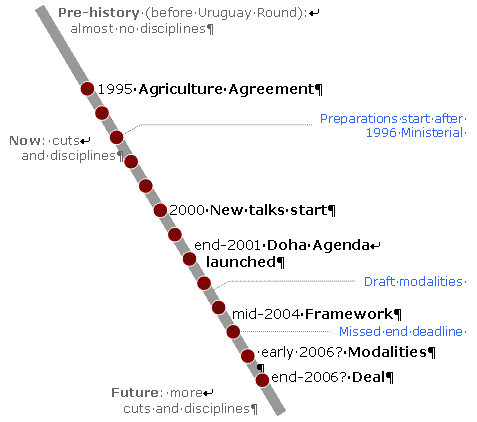
Since then, in the agriculture talks, the following have been “acquired”:
- The original mandate: Article
20. The
present Agriculture Agreement, resulting from the 1986–94 Uruguay
Round, was significant but only a first step towards reforming
agricultural trade. Many countries considered
the deal to be unfinished business, a view confirmed in Article 20
of the Agriculture Agreement, which describes reform as an “ongoing
process” and
commits members to further negotiations from 2000. The article clearly
sets out the direction of the talks, but in broad terms — “substantial
progressive reductions in support and protection resulting in fundamental
reform”.
- The 2001 Doha Ministerial Declaration (see below).
- The framework agreed in the 1 August 2004 General Council decision, part of what is sometimes called the “July 2004 package” (see below).
The negotiations: before Doha — 2000–2001
The negotiations began in early 2000 in “Special Sessions” of the Agriculture Committee. Right from the start, participation was and remains unprecedented. In the first year alone, 126 member governments (89% of the then 142 members) submitted 45 proposals and three technical documents. Because the proposals were starting positions, and because so many countries were involved, the positions were diverse and the differences considerable.
The Doha mandate — from 2002
The 14 November 2001 Doha Ministerial Declaration set a new mandate by making the objectives more precise, building on the work carried out so far, confirming and elaborating the objectives, and setting a timetable with deadlines. Agriculture became part of the single undertaking. The declaration made special and differential treatment for developing countries integral throughout the negotiations, both in countries’ new commitments and in any relevant new or revised rules and disciplines. It said the outcome should be effective in practice and should enable developing countries to meet their needs, in particular in food security and rural development. The ministers also took note of the non-trade concerns (such as environmental protection, food security, rural development, etc.) reflected in the negotiating proposals already submitted, and they confirmed that the negotiations would take non-trade concerns into account, as provided for in the Agriculture Agreement. Talks under this mandate began in March 2002.
Consensus is impossible if negotiators stick to their starting positions. Although the intensity of the agriculture negotiations was sustained almost continuously for over three years from the start in 2000, crucially lacking was any significant move towards middle ground, even under the new Doha mandate.
Under this mandate, intensive negotiations continued from March 2002 to March 2003 but still failed to produce agreement on “modalities” as members held on to their positions. The negotiators’ failure to agree was not for lack of trying. Rather, they lacked political decisions from their governments to allow them to start to shift.
The then chairperson Stuart Harbinson did produce a draft in March 2003, as required under the Doha mandate, but without consensus this was set aside. Instead, members began discussing a more modest “framework” as an interim step, aiming to reach agreement on this at the September 2003 Cancún Ministerial Conference. (Under the original Doha mandate, Cancún was supposed to be much closer to the end of the talks, with members producing their offers or “comprehensive draft commitments” on thousands of products and a range of subsidies and supports, based on the “modalities”.)
Finally, in July 2003 countries did start to move. This produced draft “frameworks”, some of them compromises between opposing positions, which were on the table at the Ministerial Conference in September. But agreement was not possible. After Cancún, the farm talks were suspended, as were all the Doha Agenda subjects, until the end of the year.
The momentum picked up again from the beginning of 2004, with a number of political initiatives. The US set the tone with a call-to-arms letter to fellow-ministers on 11 January 2004, suggesting how to proceed. In May, the EU announced some key concessions, including agreement to negotiate a date for the end of all forms of agricultural export subsidies. There were a number of important meetings around the world, including the first major attempts to compromise by ministers and officials from Australia, Brazil, the EU, India and the US (sometimes called the Five Interested Parties or FIPS).
The result was the framework, outlining key principles of the modalities, which was agreed by all members in Geneva shortly after midnight on 1 August 2004, an annex of the decision sometimes called the “July package”. This is the latest document that banks what has been achieved in the negotiations.
Work since then, in the second half of 2004 and in 2005, has built on the framework, producing agreement on some key technical questions. Some gaps between countries’ positions have been closed or narrowed. But an unexpected delay of four months was caused by negotiations over a technical issue (the method for converting non-ad valorem duties — duties not charged as percentages of the value of the imports — into ad valorem or percentage equivalents). Further slippages meant that as Hong Kong approached, a lot more work was still needed before everything could be compiled into “modalities”.
Assessing the situation at the end of July 2005, Tim Groser, then chairperson of the negotiations, told negotiators that the talks were stalled, but they had also clarified some of the key political trade-offs that members would have to sort out in the coming months:
After the summer break, the talks took a new turn. Now under the new chairperson, Ambassador Crawford Falconer of New Zealand, and with little more than two working months left, they focused more comprehensively on the core parts of the modalities so that members could start to discuss concrete trade-offs between reductions in tariffs and domestic support, and between the depths of the cuts in general and the accompanying flexibilities for particular products or circumstances. A large number of new proposals were tabled.
Amb. Falconer was able to report that the way members were presenting their positions had changed: for the first time in five years of negotiations, instead of simply making proposals, they were starting to discuss what they would demand in return for yielding — at least part of the way — to others’ demands. For example, some countries were stating more clearly their view that more flexibility in the formula for cutting tariffs would allow them to reduce the number of products that they would designate as “sensitive”. However, Ambassador Falconer said this change of tone should have happened six months earlier. Still overhanging the talks was the question of whether members had left themselves too little time to sort out the main issues by the Hong Kong conference.
back to top
The latest issues: the 2004 framework and after
> Explanations of these issues
Export subsidies and competition
Of the three
pillars, this is the one that has progressed most. All forms of export
subsidies will be eliminated by a “credible” date, including “parallel” elimination
of subsidies in government-supported export credit, food aid, and state-sanctioned
exporting enterprises. Disciplines will be negotiated on all export
measures whose effects are equivalent to subsidies. With elimination
agreed, discussions
on some other headings have progressed well, particularly on export
credit. Food aid and exporting state trading enterprises remain more
difficult.
Market access
This is the most difficult of the three pillars with a wider and more complex range of interests because all countries have market access barriers, whereas only some have export subsidies or trade-distorting domestic supports. Most governments are under pressure to protect their farmers, but many also want to export and therefore want to see others’ markets open up.
The framework commits members to “substantial improvements in market access for all products”. Among the key issues are:
- The tariff reduction formula: “bound” tariffs
will be sorted into tiers according to how high they are so that higher
tariffs can be cut more steeply; the debate over the type of formula
in each tier has been narrowed. By October, most members had accepted
that the flexible “Uruguay Round approach” and the tighter “Swiss formula” would
not be agreed. Instead, some kind of linear reduction (usually a flat
rate percentage cut in each tier) was pursued, although one proposal
envisaged a more complicated sliding scale of reductions. A key question
was whether flexibility could be built into the formula in the form of
a “pivot”: each tier would have a fixed percentage reduction subject
to a permitted variation of plus or minus a number of percentage points.
Members argued for and against this.
- All countries will be given flexibility
for sensitive products; details are still being negotiated. Some
countries have said they would reduce the number of sensitive products
if the tariff
reduction formula contained more flexibility.
- Developing countries
are given further flexibility for “special products” and can use a “special
safeguard mechanism” still to be developed. Delegations advocating greater
flexibility for developing countries’ special products have been preparing
proposed indicators to be used so that these products comply with the
criteria of the 2004 framework: food security, livelihood security
and rural development needs.
- Also still debated are how to deal with conflicting interests among developing countries, including how to address the issue of preference erosion; and how to achieve the fullest liberalization of trade in tropical products and crops grown as alternatives to illicit narcotics.
Domestic support
All developed countries will make substantial reductions in distorting supports, and those with higher levels are to make deeper cuts from “bound” rates (the actual levels of support are generally lower than the bound levels). The way to achieve this will include reductions both in current ceilings overall for three types of distorting support (“Amber Box”, “de minimis” and “Blue Box”), and in two components — Amber Box (supports having a direct impact on prices and quantities) and de minimis supports (minimal amounts of amber-type supports). The third component Blue Box supports (distorting but less so because of production limits or other criteria) will be capped; at the moment the Blue Box has no limits. The fine print contains details but also stresses that these have to meet the long-term objective of “substantial reductions”. On top of that, in the first year each country’s ceiling of permitted overall support will be cut by 20% (sometimes called a “downpayment”). This will considerably tighten disciplines on distorting domestic support, but for most countries it might not bite much into actual supports since current levels tend to be below the ceilings.
As for “Green Box” supports, currently unlimited, criteria for defining supports eligible for this category will be reviewed and clarified to ensure that the supports really do not distort trade, or do so minimally. At the same time, the exercise will preserve the basic concepts, principles and effectiveness of the Green Box, and take account of non-trade concerns such as environmental protection and rural development.
Other
material:
> Agriculture gateway
> Agriculture
negotiations
> Negotiations
backgrounder
> Doha declaration
> Doha declaration
explained